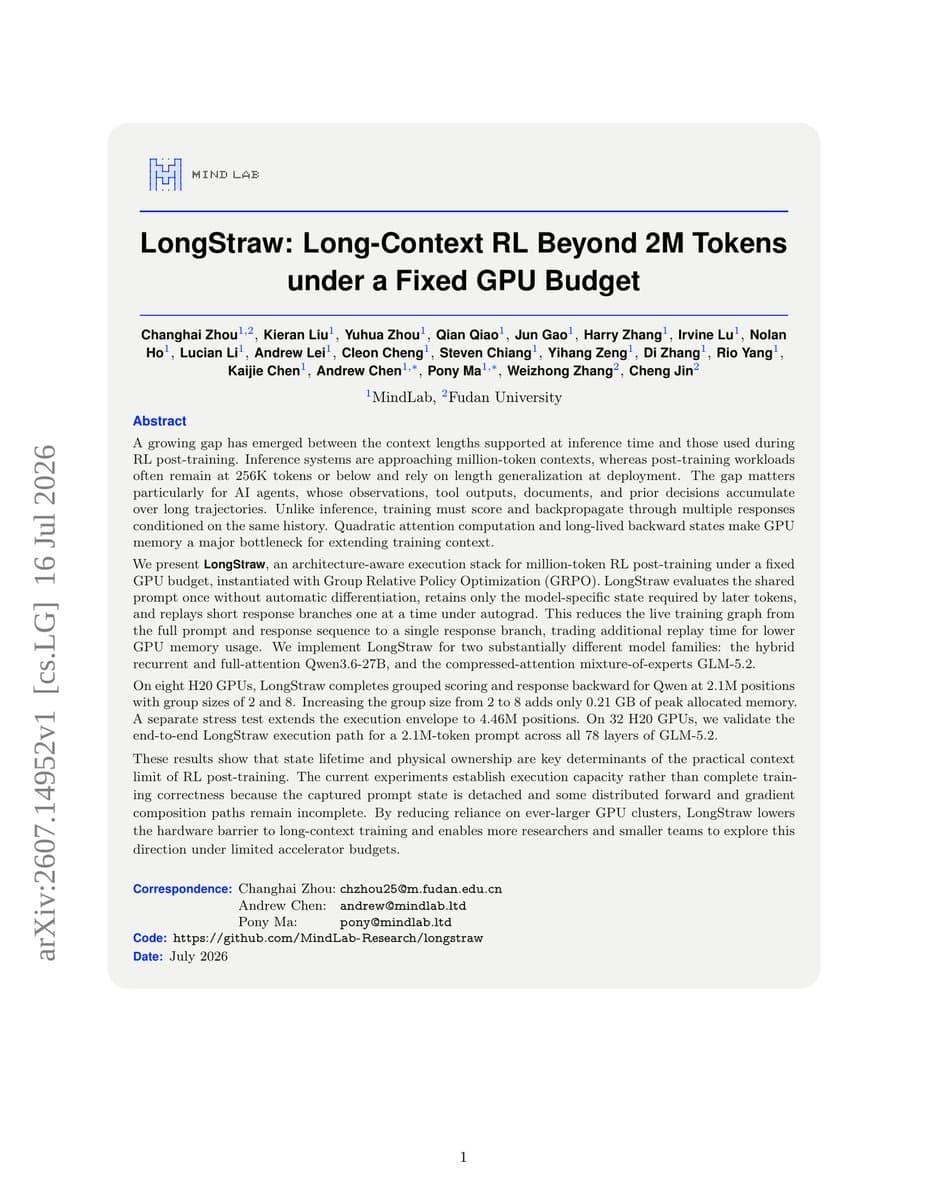
LongStraw reaches 2.1 million token positions for RL post-training on just eight H20 GPUs. The architecture-aware stack replays short response branches instead of full sequences, cutting compute dramatically.
Key facts
- 2.1M token positions on 8 H20 GPUs
- Replays short response branches not full sequences
- Cuts per-iteration compute by reusing shared prefix
- Targets RL post-training bottleneck for long contexts
- Unverified by independent benchmarks
LongStraw is an architecture-aware execution stack for million-token reinforcement learning (RL) post-training under a fixed GPU budget. According to @HuggingPapers, it reaches 2.1 million positions on just eight H20 GPUs by replaying short response branches instead of full sequences.
The key insight is that during RL rollouts, most tokens in long sequences are identical across iterations. Only the sampled response branches differ, so replaying just those branches cuts per-iteration compute dramatically. This allows scaling to context lengths that would otherwise require dozens or hundreds of GPUs for post-training.
The approach targets the bottleneck in RL post-training for long-context models: storing and recomputing full sequences of a million tokens or more. By reusing cached activations for the shared prefix and recomputing only the diverging suffix, LongStraw achieves near-linear scaling of effective context length with GPU count.
The paper was announced on X by @HuggingPapers on an unspecified date in 2026. No arXiv preprint link, training details, or benchmark comparisons were provided in the announcement. The claim of 2.1M positions on eight H20 GPUs is unverified by independent benchmarks.
Architecture-aware execution
The stack exploits the autoregressive nature of transformer decoding: in RL post-training, the model generates multiple candidate responses for the same prompt. LongStraw caches the forward pass for the prompt and shared prefix, then only runs the backward pass on the unique suffix of each sampled response. This mirrors techniques like gradient checkpointing applied at the rollout level rather than per-layer.
Comparison to prior work
Existing long-context RL systems typically require 64–128 GPUs to reach 1M tokens during post-training, as seen in DeepSeek-R1-style setups. LongStraw's 2.1M positions on eight H20 GPUs represents a 8–16x reduction in hardware requirements. However, the trade-off is that only the response branch is replayed — if the prompt itself changes, the full sequence must be recomputed.
Unanswered questions

The announcement does not disclose: training throughput in tokens per second, convergence properties compared to full-sequence training, or whether the approach works with non-autoregressive sampling methods. The H20 GPU is a mid-range inference card, not a training accelerator like H100 or B200, which may affect reproducibility on higher-end hardware.
What to watch
Watch for an arXiv preprint with full ablations and throughput numbers. If LongStraw's branch replay technique generalizes to non-RL post-training (e.g., DPO or PPO variants), it could reshape hardware requirements for long-context alignment. The next benchmark to track is a verified comparison against full-sequence training on SWE-Bench-Lite or similar long-context coding tasks.