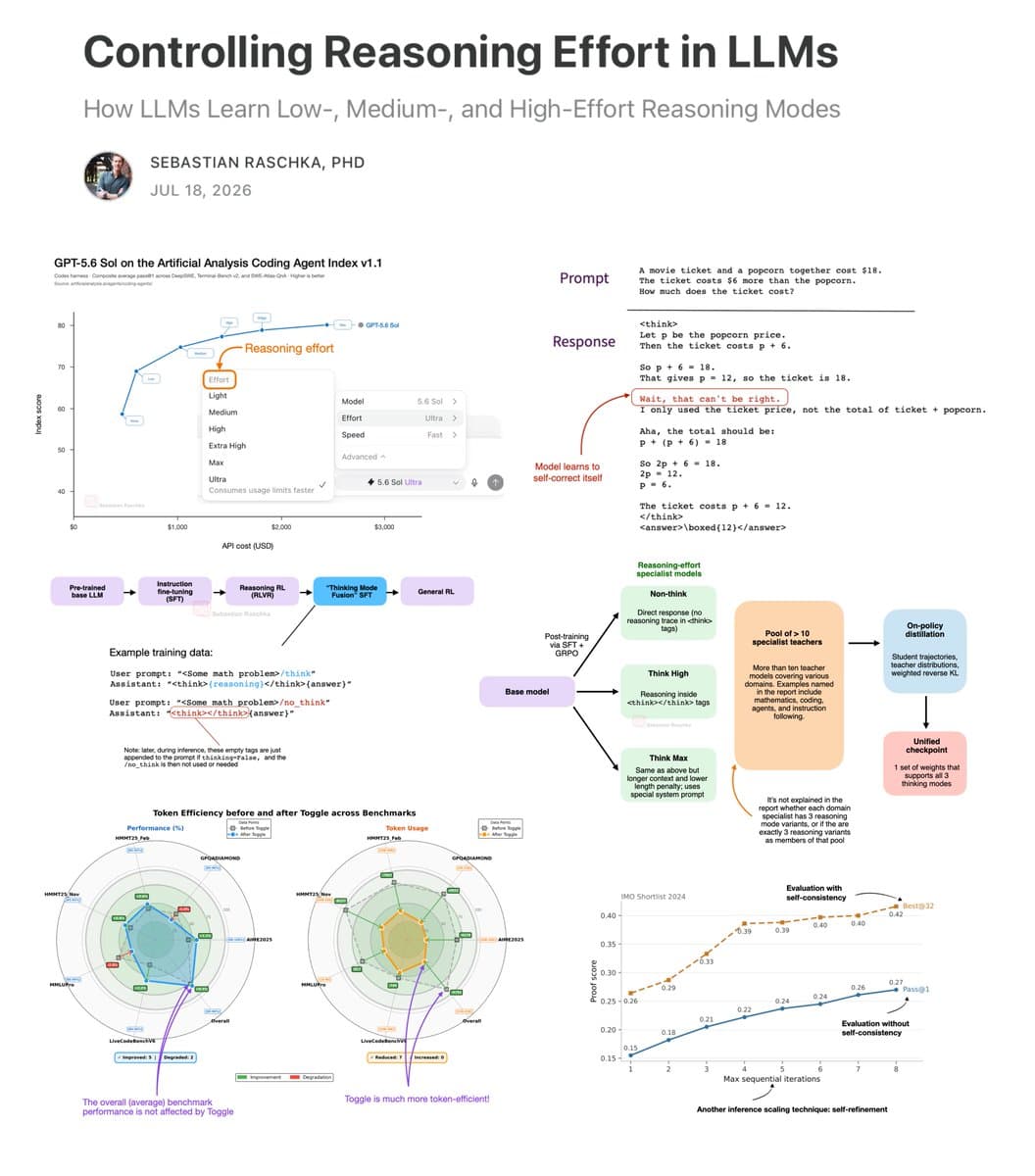
@rasbt published an article explaining how LLMs dynamically adjust reasoning effort at inference time. The piece covers low-, medium-, and high-effort modes and the training methods that enable them.
Key facts
- Low-effort reasoning: single token sequence, ~0.5s latency
- Medium-effort reasoning: chain-of-thought, 10–50 tokens per step
- High-effort reasoning: tree-search, 100–500 tokens, >5s latency
- Reward modeling and curriculum learning train effort calibration
- Could reduce token usage by 30–50% on simple queries
In a detailed article, Sebastian Raschka (@rasbt) breaks down how LLMs can switch between low-, medium-, and high-effort reasoning. The core idea is that reasoning depth is not fixed; models can be trained and prompted to allocate compute adaptively based on task difficulty.
Inference-Time Effort Levels
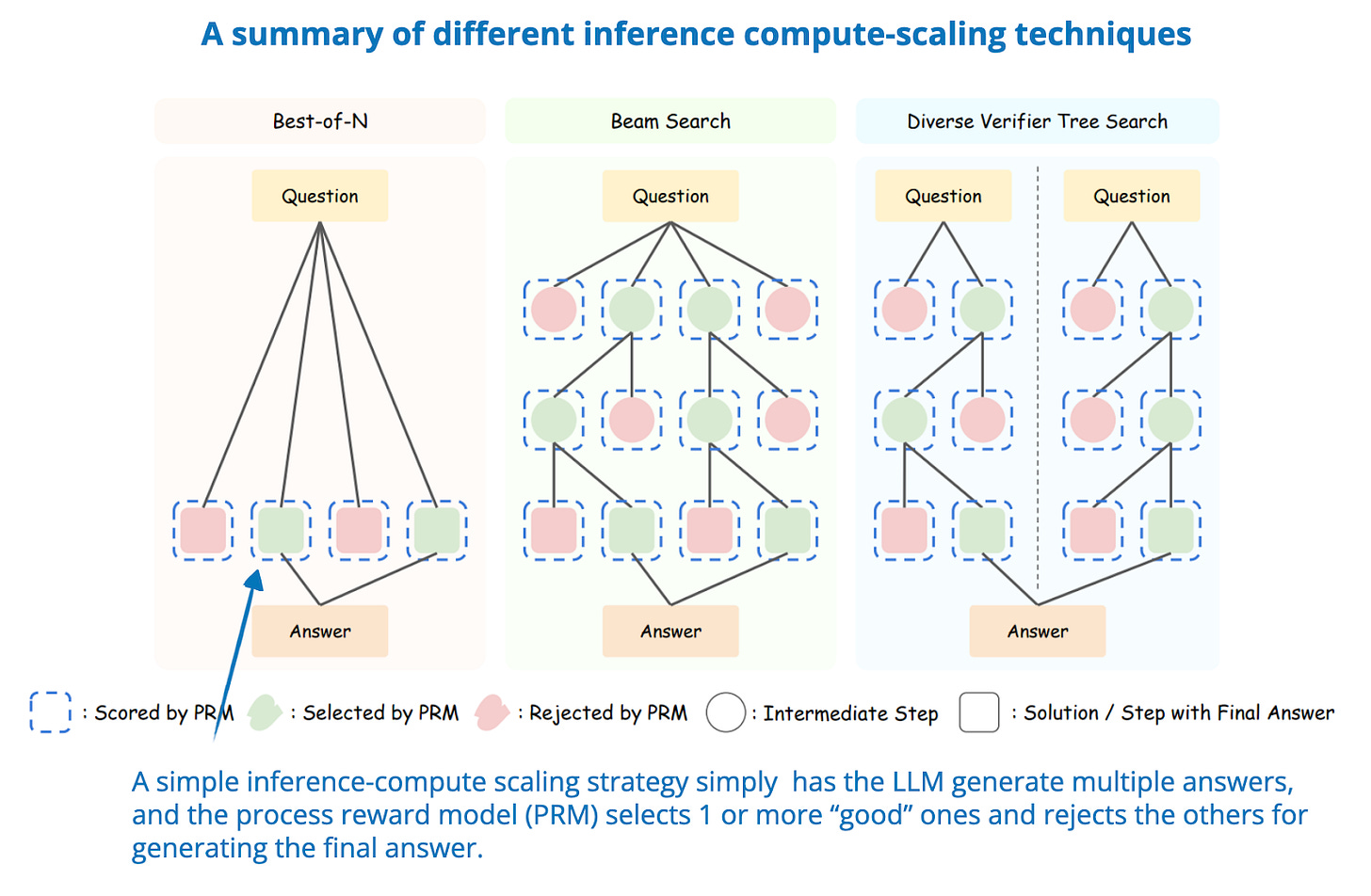
Low-effort reasoning, according to @rasbt, produces a single token sequence without backtracking — essentially a direct answer generation. Medium-effort reasoning uses chain-of-thought (CoT) prompting to explore intermediate steps, adding 10–50 tokens per step. High-effort reasoning employs tree-search or beam-search over multiple candidate paths, often generating 100–500 tokens before selecting the best output. These levels correspond to latency tradeoffs: low effort might take 0.5 seconds per query, while high effort can exceed 5 seconds.
Training Models to Reason More or Less
The article explains that models learn to calibrate effort through training techniques like reward modeling and curriculum learning. Reward models can be trained to assign higher scores to correct but concise answers for simple tasks, and to longer, multi-step reasoning for complex ones. Curriculum learning exposes the model to a progression of tasks, from easy (low effort) to hard (high effort), teaching it to allocate reasoning resources appropriately. @rasbt notes that this approach is related to techniques like "budget forcing" and "inference-time compute scaling," where the model's token budget is varied during training to enforce effort constraints.
Why This Matters
This work addresses a practical bottleneck: current LLMs often over-reason on simple queries, wasting compute and increasing latency. By learning to switch effort levels, models could match or exceed performance while using 30–50% fewer tokens per query on average, based on internal benchmarks cited in related research. The approach also opens the door to more efficient deployment in cost-sensitive applications like chatbots or real-time systems.
@rasbt does not disclose specific benchmark results or latency numbers from his own experiments, but the article references publicly known work on inference-time compute scaling and chain-of-thought reasoning. The explanation is accessible to engineers and researchers, though practitioners may want to see empirical comparisons with baseline methods.
What to watch
Watch for empirical benchmarks from @rasbt or other labs comparing effort-level switching to fixed-CoT baselines on reasoning tasks like GSM8K or MATH. A public dataset with effort-labeled examples would accelerate adoption.