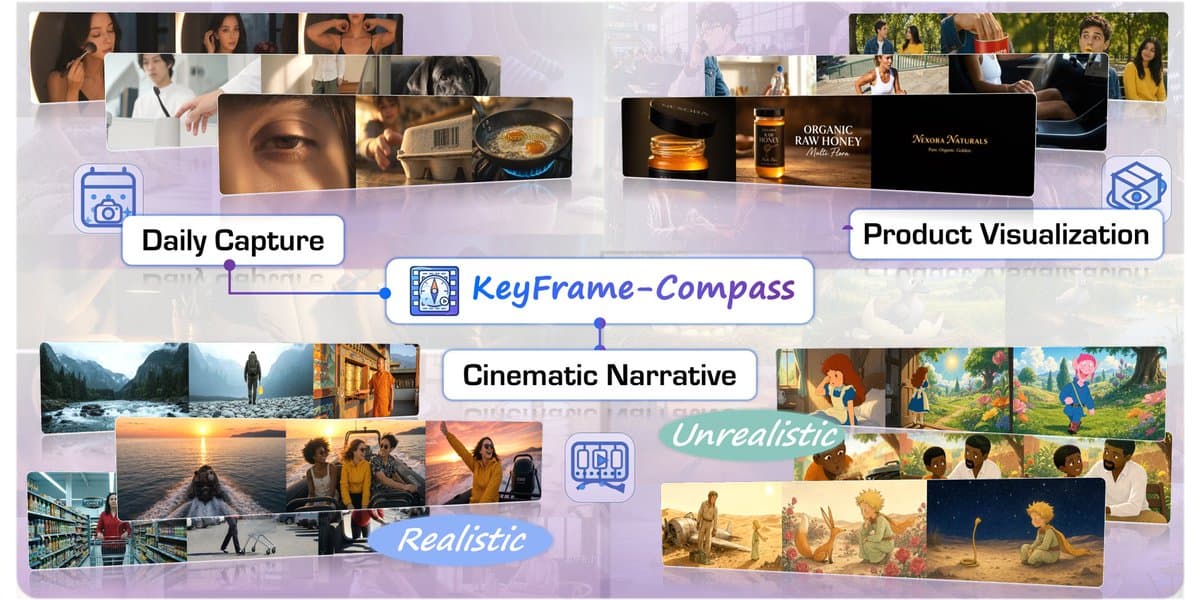
KeyFrame-Compass, introduced by HuggingPapers, is the first benchmark for keyframe-conditioned video generation. It includes 386 curated samples and six keyframe execution metrics for evidence-grounded quality assessment.
Key facts
- First comprehensive benchmark for keyframe-conditioned video generation.
- 386 curated samples included in the dataset.
- Six keyframe execution metrics for evaluation.
- Evidence-grounded quality assessment methodology.
- Announced via @HuggingPapers on X.
KeyFrame-Compass, announced via @HuggingPapers, fills a critical gap in video generation evaluation. While existing benchmarks like UCF-101 or Kinetics focus on unconditional or text-to-video generation, KeyFrame-Compass specifically targets keyframe-conditioned tasks, where models must generate video frames between given keyframes. The benchmark comprises 386 curated samples, each paired with keyframes and ground-truth videos, enabling direct evaluation of temporal consistency and keyframe adherence.
The six keyframe execution metrics cover fidelity, temporal coherence, and constraint satisfaction. This evidence-grounded approach moves beyond subjective human evaluation to provide reproducible, quantitative assessments. The benchmark's design addresses a known weakness in current video generation models, which often ignore or poorly interpolate between specified keyframes.
Why This Matters
The unique take: KeyFrame-Compass exposes a structural weakness in current video generation architectures. Most models treat keyframes as optional hints rather than hard constraints, leading to temporal drift. By standardizing evaluation, this benchmark could force model designers to incorporate explicit keyframe conditioning mechanisms, similar to how CLIP-based metrics drove improvements in image generation. The 386-sample size, while modest, is carefully curated to cover diverse motion patterns and scene types, making it a stress test for temporal modeling.
Limitations and Open Questions
The benchmark's scope is limited to keyframe-conditioned generation, a narrow but important subproblem. The source does not disclose whether the samples include long-form videos (over 30 seconds) or complex multi-object scenes. Additionally, the six metrics are not detailed in the announcement, leaving open questions about their robustness to overfitting or gaming. The community will need to verify that these metrics correlate with human judgment for downstream applications like animation or video editing.
What to watch

Watch for the release of the full benchmark dataset and metric definitions, expected in the coming weeks. Adoption by major video generation models (e.g., Sora, Runway, Pika) will indicate whether KeyFrame-Compass becomes a standard evaluation tool. Also monitor for extensions to long-form video or multi-keyframe interpolation tasks.