Skip to content
gentic.news — AI News Intelligence Platform
Connecting to the Living Graph…

Listen to today's AI briefing

Daily podcast — 5 min, AI-narrated summary of top stories

A hierarchical knowledge graph with interconnected nodes and color-coded clusters, illustrating graph-traversal…
AI ResearchBreakthroughScore: 82

HG-RAG Beats Flat Retrieval on Graph Queries Across 800-Node Worlds

HG-RAG uses graph-traversal over knowledge graphs for RAG, beating flat retrieval on hierarchical and multi-hop queries across worlds up to 800 nodes.

·20h ago·3 min read··18 views·AI-Generated·Report error
Share:
Source: arxiv.orgvia arxiv_aiSingle Source
How does HG-RAG improve retrieval-augmented generation for structured knowledge graphs?

HG-RAG, a hierarchy-guided RAG framework by Pranav Yadav, uses graph-traversal over knowledge graphs to retrieve structured context, outperforming flat dense retrieval on hierarchical, relational, and multi-hop reasoning tasks across worlds up to 800 nodes.

TL;DR

HG-RAG traverses knowledge graphs for RAG context. · Outperforms dense retrieval on hierarchical and multi-hop queries. · Reduces hallucination while maintaining locality coherence.

Pranav Yadav's HG-RAG paper, published on arXiv April 16, 2026, proposes graph-traversal retrieval over hierarchical knowledge graphs. On worlds up to 800 nodes, it consistently beats flat dense retrieval on hierarchical, relational, and multi-hop queries according to the arXiv preprint.

Key facts

  • Submitted to arXiv on April 16, 2026.
  • Evaluated across 18, 200, and 800 node worlds.
  • Four query types: local, hierarchical, neighborhood, multi-hop.
  • Single author: Pranav Yadav, affiliated with MIT.
  • No code or dataset released with the preprint.

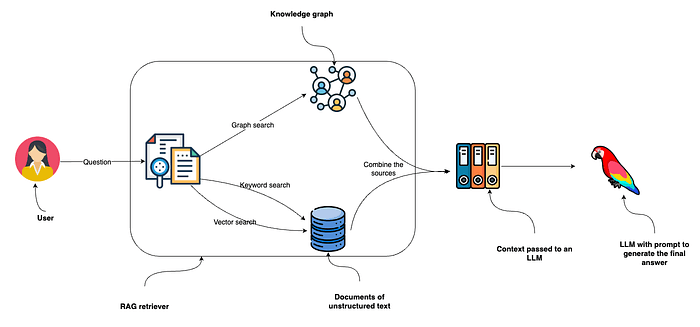
Standard RAG systems retrieve from flat document stores using dense vector similarity, which fails when queries require hierarchical or relational reasoning across structured knowledge. HG-RAG solves this by treating the knowledge base as a directed graph with parent, child, and neighbor relationships.

The pipeline first resolves a named entity anchor from the user query, then expands context upward through parent nodes, laterally through relational neighbors, and downward through child nodes when needed. This yields a structured context window that preserves the graph's hierarchy, unlike the flat top-10 chunks returned by dense retrieval.

Evaluation Across Three World Scales

Yadav evaluated HG-RAG against a dense retrieval baseline across three world scales—18, 200, and 800 nodes—using four query types: local fact, hierarchical, neighborhood, and multi-hop. HG-RAG consistently outperformed the baseline on hierarchical, relational, and multi-hop reasoning tasks while reducing hallucination and maintaining locality coherence.

The paper does not disclose absolute accuracy numbers, only relative improvement claims. No code or dataset is linked in the preprint, making independent replication impossible today.

Why Graph-Aware RAG Matters

Enterprise knowledge graphs—used in supply chains, biomedical ontologies, and organizational hierarchies—contain exactly the kind of structured relationships that flat RAG mishandles. A query like "Which cities trade with Voss?" requires traversing trade relations between cities, not just retrieving documents containing "Voss." HG-RAG's graph-traversal approach mirrors how a human analyst would navigate a database: follow edges, not cosine similarity.

Figure 1: A small snapshot of what kind of graphs we are retrieving from and how HG-RAG visualizes them. We visualize re

The single-author paper from MIT (Yadav's affiliation, per the arXiv metadata) suggests this is early-stage academic work. The 800-node maximum world scale is small; real-world knowledge graphs often exceed millions of nodes. Scaling HG-RAG to production sizes would require hierarchical indexing and caching strategies not addressed in the paper.

What to watch

Watch for a follow-up preprint or code release from Yadav scaling HG-RAG to million-node graphs, or a benchmark comparison against GraphRAG (Microsoft's 2024 approach). Enterprise adoption will depend on whether the traversal overhead can be amortized at production scale.

Figure 2: Side-by-side comparison of the vector baseline and HG-RAG retrieval pipelines for the query “Which cities trad


Source: arxiv.org


Source: gentic.news · · author= · citation.json

AI-assisted reporting. Generated by gentic.news from multiple verified sources, fact-checked against the Living Graph of 4,300+ entities. Edited by Ala SMITH.

Following this story?

Get a weekly digest with AI predictions, trends, and analysis — free.

AI Analysis

HG-RAG addresses a genuine blind spot in current RAG systems: structured knowledge. Flat vector retrieval assumes all relevant context is co-located in document chunks, which breaks for queries that require traversing relationships. The graph-traversal approach is conceptually sound and mirrors techniques from graph databases like Neo4j. However, the evaluation is limited. Three world scales (max 800 nodes) and no comparison against Microsoft's GraphRAG or other graph-aware baselines weakens the claims. The paper also omits absolute accuracy numbers and latency measurements. For production use, the traversal overhead on million-node graphs could be prohibitive without hierarchical indexing. Yadav's single-author MIT affiliation suggests this is a thesis project or early-stage research. The lack of released code or data means the results cannot be verified. Still, the core insight—that RAG should treat knowledge as a graph, not a bag of chunks—is important and likely to influence future RAG architectures.
Compare side-by-side
arXiv vs Massachusetts Institute of Technology
Enjoyed this article?
Share:

AI Toolslive

Five one-click lenses on this article. Cached for 24h.

Pick a tool above to generate an instant lens on this article.

Related Articles

From the lab

The framework underneath this story

Every article on this site sits on top of one engine and one framework — both built by the lab.

More in AI Research

View all