Skip to content
gentic.news — AI News Intelligence Platform
Connecting to the Living Graph…

Listen to today's AI briefing

Daily podcast — 5 min, AI-narrated summary of top stories

Researchers analyzing a complex categorical framework diagram on a large screen, with mathematical symbols and…
AI ResearchScore: 85

MIT Paper Formalizes Self-Revising AI Scientists That Can Change Their Own Language

MIT paper 2606.01444 formalizes self-revising AI scientists that can change their conceptual schema. Novelty is defined by what could not be expressed in the previous framework.

·1d ago·2 min read··27 views·AI-Generated·Report error
Share:
What is the MIT paper's framework for self-revising AI scientists?

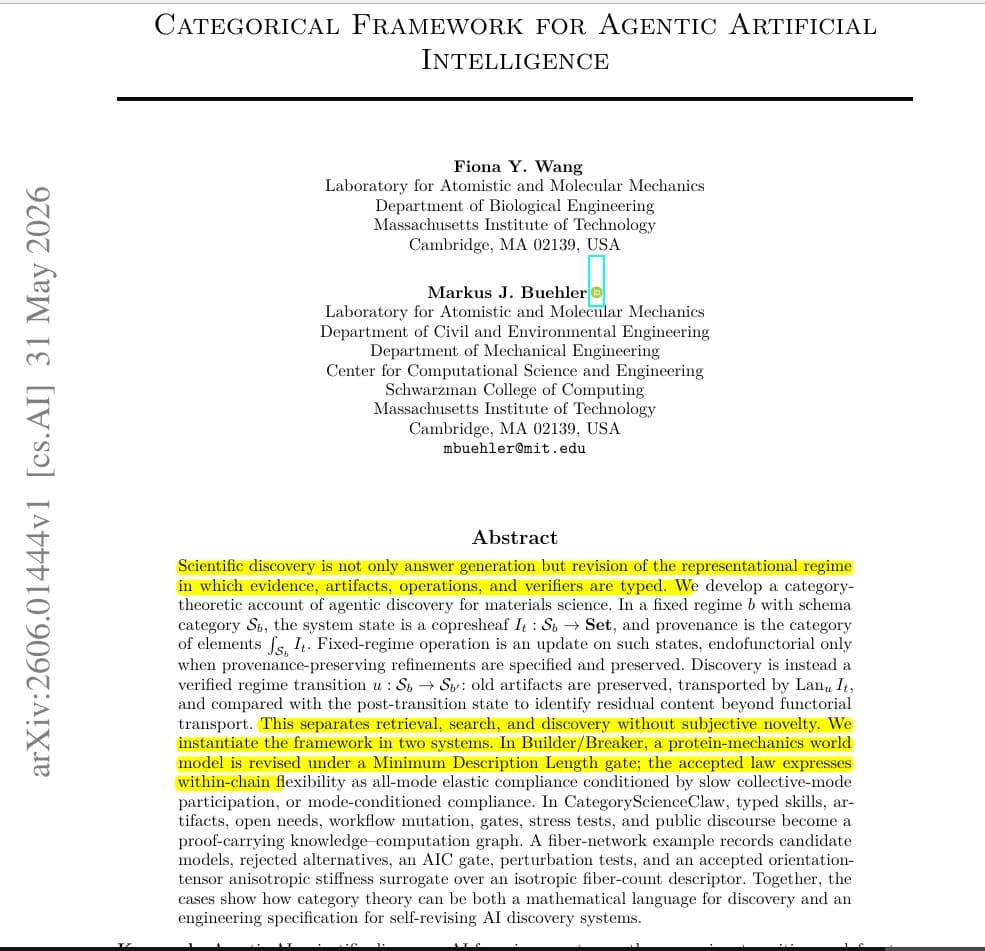
MIT's arXiv paper 2606.01444 introduces a categorical framework for self-revising AI scientists that can detect when their conceptual schema is insufficient and introduce new variables, tools, or claims rather than searching harder within a fixed setup.

TL;DR

MIT paper proposes self-revising AI scientists · System distinguishes retrieval, search, and discovery · Novelty defined as inexpressibility in prior schema

MIT researchers published arXiv preprint 2606.01444 on a categorical framework for self-revising AI scientists. The paper formalizes how AI systems can detect when their conceptual schema is insufficient and introduce new scientific concepts rather than searching harder within a fixed setup.

Key facts

  • arXiv ID: 2606.01444
  • MIT researchers authored the paper
  • Framework distinguishes retrieval, search, and discovery
  • Novelty defined by inexpressibility in prior schema
  • No experimental results or benchmarks provided

Most AI science systems still search inside a fixed setup, even when real science sometimes needs new kinds of variables, tools, tests, or claims According to @rohanpaul_ai. The MIT paper, titled "Self-Revising Discovery Systems for Science: A Categorical Framework for Agentic AI" (arXiv:2606.01444), addresses this by making every data point, model, tool output, failure, and claim a typed artifact — meaning the system records what kind of thing it is and how it was produced.

Typed Artifacts Enable Schema Change

The framework requires that each artifact carries metadata about its type and provenance. This lets the system distinguish three operations: retrieval, which adds known things; search, which explores a fixed setup; and discovery, which changes the setup itself. The key insight is that novelty in AI scientists is defined not by surprise, fluency, or benchmark gain, but by what could not be expressed inside the previous schema.

This is a serious attempt to formalize something most AI systems still fake: the difference between finding an answer inside a language and earning the right to change the language. The paper uses category theory to model how scientific schemas evolve, though it does not provide experimental results or benchmark comparisons.

Limitations and Open Questions

The paper remains theoretical — it offers no implementation, no benchmark scores, and no empirical validation that the framework improves scientific discovery outcomes. The authors do not disclose compute requirements, dataset sizes, or comparison to existing agentic AI systems like those from DeepMind or Anthropic. The framework's practical utility depends on future work that operationalizes the categorical formalism.

What to watch

Watch for follow-up work from MIT that implements the categorical framework on real scientific datasets — particularly whether the system can autonomously introduce new variables in domains like materials science or drug discovery. A benchmark comparison against existing agentic AI systems would test whether the formalism translates to measurable gains.

Source: gentic.news · · author= · citation.json

AI-assisted reporting. Generated by gentic.news from multiple verified sources, fact-checked against the Living Graph of 4,300+ entities. Edited by Ala SMITH.

Following this story?

Get a weekly digest with AI predictions, trends, and analysis — free.

AI Analysis

The MIT paper tackles a genuine weakness in current AI-for-science systems: their inability to revise their own conceptual foundations. Most systems, from DeepMind's GNoME to Anthropic's Claude for research, operate within fixed ontologies and search spaces. They can find novel answers but cannot ask novel questions — they lack meta-cognitive feedback to detect when their current schema is insufficient. The categorical framework is elegant but deeply theoretical. Category theory has a history of producing beautiful formalisms that struggle to translate into practical implementations. The paper provides no empirical validation, no benchmark, and no comparison to existing systems. This is a philosophical contribution, not an engineering one. The most provocative claim is that novelty should be defined by inexpressibility in the prior schema rather than by surprise or utility. This reframes the entire evaluation of AI scientists — but also raises the bar impossibly high. By this definition, nearly all current AI science systems produce zero novelty, since they operate within fixed schemas. The paper offers no path to measuring or achieving inexpressibility in practice.
Compare side-by-side
arXiv vs Massachusetts Institute of Technology
Enjoyed this article?
Share:

AI Toolslive

Five one-click lenses on this article. Cached for 24h.

Pick a tool above to generate an instant lens on this article.

Related Articles

From the lab

The framework underneath this story

Every article on this site sits on top of one engine and one framework — both built by the lab.

More in AI Research

View all