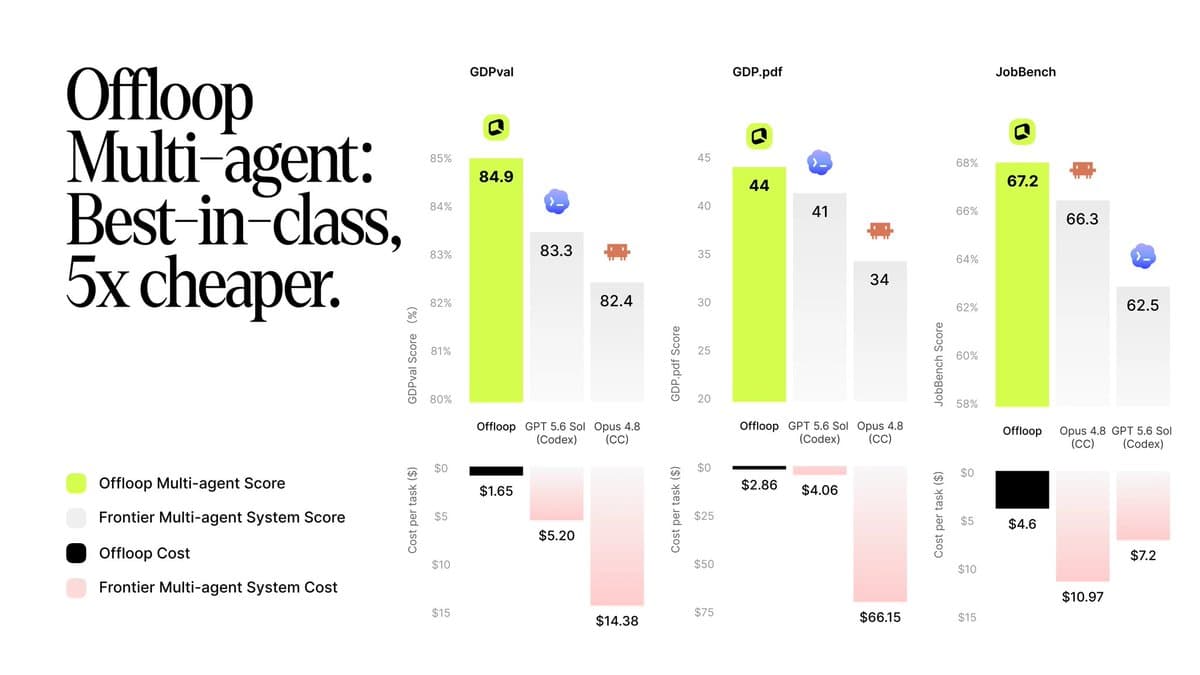
Offloop's D1 dispatcher model tackles the core failure mode of multi-agent systems: channel noise. According to @kimmonismus, most multi-agent setups collapse when every agent talks at once, turning the channel into useless noise.
Key facts
- D1 is a small dispatcher model for multi-agent coordination.
- It decides agent turns, continuation, stopping, and human escalation.
- Two stuck tasks were escalated to a human at 2am.
- The company has not disclosed D1's architecture or training data.
Offloop built D1, a dedicated dispatcher model that decides at every step which agent moves next, when to keep going, when to stop, and when to pull a person in. During an overnight benchmark run, two tasks got stuck, and D1 escalated both to a human at 2am instead of grinding on them indefinitely.
This contrasts with typical multi-agent orchestration, which often relies on rigid turn-taking or a central planner that itself becomes a bottleneck. D1 is intentionally small — a "tiny" model, per the source — suggesting the overhead of the dispatcher is minimal relative to the agents it coordinates.
The human-in-the-loop escalation is the key structural insight: D1 doesn't just manage agent turns, it has a clear threshold for when to hand off to a person. This mirrors the pattern seen in production AI systems like Anthropic's Claude or OpenAI's Operator, where escalation rules are critical for reliability in open-ended tasks.
Offloop has not disclosed D1's architecture, training data, or benchmark details beyond the overnight run. The company did not share model size, latency, or cost per decision. That level of transparency will matter if D1 is to be adopted beyond Offloop's own systems.
What this means for multi-agent design
The dispatcher pattern directly addresses the coordination problem that has plagued multi-agent research for years. Prior work like AutoGen, CrewAI, and Microsoft's TaskWeaver all struggle with agent chatter — agents over-communicating, conflicting, or spinning on subtasks. D1's approach of a lightweight, dedicated coordinator with escalation logic is a practical counterpoint to those heavier frameworks.
The overnight benchmark run is a proof point: two stuck tasks were escalated rather than hung, which is a concrete improvement over systems that silently deadlock. But a single overnight run is not a general evaluation. Scaling the dispatcher to hundreds of agents, or to tasks with longer horizons, will test whether D1's decisions remain optimal as coordination complexity grows.
The human escalation threshold
D1's decision to pull in a human at 2am is notable not just for the hour but for the principle: the dispatcher can recognize when a task is stuck and break the loop. This is a step beyond self-critique or reflection loops, which can themselves loop indefinitely. By routing to a person, D1 trades latency for reliability — a tradeoff that many production systems will accept for critical tasks.
Offloop has not specified what signals D1 uses to detect "stuck" states. It could be timeouts, repeated actions, confidence thresholds, or a learned model of task progress. The source does not clarify. That detail will matter for reproducibility and for users who need to tune escalation sensitivity.
What to watch
Watch for Offloop to release benchmark details — task counts, escalation rates, and agent counts. Also look for whether D1's architecture or weights are open-sourced, which would determine if the dispatcher pattern becomes a community standard or remains proprietary.