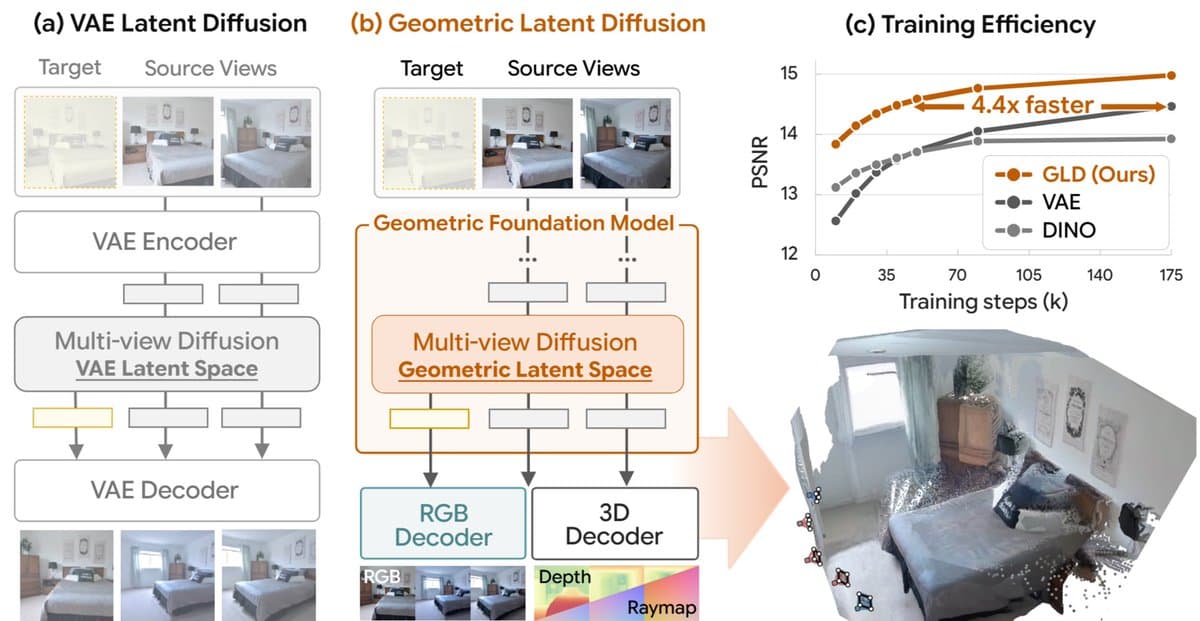
A new approach to 3D generation, Geometric Latent Diffusion (GLD), has been introduced, leveraging features from geometric foundation models as a structured latent space. The method sidesteps the need for text-to-image pretraining and demonstrates substantial efficiency gains and performance improvements in novel view synthesis.
What the Method Does
GLD fundamentally changes how diffusion models approach 3D scene generation. Instead of using a Variational Autoencoder (VAE) to learn a compressed latent representation from scratch, GLD repurposes pre-computed features from geometric foundation models as its latent space. Specifically, the paper mentions using features from models like Depth Anything 3 and VGGT.
These geometric features—encoding depth, surface normals, and potentially other 3D-aware information—provide a strong, structured prior. The diffusion model is then trained to denoise and generate novel views directly within this geometric feature space, rather than in pixel space or a generic VAE latent space.
Key Reported Advantages
According to the source, GLD delivers on three main fronts:
- Training Speed: The model trains 4.4 times faster than comparable VAE-based latent diffusion approaches. This is a direct result of bypassing the need to jointly learn a meaningful latent representation; the geometric features provide that structure from the start.
- Performance: It achieves state-of-the-art (SOTA) results in novel view synthesis, the task of generating consistent new viewpoints of an object or scene from a limited set of input images.
- Zero-shot Capabilities: Because it operates in a geometric latent space, the model can generate depth maps and 3D representations in a zero-shot manner—as a natural byproduct of its architecture, not a separate supervised task.
A critical technical detail is that GLD accomplishes this without any text-to-image pretraining. This contrasts with many contemporary 3D generation models (like Stable Diffusion 3D or Zero-123) which are often fine-tuned from large 2D text-to-image models. GLD's training appears to be more direct, focusing solely on the multi-view geometry problem.
How It Works (Inferred Architecture)
While the source tweet is brief, the core technical innovation can be inferred:
- Feature Extraction: A set of input images (e.g., a few views of an object) is passed through a frozen, pre-trained geometric foundation model (Depth Anything 3/VGGT). This produces a set of feature maps or embeddings that encode 3D structure.
- Latent Conditioning: These extracted geometric features serve as the conditioning input and potentially as the base state of the latent space for a diffusion model.
- Diffusion in Feature Space: A U-Net-like diffusion model is trained to perform denoising diffusion within this geometric feature space. Its objective is to learn the distribution of multi-view consistent geometric features.
- Generation & Rendering: To generate a novel view, the model samples and denoises within the geometric latent space. The output geometric features can then be decoded—possibly through a lightweight renderer or decoder—into RGB images for the new viewpoint. The intermediate geometric features directly provide depth and 3D information.
This pipeline is inherently more efficient because the heavy lifting of 3D understanding is offloaded to the pre-trained geometric foundation model, allowing the diffusion process to focus on view consistency and detail.
Why This Approach Matters
GLD represents a pragmatic shift in 3D generative AI. The field has been dominated by two paths: extending 2D diffusion models into 3D (often requiring massive scale and distillation), or training 3D-aware models like NeRFs from scratch (which is computationally expensive).
GLD offers a third way: building on top of the rapid progress in specialized, monocular geometric understanding. Models like Depth Anything have become remarkably good at estimating 3D properties from a single image. GLD cleverly uses these robust, off-the-shelf estimators as a backbone, treating 3D generation as a "correction" and "multi-view harmonization" task in a known-good geometric space.
The reported 4.4x training speedup is not just a nice bonus; it makes iterative research and development in this area more accessible. The zero-shot depth generation is a logical and useful feature, suggesting the model maintains a disentangled and interpretable representation.
The main trade-off is likely flexibility: the model's output is constrained by the capabilities and biases of the chosen geometric foundation model. It may excel at objects and scenes well-represented in Depth Anything's training data but struggle with highly abstract or novel structures that defy standard geometric intuition.
gentic.news Analysis
This development aligns with a broader, emerging trend we've noted: the rise of the "foundation model stack." Instead of building monolithic, all-purpose generative models, researchers are increasingly creating specialized foundation models for specific modalities (geometry, audio, physics) and then composing them. GLD is a direct implementation of this philosophy, using Depth Anything 3 as a geometric foundation. This follows the pattern set by other recent work, such as OpenAI's Sora, which reportedly uses a video compression network to create a latent space for spacetime patches, and Stable Video Diffusion, built atop Stable Diffusion's image latent space.
The choice of Depth Anything 3 as a backbone is particularly strategic. As we covered in our analysis of its release, Depth Anything v2 was a significant leap in monocular depth estimation, trained on a massive dataset of 1.5 million labeled images and 62+ million unlabeled images. Its successor, v3, likely offers even more robust and generalizable features. By leveraging this, the GLD team effectively bootstraps their model with a world model of 3D structure, avoiding the need to learn geometry from scratch. This is a classic example of transfer learning applied at the architectural level, not just the weight level.
Furthermore, GLD's avoidance of text-to-image pretraining is a notable divergence from the current mainstream. It suggests a belief that for core 3D tasks like novel view synthesis, geometric consistency is a more fundamental objective than text-aligned aesthetics. This could lead to a bifurcation in the field: models like Luma AI's Genie or TripoSR that prioritize fast, high-quality 3D asset creation from text or image, versus models like GLD that prioritize geometric accuracy and multi-view consistency for applications in robotics, simulation, or augmented reality. The 4.4x training efficiency could allow GLD-style models to iterate rapidly on specific domain datasets, a significant advantage in applied industrial research.
Frequently Asked Questions
What is Geometric Latent Diffusion (GLD)?
Geometric Latent Diffusion (GLD) is a new method for 3D scene generation and novel view synthesis. Its key innovation is using the pre-computed features from a geometric foundation model (like Depth Anything 3) as the latent space for a diffusion model, instead of learning a latent space from scratch with a VAE. This leads to faster training and strong geometric consistency.
How much faster does GLD train compared to previous methods?
According to the initial report, GLD trains 4.4 times faster than comparable Variational Autoencoder (VAE)-based latent diffusion models for multi-view synthesis. This speedup comes from using a pre-defined, semantically rich geometric latent space.
Can GLD generate 3D models from a single image?
While the source focuses on multi-view diffusion, the architecture implies strong capabilities for single-image 3D reconstruction. The model uses a geometric foundation model that excels at single-image depth estimation. By diffusing in that geometric feature space, it can plausibly generate a complete, consistent 3D representation from a single input image in a zero-shot manner, as mentioned in the report.
Does GLD require text prompts to work?
No. A highlighted feature of GLD is that it operates without any text-to-image pretraining. It is trained purely for the task of generating consistent novel views from input images, making it a geometry-first model rather than a text-conditioned creative tool. Its conditioning is visual and geometric, not textual.