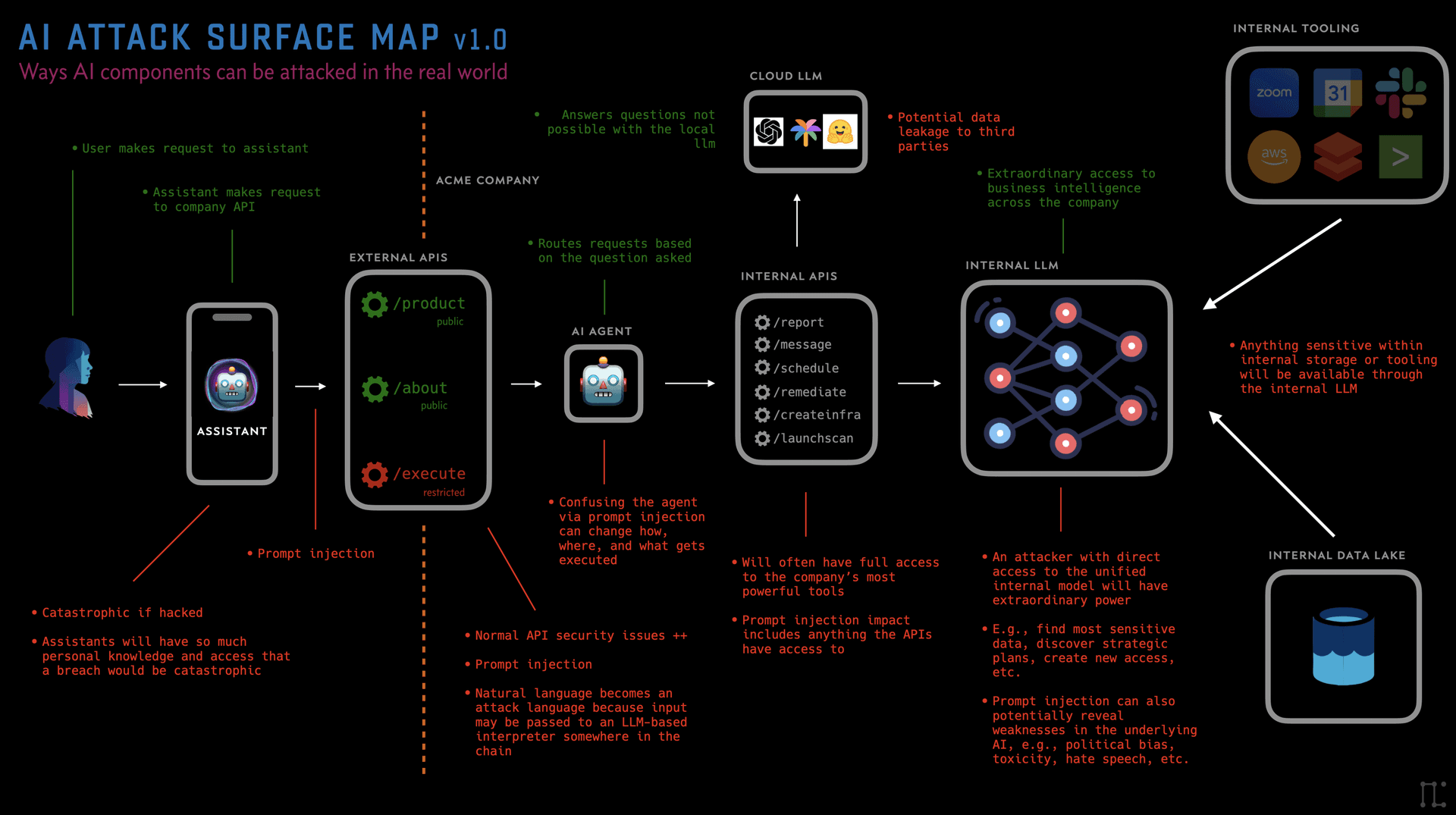
Google DeepMind has published a research paper that systematically catalogs the security vulnerabilities inherent to AI agents, describing it as a map of the "fundamental attack surface" that will emerge as these systems become more autonomous. The work, framed as a critical security audit, aims to proactively identify and mitigate risks before AI agents are widely deployed in high-stakes environments.
The paper argues that the shift from standalone large language models (LLMs) to persistent, tool-using agents introduces a new class of security threats. Unlike a single API call, an agent operates over extended sessions, maintains memory, and interacts with external tools and data sources. This expanded functionality creates persistent attack vectors that are not present in static models.
Key Takeaways
- Google DeepMind researchers published a paper mapping the fundamental attack surface of AI agents, identifying critical vulnerabilities that could lead to persistent compromise and data exfiltration.
- The work provides a framework for red-teaming and securing autonomous AI systems before widespread deployment.
What the Researchers Mapped
The research team approached AI agents as complex systems, breaking down their architecture into core components that an attacker could target. The identified attack surface spans the entire agent lifecycle and stack:
- The Agent Core: The LLM itself, vulnerable to prompt injection, jailbreaking, and training data extraction.
- Agent Memory: Both short-term (session context) and long-term (vector databases, external storage) memory systems that can be poisoned, leaked, or manipulated.
- Tool Use & Execution: The mechanisms by which an agent calls external APIs, executes code, or queries databases. Vulnerabilities here allow for privilege escalation, arbitrary code execution, and data exfiltration.
- The User-Agent Interface: The input and output channels, which are susceptible to adversarial user inputs and prompt leakage.
- Multi-Agent Ecosystems: The communication and coordination protocols between multiple agents, which can be disrupted or hijacked.
The paper details how attacks can chain across these surfaces. For example, a successful prompt injection could force an agent to maliciously modify its own long-term memory, creating a persistent backdoor. That compromised agent could then exfiltrate sensitive data through its tool-use capabilities or spread the compromise to other agents in a network.
Key Vulnerabilities and Attack Vectors
The research highlights several "critical" vulnerability patterns:
- Persistent Compromise: An agent's memory can be poisoned, causing harmful instructions to be reloaded and executed in future sessions, making remediation difficult.
- Data Exfiltration via Tool Abuse: A compromised agent could be instructed to encode and exfiltrate sensitive data from its context or accessed systems through its normal tool-use functions (e.g., embedding data in seemingly benign API calls).
- Privilege Escalation through Tool Arguments: By manipulating an agent into calling tools with malicious arguments, an attacker could achieve outcomes far beyond the agent's intended permissions.
- Pivot Attacks in Multi-Agent Systems: A single compromised agent could spread malicious instructions or poisoned data to other agents, potentially compromising an entire organizational workflow.
A Framework for Red-Teaming and Defense
Beyond just identifying risks, the paper provides a structured framework for security practitioners to red-team their own AI agent deployments. It outlines methodologies for probing each component of the attack surface and suggests defensive architectures, such as:
- Strict tool sandboxing and permission controls.
- Input/output sanitization and validation layers.
- Memory integrity checks and versioning.
- Agent-to-agent communication authentication.
The core message is that securing AI agents requires moving beyond LLM-specific safety (like content filtering) and adopting traditional software security principles—secure design, least privilege, and robust audit trails—applied to this new, dynamic paradigm.
gentic.news Analysis
This paper is a significant and timely intervention from one of the field's leading labs. It formalizes concerns that have been circulating among practitioners since the rapid adoption of frameworks like LangChain and AutoGPT. The timing is critical; as companies rush to deploy AI agents for customer service, coding, and data analysis, this research underscores that they are deploying not just a model, but a potentially vulnerable software system.
DeepMind's work directly connects to the broader industry trend of AI Security becoming a distinct and urgent discipline. It follows increased activity from other players: Microsoft released its own AI Security framework earlier this year, and startups like Protect AI and Robust Intelligence are gaining traction by offering specialized scanning tools for ML pipelines. This paper elevates the conversation from detecting malicious prompts to securing the entire agentic runtime.
The framework provided is less about presenting novel attacks—many in the community have discussed these possibilities—and more about providing a comprehensive, authoritative taxonomy from a top-tier lab. This gives security teams a concrete checklist and legitimacy when arguing for security budgets and design changes. It also sets a clear research agenda for the community: developing practical mitigations for each identified vector. Expect a wave of follow-up papers and tools focused on agent security hardening in the coming months.
Frequently Asked Questions
What is an "AI agent" in this context?
In this paper, an AI agent refers to a system built around a large language model (LLM) that can perform multi-step tasks autonomously. It uses tools (APIs, code execution, search), maintains memory across interactions, and operates without human intervention for each step. Examples include automated coding assistants, customer service bots that can browse knowledge bases, and data analysis agents.
How is this different from traditional prompt injection?
Traditional prompt injection attacks a single LLM call. The vulnerability described here is systemic. A successful attack can persist in an agent's memory, affect all its future actions, and leverage its tools to cause harm outside the chat interface (like deleting data or sending emails). It's the difference between tricking someone once and installing malware on their computer.
Does this mean we shouldn't use AI agents?
No, but it means they must be deployed with the same security rigor as any critical software system. The paper is a call for proactive security-by-design, not a condemnation of the technology. Developers need to implement sandboxing, input/output validation, strict access controls for tools, and robust monitoring before deploying agents in sensitive environments.
Who is the target audience for this research?
The primary audience is AI developers, platform builders (like OpenAI for GPTs, Google for Gemini extensions), and enterprise security teams. It provides them with a blueprint for threat modeling their agentic AI applications. Secondarily, it informs policymakers and auditors about the concrete risks that need governance as autonomous AI becomes more prevalent.