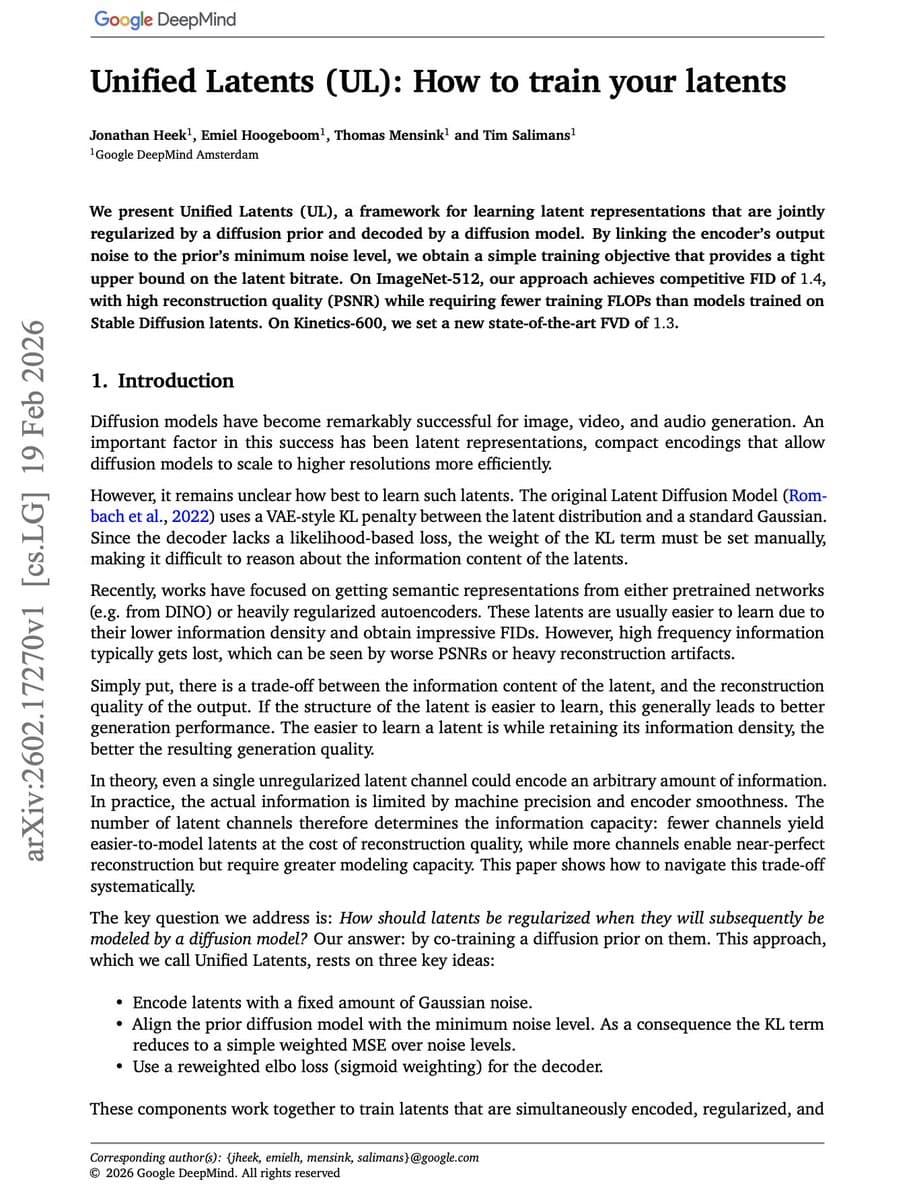
New research from Google DeepMind has revealed fundamental limitations in how diffusion models are typically trained, challenging a widely adopted practice in the AI community. The findings, detailed in a recent paper, suggest that the standard approach of using KL (Kullback-Leibler) penalties borrowed from variational autoencoders (VAEs) may be fundamentally flawed when applied to diffusion models.
The Problem with Borrowed Methods
Diffusion models have revolutionized generative AI, powering everything from image generation tools like DALL-E and Stable Diffusion to advanced video creation systems. These models work by gradually adding noise to data (the forward process) and then learning to reverse this process (the backward process) to generate new samples.
For years, researchers have borrowed training techniques from VAEs, particularly the use of KL penalties to regularize the latent space. This penalty term encourages the learned latent representations to follow a specific distribution, typically a standard normal distribution. The assumption has been that what works for VAEs should work for diffusion models.
However, the DeepMind researchers discovered that this borrowed approach has significant limitations. "Training good latents for diffusion models is harder than it looks," the researchers noted. "The standard approach uses a KL penalty borrowed from VAEs, with no principled way to control how much information actually lives in the latent space."
The Information Control Problem
At the heart of the issue is what researchers call the "information control problem." In diffusion models, the latent space should contain just the right amount of information—not too little (which would limit expressiveness) and not too much (which could lead to overfitting or poor generalization).
The KL penalty approach provides no systematic way to control this information content. The penalty term essentially pushes all latent representations toward a simple distribution, but doesn't offer fine-grained control over how much information from the original data should be preserved in the latent space.
This lack of control can lead to several problems:
- Suboptimal performance: Models may fail to capture important data characteristics
- Inefficient training: More iterations may be needed to achieve desired results
- Limited expressiveness: Generated samples may lack diversity or quality
Implications for AI Development
The findings have significant implications for the entire field of generative AI. Diffusion models have become the backbone of many commercial AI systems, and any fundamental limitation in their training could affect:
- Image generation systems: Tools like Midjourney, Stable Diffusion, and DALL-E
- Video generation: Emerging technologies for creating synthetic video content
- Scientific applications: Drug discovery, material design, and protein folding
- Creative tools: AI-assisted art, music, and content creation platforms
Potential Solutions and Future Directions
While the paper identifies the problem, it also points toward potential solutions. Researchers suggest that new training objectives specifically designed for diffusion models, rather than borrowed from VAEs, may be necessary. These could include:
- Information-theoretic approaches: Explicitly controlling mutual information between data and latents
- Task-specific regularization: Tailoring the training objective to the specific generation task
- Adaptive penalties: Dynamically adjusting regularization during training
The Broader Context
This research comes at a critical time for generative AI. As diffusion models become more powerful and widespread, understanding their theoretical foundations becomes increasingly important. The DeepMind paper represents a significant step toward more principled approaches to training these models.
The findings also highlight a broader trend in AI research: the need to move beyond borrowed techniques and develop methods specifically designed for new architectures. As one researcher noted, "What works for one type of model may not work for another, even if they seem superficially similar."
Looking Ahead
The DeepMind research opens up several important avenues for future work:
- New training objectives: Developing diffusion-specific regularization methods
- Theoretical analysis: Better understanding of diffusion model dynamics
- Practical improvements: Enhancing existing diffusion-based systems
- Cross-architecture insights: Learning what can and cannot be transferred between different model types
As the AI community digests these findings, we can expect to see new training approaches emerge that address the fundamental limitations identified in this research. The ultimate goal remains the same: creating more powerful, efficient, and controllable generative models that can push the boundaries of what AI can create.
Source: Research from Google DeepMind as highlighted by @omarsar0 on Twitter