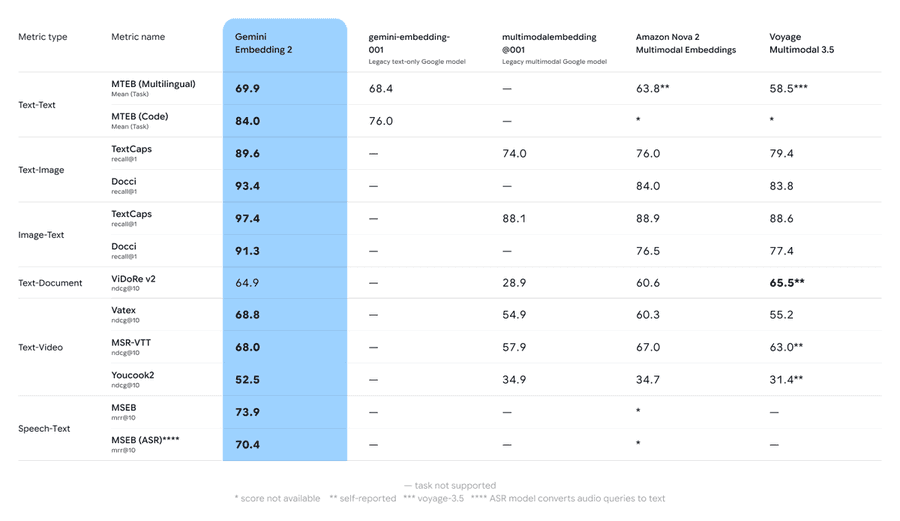
Google has taken a significant leap forward in artificial intelligence with the introduction of Gemini Embedding 2, the company's first fully multimodal embedding model capable of mapping diverse media types into a unified vector space. This development represents a fundamental shift in how AI systems can understand and process information across different formats, potentially revolutionizing applications from search to content analysis.
What Makes Gemini Embedding 2 Revolutionary
Traditional embedding models have typically been specialized for specific data types—text embeddings for language, image embeddings for visual content, and separate systems for audio and video. Gemini Embedding 2 breaks down these silos by creating a single shared vector space that can accommodate text, images, video, audio, and documents simultaneously.
This unified approach means that for the first time, developers can work with a consistent representation framework regardless of input modality. A paragraph about a sunset, a photograph of a sunset, a video clip showing a sunset, and an audio recording of ocean waves at sunset can all be mapped to related positions in the same vector space, enabling truly multimodal understanding and retrieval.
Technical Capabilities and Specifications
According to the announcement, Gemini Embedding 2 offers impressive technical specifications:
- Multilingual support: The model works with over 100 languages, making it globally applicable
- Text processing: Handles inputs up to 8,192 tokens, sufficient for lengthy documents
- Visual content: Processes up to 6 images per request
- Video support: Can embed videos up to 120 seconds in length
- Audio capabilities: Includes native audio embeddings without requiring separate preprocessing
- Document handling: Supports PDFs up to 6 pages
Perhaps most significantly, the model incorporates Matryoshka Representation Learning, which allows developers to use flexible vector sizes (3072, 1536, or 768 dimensions). This innovation enables practical trade-offs between performance and storage requirements—critical considerations for real-world applications where computational resources and latency matter.
Practical Applications and Implications
The introduction of Gemini Embedding 2 has immediate implications for several key AI applications:
Retrieval-Augmented Generation (RAG): Developers can now build RAG systems that retrieve relevant information regardless of whether it exists as text, images, audio, or video. This could dramatically improve the quality and relevance of AI-generated responses by providing richer context from diverse sources.
Semantic Search: Search engines and enterprise search systems can move beyond text-only matching to truly understand queries in context with all available media types. A search for "how to change a tire" could return relevant video tutorials, instructional images, and text manuals with equal understanding of their relevance.
Content Clustering and Organization: Media companies, educational platforms, and content management systems can automatically organize mixed-media content based on semantic similarity rather than file type or metadata alone.
Sentiment and Content Analysis: Brands and researchers can analyze customer sentiment across review text, product images, video testimonials, and audio feedback using a consistent analytical framework.
The Competitive Landscape
Google's announcement positions the company at the forefront of multimodal AI development, potentially leapfrogging competitors who have focused on unimodal or limited multimodal approaches. While other companies have developed multimodal models, the comprehensive nature of Gemini Embedding 2's capabilities—particularly its native handling of audio and video alongside text and images—represents a significant technical achievement.
This development also reflects Google's broader strategy of creating integrated AI ecosystems. By providing a unified embedding framework, Google makes it easier for developers to build applications that leverage the full Gemini family of models while potentially locking them into Google's AI infrastructure.
Challenges and Considerations
Despite its impressive capabilities, Gemini Embedding 2 will face practical challenges:
Computational Requirements: Processing multiple media types simultaneously requires significant computational resources, which may limit accessibility for smaller organizations or applications with strict latency requirements.
Integration Complexity: While the model simplifies some aspects of multimodal AI, integrating it into existing systems and workflows will still require substantial engineering effort.
Evaluation Metrics: Assessing the quality of truly multimodal embeddings presents methodological challenges, as traditional evaluation approaches were designed for unimodal systems.
Privacy and Ethical Considerations: The ability to analyze and correlate information across media types raises important questions about privacy, consent, and potential misuse.
Looking Forward
Gemini Embedding 2 represents more than just another AI model release—it signals a fundamental shift toward truly integrated multimodal understanding. As AI systems move beyond processing individual data types in isolation, we can expect more sophisticated applications that mirror how humans naturally understand the world through multiple senses and information channels.
The model's flexible vector sizing through Matryoshka Representation Learning also points toward a future where AI systems can dynamically adjust their computational footprint based on application requirements, making advanced AI more accessible across different resource constraints.
For developers and organizations, the immediate opportunity lies in reimagining how information retrieval, content organization, and AI-assisted workflows can leverage this unified understanding of diverse media types. Those who successfully integrate these capabilities may gain significant competitive advantages in user experience, content discovery, and analytical insights.
Source: Based on announcement from @kimmonismus on X (formerly Twitter) detailing Google's Gemini Embedding 2 release.