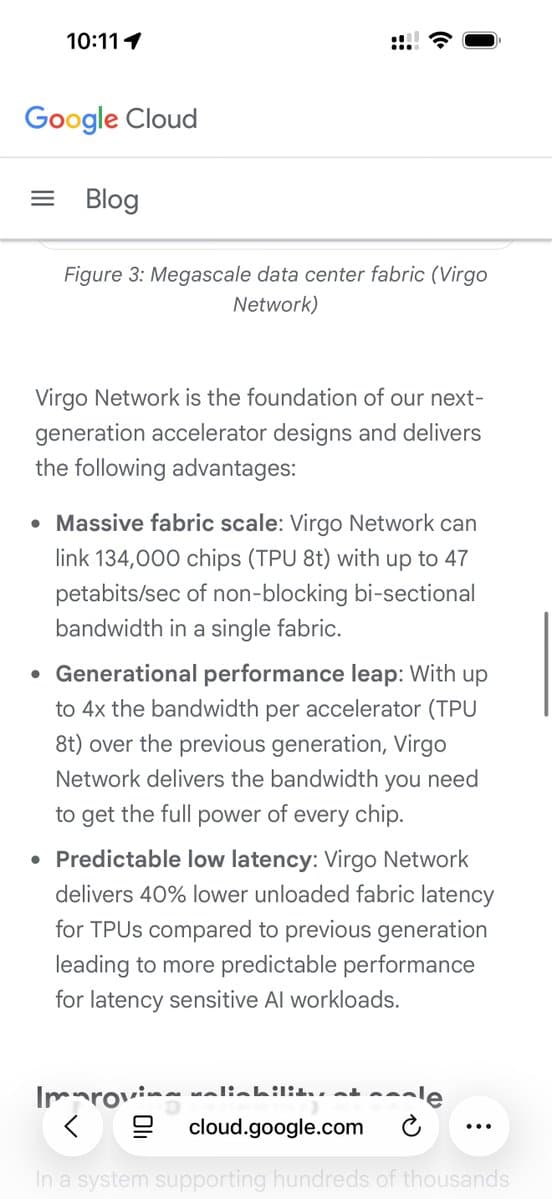
Google has announced a new networking stack called Virgo designed for its latest TPU v8 AI accelerators. The key technical specification revealed is the system's massive fabric scale: Virgo can link up to 134,000 TPU v8 chips within a single, non-blocking network fabric, delivering up to 47 petabits per second (Pbps) of bi-sectional bandwidth.
Key Takeaways
- Google unveiled its Virgo networking stack for TPU v8, capable of linking 134,000 chips in a single fabric with 47 petabits/sec of bi-sectional bandwidth.
- This represents a massive scale-up in interconnect technology for large-scale AI model training.
What's New: The Virgo Networking Stack

Virgo represents Google's next-generation interconnect technology for its Tensor Processing Unit (TPU) pods. The announcement, made alongside the TPU v8 reveal, highlights networking as a critical bottleneck in scaling AI training workloads. The 47 Pbps bi-sectional bandwidth figure indicates the total bandwidth available across a theoretical midpoint cut of the network, a key metric for all-to-all communication patterns common in large model training.
Technical Details & Scale Context
Linking 134,000 chips in a single fabric is a substantial leap in scale. For comparison, Google's previous-generation TPU v4 pods typically scaled to thousands of chips. The non-blocking characteristic is crucial—it means the network can handle any permutation of traffic between chips without contention, preventing slowdowns when different parts of a massive model need to communicate simultaneously during training.
- Fabric Scale: 134,000 TPU v8 chips (likely referring to the "8t" variant)
- Bandwidth: Up to 47 petabits/sec (47,000 terabits/sec) of bi-sectional bandwidth
- Architecture: Details are sparse, but the "Virgo" name suggests a new topology or switching architecture beyond previous generations like the TPU v4's optical circuit switches.
This scale is designed to support the next frontier of AI model training, where models with tens of trillions of parameters may require synchronization across hundreds of thousands of accelerators.
How It Compares: The Interconnect Arms Race
AI supercomputing is increasingly defined by interconnect performance. Competitors are pushing similar boundaries:
- NVIDIA's Blackwell Platform: Features the NVLink Switch Chip enabling 1.8 terabytes per second (TB/s) of bidirectional bandwidth per GPU across a 576-GPU fabric. Google's 47 Pbps equates to roughly 5.875 TB/s per chip if evenly distributed, though architectural differences make direct comparison complex.
- Cerebras' Wafer-Scale Engine: Avoides the networking problem entirely by building a giant chip, but is limited to single-wafer scale.
- Amazon's Trainium & Inferentia: Rely on scalable Ethernet-based fabrics (AWS NeuronLink) but at different scale points.
Virgo appears to be Google's answer to maintaining a competitive edge in training the largest models by ensuring its custom silicon isn't hampered by communication bottlenecks.
What to Watch: Implications for Large-Scale Training

The Virgo announcement is a hardware enabler, not a direct product. Its success will be measured by:
- Real-World Availability: When will researchers outside of Google DeepMind gain access to pods of this scale?
- Software Stack Maturity: Can frameworks like JAX and TensorFlow efficiently utilize this fabric without requiring massive code rewrites?
- Reliability at Scale: Managing failures across 134,000 chips and the network connecting them is a monumental software engineering challenge.
If realized, this fabric could significantly reduce the wall-clock time to train models like Gemini's successors, potentially compressing training cycles from months to weeks.
gentic.news Analysis
This announcement continues the intense infrastructure arms race among AI hyperscalers. Google's investment in Virgo is a defensive and offensive move. Defensively, it ensures their flagship AI research team, Google DeepMind, has the necessary infrastructure to keep pace with or exceed work done on NVIDIA clusters at competitors like OpenAI and Meta. Offensively, it's a showcase for Google Cloud Platform, aiming to attract enterprises that want to train frontier models but lack the capital to build such infrastructure themselves.
This follows Google's pattern of deep vertical integration—controlling the silicon (TPU), the interconnect (Virgo), the software (JAX, TensorFlow), and the models (Gemini). The 134,000-chip fabric target suggests Google is planning for models an order of magnitude larger than current frontier LLMs. The real test will be in the efficiency gains: will a 134,000-chip Virgo pod deliver linear scaling for model training, or will software overheads dominate? Google's previous papers on TPU v4 showed impressive scaling efficiency; the industry will be watching for similar publications on Virgo.
Frequently Asked Questions
What is a non-blocking network fabric?
A non-blocking network fabric is one where any input port can communicate with any output port simultaneously without contention or blocking. In the context of AI training, this means that all TPU chips can exchange data (for synchronization or gradient sharing) at full bandwidth concurrently, which is critical for maintaining high utilization in large-scale parallel training jobs.
How does 47 petabits/sec compare to internet bandwidth?
47 petabits per second is an almost incomprehensibly large amount of bandwidth. For perspective, total global internet backbone capacity is estimated to be in the range of several petabits per second. Google's Virgo fabric, within a single data center, aims for bandwidth that is an order of magnitude greater than major global internet exchanges.
What is the "TPU v8 8t" chip mentioned?
While not officially detailed in this tweet, the "8t" suffix likely denotes a specific variant of the TPU v8, possibly with higher memory bandwidth or a different form factor optimized for the Virgo fabric. Google has historically used suffixes (like TPU v4 "lit" for liquid-cooled versions) to denote specialized configurations.
When will Virgo be available on Google Cloud?
The announcement did not include a timeline for general availability on Google Cloud Platform. Historically, there has been a lag between Google's internal deployment of new TPU generations and their cloud offering. Given the extreme scale hinted at, Virgo-based pods may initially be reserved for Google's own use or for select strategic cloud customers before a broader rollout.