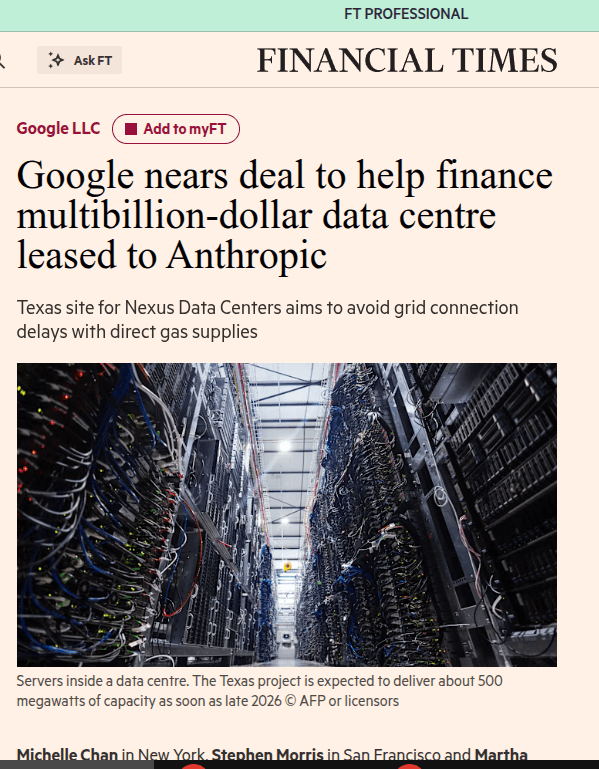
According to a report from the Financial Times, Google is moving to help fund the construction of a data center campus in Texas with a total projected cost exceeding $5 billion. The facility is being built for Anthropic, the AI safety and research company, which will lease the capacity. The deal represents a significant, hands-on infrastructure investment by Google to secure long-term compute for a key AI partner.
The project's scale is notable. The first phase is targeting approximately 500 megawatts (MW) of capacity, slated to come online by late 2026. For context, a single 500MW data center campus is already among the largest built by tech companies. The full build-out potential for the campus is reported to be about 7.7 gigawatts (GW). At that scale, the facility enters "utility-scale" territory, comparable to the output of a large power plant, rather than a typical corporate data center.
The Technical Twist: Behind-the-Meter Power
The report highlights a critical technical and logistical strategy for the site: behind-the-meter power. Instead of relying solely on a slow and congested connection to the public electrical grid, the data center will source power directly from adjacent natural gas pipelines and use on-site turbines for generation.
This approach addresses several major bottlenecks in building AI-scale infrastructure:
- Avoids Interconnection Delays: Connecting a multi-gigawatt load to the Texas grid (ERCOT) can involve years of study and upgrade work. Behind-the-meter generation sidesteps this queue.
- Reduces Exposure to Peak Pricing: Power prices in Texas can spike dramatically during high-demand periods. Generating power on-site provides more predictable, and potentially lower, long-term energy costs.
- Provides a Steadier Path to Capacity: For AI companies like Anthropic, predictable access to vast, contiguous blocks of compute is essential for training frontier models. This setup de-risks the power supply chain.
Google's Role and the Broader Context
Google's involvement is described as "unusually hands-on." By providing financial backing, Google can lower the borrowing costs for the project's developers, making it feasible to build a site of this enormous scale before customer demand (in this case, Anthropic's) is fully realized. This is not a simple cloud credits agreement; it is direct investment in physical infrastructure for a specific partner.
This move follows Google's existing $2 billion investment in Anthropic and a prior $300 million cloud credits deal. It also comes amidst an industry-wide scramble for AI compute capacity, with Microsoft and OpenAI pursuing similar large-scale, custom infrastructure projects.
gentic.news Analysis
This deal is a concrete manifestation of the strategic realignment happening at the highest levels of AI infrastructure. It's no longer just about selling cloud instances; it's about capital partners (Google, Microsoft) vertically integrating with and bankrolling the physical plants for their most important AI tenants (Anthropic, OpenAI). Google's direct funding to lower borrowing costs reveals the capital-intensive nature of the AI arms race—it's as much about finance and energy logistics as it is about algorithms.
The choice of behind-the-meter power is the most technically significant detail. It confirms that the primary constraint for scaling AI is no longer chip availability alone, but power delivery and grid interconnection. The 7.7GW potential scale is staggering. For comparison, Meta has stated its total global data center capacity is around 5GW. A single campus approaching 8GW would represent a fundamental shift in what constitutes "data center" scale, blurring the line between tech infrastructure and independent power production. This model—building dedicated power plants for AI—is likely to become a template, especially in deregulated markets like Texas.
This development directly relates to our previous coverage of Microsoft and OpenAI's "Stargate" supercomputer project, which is also rumored to be a multi-billion-dollar, multi-gigawatt endeavor. The parallel paths of Microsoft-OpenAI and Google-Anthropic show a clear industry trend: the largest cloud providers are locking in their frontier AI partners through bespoke, capital-intensive infrastructure deals that are difficult for competitors to replicate or for the AI firms to walk away from.
Frequently Asked Questions
What is "behind-the-meter" power?
Behind-the-meter power refers to generating electricity on-site or sourcing it directly, bypassing the traditional public utility grid. In this case, the data center will use natural gas from nearby pipelines to fuel on-site turbines, creating a dedicated, private power supply. This avoids the lengthy process and uncertainty of securing a multi-gigawatt connection to the Texas electrical grid.
Why is Google funding a data center for Anthropic?
Google is a major investor in Anthropic (having committed $2 billion) and its primary cloud provider. Funding this data center secures long-term, massive-scale compute capacity for Anthropic's AI model training, ensuring it remains a key Google Cloud customer. It also gives Google a strategic asset and deepens the partnership in the race against the Microsoft-OpenAI alliance.
How big is a 7.7GW data center?
7.7 gigawatts is an enormous amount of power. It is equivalent to the output of about seven large nuclear reactor units or enough electricity to power over 5 million homes. In data center terms, it is more than the total combined power capacity of several of the world's largest existing cloud regions. It represents a utility-scale power project that happens to run computers.
When will this data center be operational?
According to the report, the first phase of the project, targeting about 500MW of capacity, is aiming to come online by late 2026. The full build-out to the potential 7.7GW scale would occur in subsequent phases, with no specific timeline reported yet.