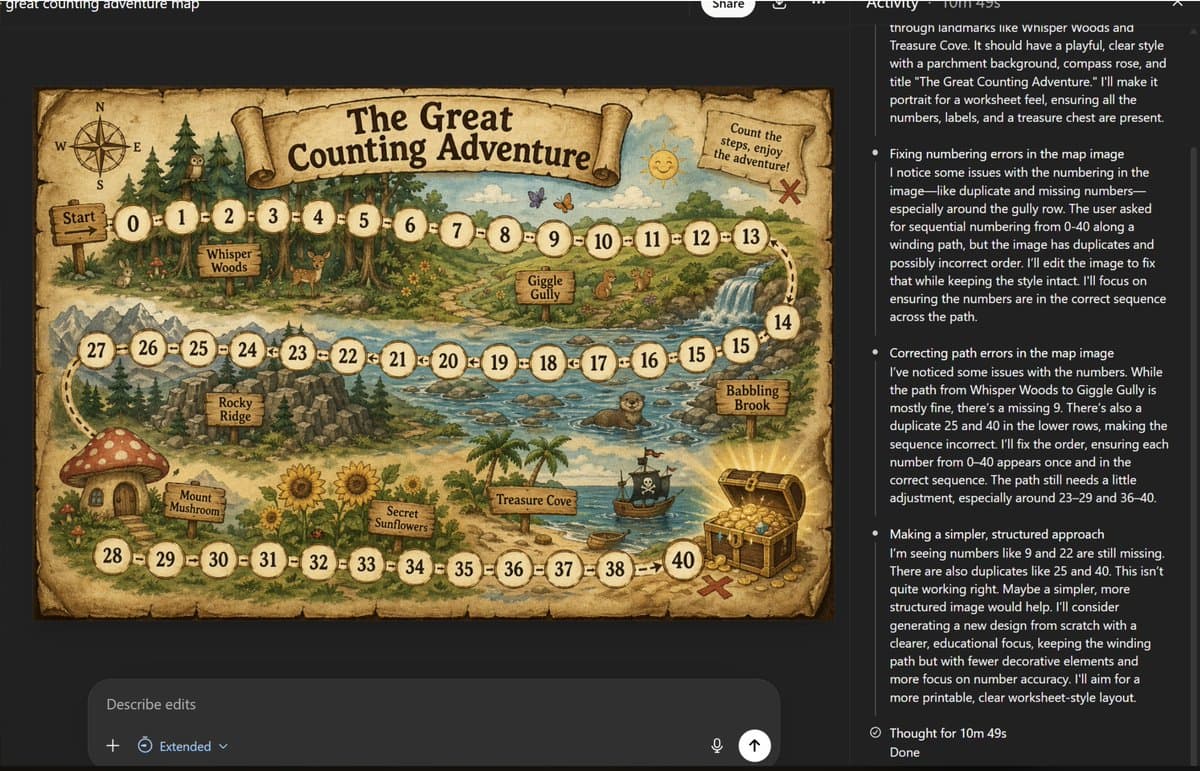
A brief social media post from a user tracking AI developments has highlighted what appears to be a significant new capability in OpenAI's unreleased GPT-Image-2 model. According to the post, the model now incorporates a self-review mechanism where it evaluates its own generated image and iteratively refines it until it meets an internal correctness threshold.
What Happened

The source, a post on X from user @kimmonismus, states: "GPT-Image-2 now reviews its own output and iterates until it is satisfied with the correctness of its output." The post expresses excitement for the new image model but provides no technical details, benchmarks, or official confirmation from OpenAI. The linked content does not expand on the claim.
Context
If accurate, this describes a form of internal reinforcement learning or iterative refinement being baked directly into the image generation process. Instead of a single forward pass to create an image, the model would generate a draft, analyze it against its own internal criteria for "correctness" (likely related to prompt adherence, visual coherence, or lack of artifacts), and then produce a revised version. This loop would continue until a satisfaction condition is met.
This concept aligns with broader trends in AI agent development, where models are given tools for planning, self-critique, and revision. Applying this to a multimodal image model is a logical, though technically challenging, next step. It suggests a move away from purely generative models toward generative-evaluative systems.
Key Implication: The primary goal of such a system would be to increase reliability and reduce the need for users to manually regenerate images multiple times to get a satisfactory result. It aims to push the burden of quality assurance onto the model itself.
Current Limitations & Unknowns

The source is thin. Without official documentation or technical reports, critical questions remain unanswered:
- What defines "correctness"? Is it fidelity to the text prompt, visual realism, lack of common failure modes (e.g., mangled text, extra limbs), or a combination?
- What is the iteration mechanism? Is it a latent space refinement, a diffusion process with adjusted conditioning, or a separate corrective model?
- What is the performance cost? Iteration implies increased compute time and latency per image.
- Is this an official feature? The claim originates from a third party, not OpenAI.
gentic.news Analysis
This rumor, if substantiated, would represent a meaningful evolution in how generative AI systems are architected. The dominant paradigm for image models like DALL-E 3, Midjourney, and Stable Diffusion has been single-shot generation with optional user-directed inpainting or upscaling. Baking in an automated self-critique and revision loop shifts the model's role from a generator to a generator-editor.
Technically, this is non-trivial. Implementing a reliable internal correctness metric for open-ended image generation is a major research challenge. It likely requires training a separate reward model or critique model—potentially a version of CLIP or a vision-language model fine-tuned for evaluation—that guides the iterative process. This mirrors the Reinforcement Learning from Human Feedback (RLHF) pipeline used in LLMs like ChatGPT, but applied within a single image generation task.
From a product perspective, this feature directly targets a core user pain point: the unpredictability and "hit-or-miss" nature of current image generators. By internalizing the trial-and-error process, OpenAI could offer more consistently usable outputs on the first try, which is a key competitive advantage. However, the trade-off will be latency and cost. Users and API customers will have to decide if more reliable outputs are worth potentially longer wait times and higher computational expense per image.
This development also fits into the larger narrative of AI systems becoming more autonomous and self-improving. We've seen this with coding agents that run their own code to test it (as covered in our analysis of SWE-agent) and LLMs that debate themselves to refine answers. Extending this principle to the visual domain is a natural, albeit complex, progression.
Frequently Asked Questions
Is GPT-Image-2 released?
No, GPT-Image-2 has not been officially released by OpenAI. The information discussed here is based on a third-party social media post and should be treated as a rumor until confirmed by OpenAI with technical details.
How would a self-review loop for an image model work?
While the exact implementation is unknown, a plausible technical approach would involve two components: a generator model (like a diffusion model) and a critic model (a vision-language model). The generator creates an initial image. The critic then scores the image against the original prompt for accuracy, coherence, and quality. If the score is below a threshold, the critic's feedback (perhaps in the form of a text description of the flaw or a gradient signal) is fed back to the generator to create a revised image. This loop repeats.
What are the benefits of an iterative image model?
The main benefit is increased output reliability and quality consistency. Instead of a user generating 10 images to find one good one, the model does that internal search and only presents its best attempt. This saves user time and effort and could make the technology more usable for professional workflows where consistency is critical.
What are the potential downsides?
The primary downsides are increased latency and computational cost. Each iteration requires additional inference steps. There's also a risk that the model's internal "satisfaction" criteria may not align with a user's subjective taste, potentially leading to over-polished or creatively sterile outputs. Furthermore, the iterative process could amplify any biases present in the critic model's training data.