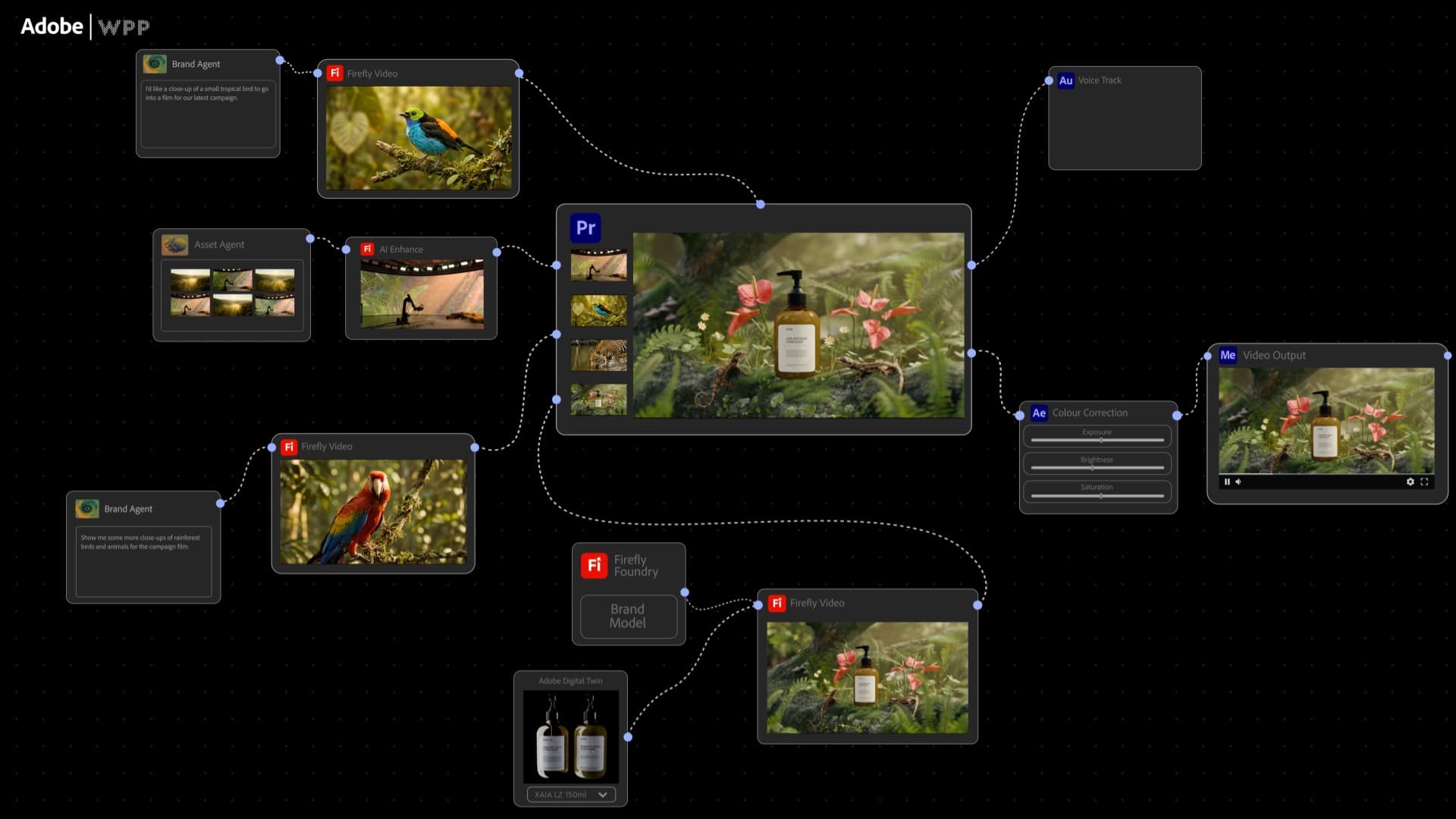
NVIDIA, Adobe, and global marketing giant WPP have announced an expanded strategic collaboration to build and deploy agentic AI systems for enterprise marketing and creative operations. The partnership aims to address a core enterprise challenge: deploying autonomous AI agents that can orchestrate complex, multi-step workflows—like generating and personalizing marketing content—while maintaining strict security, governance, and brand compliance.
The announcement, made ahead of a live demo at Adobe Summit on April 21, signals a move from experimental AI tools to production-grade, governed agentic systems for large corporations.
Key Takeaways
- NVIDIA expands collaborations with Adobe and WPP to build agentic AI systems for enterprise marketing workflows.
- The stack uses NVIDIA's OpenShell runtime to enforce security and policy compliance in multi-step creative and customer experience tasks.
What's New: Governed Agents for Marketing Lifecycles
The collaboration brings together three distinct capabilities:
- Adobe's Creative & Customer Experience Platforms: Including the newly announced Adobe CX Enterprise Coworker, an AI agent designed to orchestrate downstream customer experience workflows from personalization to activation.
- WPP's Marketing Expertise: The world's largest advertising agency group will integrate these agentic systems into global media and marketing operations for its clients.
- NVIDIA's Full-Stack AI Software & Hardware: The stack includes NVIDIA Nemotron open models for reasoning, the NVIDIA Agent Toolkit for building agents, and, critically, the NVIDIA OpenShell secure runtime.
The central technical offering is end-to-end agentic workflows. Adobe is developing agents that can generate, adapt, and version on-brand creative assets. These feed into the CX Enterprise Coworker, which then orchestrates customer experience actions, aiming to "close the loop between content creation and customer engagement."
The Key Technical Detail: NVIDIA OpenShell Runtime
For enterprises, the ability to let AI agents act autonomously—tapping sensitive data, triggering actions across software stacks—is fraught with risk. The partnership's technical answer is the NVIDIA OpenShell runtime.
OpenShell is described as a policy-based, containerized sandbox. Every agent operates within this secure, isolated environment, which is designed to deliver:
- Control & Auditability: Clear rules of engagement for what an agent can do, with verifiable policy management across the entire marketing lifecycle.
- Secure Execution: Key workflows and intelligence services can be kept inside a company's trust boundary. The blog notes enterprises can "securely invoke Adobe CX Intelligence" within this shell.
- Governed Consistency: It shifts the question from "What policy is in place?" to "What can the agent do?" by enforcing policies at the runtime level.
This addresses the primary blocker for enterprise AI agent adoption: trust. A live demo of the CX Enterprise Coworker, powered by the NVIDIA Agent Toolkit (including OpenShell and Nemotron models), is scheduled for Adobe Summit.
How It Compares: The Enterprise Security Gap in Agentic AI
The AI agent space has been dominated by startups and open-source frameworks focused on capability (e.g., AutoGPT, LangChain). Enterprise-grade solutions requiring robust security, auditing, and policy enforcement have been scarce.
This partnership directly targets the enterprise governance gap that has kept AI agents in pilot phases.
What to Watch: From Demo to Deployment
The announcement is heavy on architecture and light on specific performance metrics or deployment timelines. Key questions remain:
- Latency & Cost: Running Nemotron models within a secure sandbox for complex, multi-step workflows will have computational overhead. Enterprise scalability will depend on the efficiency of the OpenShell runtime.
- Benchmarks vs. Human Teams: The value proposition is speed ("minutes instead of months"), but no quantitative benchmarks for quality or throughput are provided.
- Integration Depth: Success hinges on deep, reliable integration between Adobe's agents, WPP's operational systems, and NVIDIA's runtime—a non-trivial challenge.
gentic.news Analysis
This partnership is a strategic consolidation in the rapidly maturing AI agent landscape. It follows a clear pattern from NVIDIA: providing the full-stack infrastructure (from chips like Blackwell to models like Nemotron 3 Super and now runtime software like OpenShell) required for next-generation AI applications. The focus on OpenShell is particularly telling. It aligns with our recent coverage on the critical need for agent "harnesses" ("Your AI Agent Is Only as Good as Its Harness — Here’s What That Means," April 19) and protocols for auditable lineage ("New Protocol Enables Self-Improving AI Agents with Auditable Lineage," April 19). NVIDIA is positioning itself not just as a hardware vendor, but as the provider of the foundational security and control layer for enterprise AI.
The timing is significant. With industry leaders predicting 2026 as a breakthrough year for AI agents and Gartner projecting 40% of enterprise apps will feature task-specific agents by 2026, this collaboration is a bid to define the enterprise-grade standard. It also reflects the trend of vertical integration, where a dominant platform player (NVIDIA) partners with domain experts (Adobe for creative software, WPP for marketing execution) to create turnkey solutions that are harder for competitors to replicate.
However, it also highlights a growing bifurcation in the agent ecosystem. On one side are open, flexible frameworks pushing the boundaries of capability. On the other are closed, integrated stacks like this one, prioritizing security and governance for regulated industries. The market will determine which approach wins enterprise budgets, but NVIDIA's move suggests it believes the latter is the immediate commercial priority.
Frequently Asked Questions
What is NVIDIA OpenShell?
NVIDIA OpenShell is a secure runtime environment for AI agents. It acts as a policy-based, containerized sandbox that isolates agent execution, enforcing what actions an agent can take and providing audit trails. It's designed to give enterprises the control needed to deploy autonomous AI systems safely.
How is this different from using ChatGPT or Claude for marketing tasks?
ChatGPT and Claude are primarily conversational AI tools. The Adobe/NVIDIA/WPP stack is built for autonomous, multi-step workflow orchestration. An agent in this system could, for example, autonomously generate a set of ad variants, analyze performance data, select the best-performing version, and then deploy it across channels—all while adhering to brand and compliance policies enforced by OpenShell.
What are the main use cases for these marketing AI agents?
The primary use case is hyper-personalized marketing at scale. The blog gives the example of a global retailer delivering the right offer, image, copy, and price across millions of product, audience, and channel combinations, updated in minutes rather than months. This moves marketing from batch campaigns to continuous, adaptive customer experience loops.
When will this technology be available to enterprises?
A live demo is scheduled for Adobe Summit on April 21, 2026. General availability timelines for the integrated stack have not been announced. Typically, such strategic collaborations move through pilot phases with select WPP clients before broader release.