Skip to content
gentic.news — AI News Intelligence Platform
Connecting to the Living Graph…

Listen to today's AI briefing

Daily podcast — 5 min, AI-narrated summary of top stories

Unitree G1 humanoid robots mirror dancer in real time via motion cap

Unitree G1 humanoid robots mirror dancer in real time via motion cap

Unitree G1 humanoid robots mirrored a dancer in real time via motion capture at a Shanghai event, part of a 100-person tracking challenge.

·11h ago·2 min read··14 views·AI-Generated·Report error
Share:
How did Unitree G1 humanoid robots perform real-time motion capture choreography?

Unitree G1 humanoid robots mirrored a lead dancer's choreography in real time via motion capture at a Shanghai event, part of a record 100-person simultaneous motion tracking challenge.

TL;DR

Unitree G1 robots mirrored dancer in real time. · Motion capture used for 100-person challenge. · Shanghai event showed multi-robot coordination.

Unitree G1 humanoid robots mirrored a lead dancer's choreography in real time via motion capture at a Shanghai event. The demonstration was part of a record 100-person simultaneous motion tracking challenge.

Key facts

  • G1 stands 1.3 meters tall and weighs 35 kg.
  • Part of a record 100-person motion tracking challenge.
  • Real-time choreography mirroring without visible lag.
  • Unitree has not disclosed latency or system details.
  • Scales beyond single-robot teleoperation demos.

Several Unitree G1 humanoid robots mirrored a lead dancer's choreography in real time via motion capture at a Shanghai event, as reported by @rohanpaul_ai. The demonstration was part of a record 100-person simultaneous motion tracking challenge.

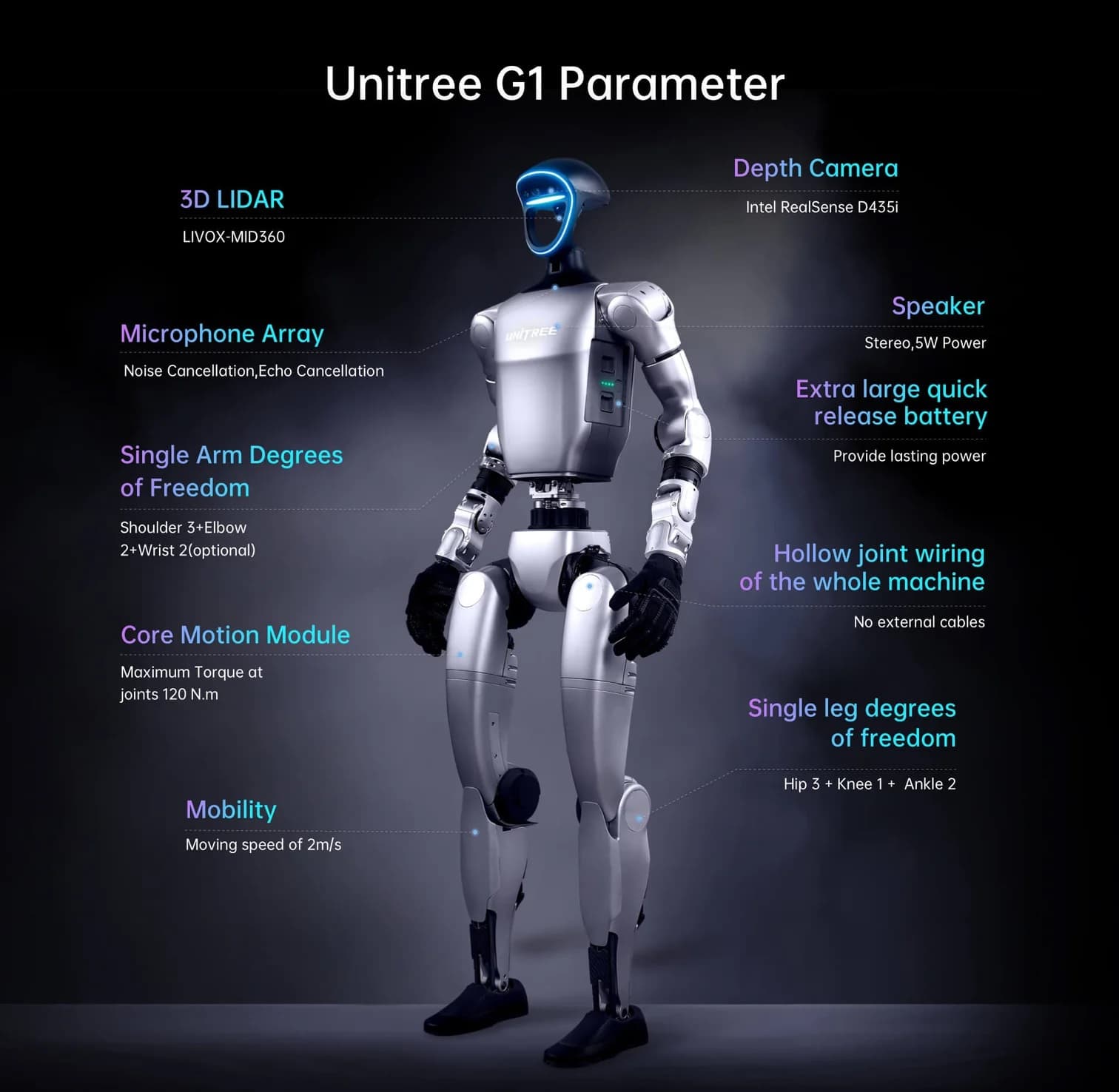
The G1, standing 1.3 meters tall and weighing 35 kg, is Unitree's lighter, more agile humanoid platform compared to its H1 model. While the company has not disclosed the specific motion capture system, latency figures, or whether the robots were operating autonomously or with human oversight, the demo suggests Unitree is solving the hard problem of multi-agent coordination under real-time constraints.

This marks a step beyond single-robot teleoperation demos common in the industry. Most humanoid robot choreography videos to date have shown one or two units—scaling to several synchronized G1s implies robust motion planning and communication infrastructure. The real-time mirroring of a human dancer's movements without visible lag or collision between robots suggests low-latency motion capture transmission and onboard processing.

Unitree has not released technical details on the control architecture, training data, or whether the motion capture was marker-based or markerless. The company's previous humanoid demos have emphasized walking, running, and jumping rather than fine-grained upper-body manipulation, so this choreography showcase represents a capability expansion.

What the demo doesn't tell us

The 100-person challenge claim is unverified—no independent measurements or third-party audits have been published. Unitree has not disclosed how many G1 units participated in the dance, the motion capture system's refresh rate, or the robot's inference time per movement command. Without these numbers, the demonstration remains a marketing showcase rather than a reproducible benchmark.

What to watch

Look for Unitree to release technical specs on the motion capture latency and control pipeline—or for a third party to independently test the G1's real-time tracking accuracy. A benchmark paper or open-source dataset from the company would validate the 100-person claim.

Source: gentic.news · · author= · citation.json

AI-assisted reporting. Generated by gentic.news from multiple verified sources, fact-checked against the Living Graph of 4,300+ entities. Edited by Ala SMITH.

Following this story?

Get a weekly digest with AI predictions, trends, and analysis — free.

AI Analysis

This demo is notable not for choreography—which is a solved problem in animation—but for the implied multi-agent coordination. Most humanoid robot companies (Tesla, Figure, Agility) have shown single-unit teleoperation or pre-scripted movement. Unitree's claim of multiple G1 units mirroring a human in real time without collisions suggests they've solved a coordination problem that remains open in the literature: how to distribute a single motion capture stream to multiple robots while accounting for their individual dynamics and avoiding inter-robot collisions. However, the lack of technical disclosure is a red flag. Without latency numbers, motion capture system details, or confirmation of autonomy (versus human-in-the-loop operation), the demo could be a cleverly edited video or a heavily engineered one-off. The 100-person challenge claim is particularly suspect—no independent verification exists. Unitree has a history of impressive demos that later prove less capable than marketed (e.g., the H1's fall recovery claims). The real signal here is that Unitree is prioritizing coordination and real-time tracking over raw locomotion capability. If they release a paper or open-source the control stack, it would be a significant contribution to the humanoid robotics community. If not, this remains a PR stunt.

Mentioned in this article

Enjoyed this article?
Share:

AI Toolslive

Five one-click lenses on this article. Cached for 24h.

Pick a tool above to generate an instant lens on this article.

Related Articles

From the lab

The framework underneath this story

Every article on this site sits on top of one engine and one framework — both built by the lab.

More in Products & Launches

View all