Wharton professor and AI researcher Ethan Mollick has shared his experience testing OpenAI's GPT ImageGen-2 over several weeks, reporting a surprising leap in capability. The key finding: the model has crossed a previously unattained "quality threshold" where it can now reliably generate coherent, formatted text within images, including slides and full academic papers.
What Happened

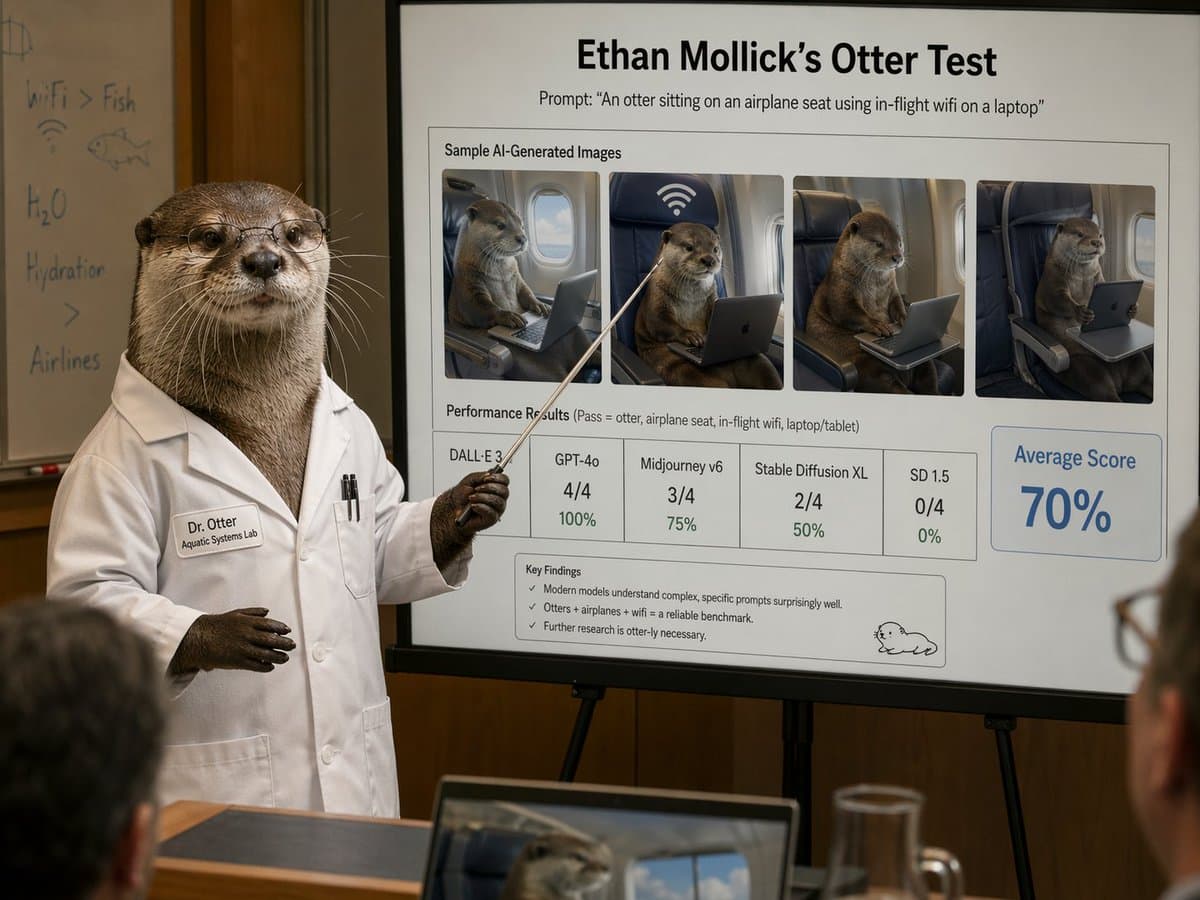
Mollick, a frequent early tester of frontier AI models, stated he "didn't think that better image-generators would be a big deal" but discovered a qualitative shift in output. The model's ability to render legible, structured text—a persistent weakness in earlier text-to-image systems—has improved dramatically. He demonstrated this with his "otter test," a prompt designed to generate a whimsical yet text-heavy image.
The results show GPT ImageGen-2 can produce images containing multi-paragraph text, formatted slides with bullet points, and the dense layout of an academic paper abstract, complete with citations. This moves the technology beyond generating pictures of objects or scenes and into the realm of creating functional, information-dense documents.
Context: The Text-in-Images Problem
Generating readable text within images has been a notorious challenge for diffusion models and other text-to-image architectures. Prior models like DALL-E 2, Midjourney v5, and even the original GPT ImageGen often produced garbled characters, nonsensical word strings, or avoided text altogether. This limitation restricted use cases primarily to illustrations, art, and conceptual imagery.
Mollick's observation suggests OpenAI has made a fundamental advance in aligning its model's understanding of language with its image synthesis process. The implication is that prompts for a "slide deck about quantum computing" or "a research paper abstract on otter behavior" could now yield usable, text-based assets, not just decorative images.
What This Means in Practice
For technical practitioners, this threshold shift could enable new workflows:
- Rapid Prototyping: Generate placeholder slides, wireframes, or document mockups from a descriptive prompt.
- Visual Content Creation: Produce infographics, charts with labels, and annotated diagrams without manual design tools.
- Educational & Research Tools: Create illustrative academic materials, paper templates, or conference posters automatically.
The capability turns the image generator from a creative toy into a potential productivity tool for drafting structured visual content.
Limitations & Caveats
Mollick's report is based on personal testing, not a formal benchmark. The actual reliability rate for perfect text generation, the model's context window for text length, and its handling of complex formatting (like mathematical equations or tables) remain unquantified. Furthermore, the model is likely still prone to occasional hallucinations or errors in the generated text content itself, requiring human verification for serious use.
gentic.news Analysis
This development is a direct shot across the bow of competitors like Google's Imagen 3 and Midjourney, which have also been racing to solve the text-generation problem. OpenAI's apparent progress here aligns with its broader strategy of tightly integrating modalities—a trend we noted in our coverage of the GPT-4o launch, which merged text, vision, and audio into a single model. GPT ImageGen-2 seems to be a specialized, powerful extension of that multimodal philosophy.
Historically, OpenAI has used incremental, user-focused releases (like the original ChatGPT) to gather real-world feedback before a major launch. Mollick, as a trusted external tester, often surfaces these capabilities first. His report suggests OpenAI is confident enough in GPT ImageGen-2's text performance to have it stress-tested in realistic academic and professional scenarios. This isn't just about generating a picture of a sign with words; it's about generating a functional document that is primarily text.
For the AI engineering community, the technical question is how. Did OpenAI employ a novel architecture, a vastly improved training dataset with more text-rich images, or a more sophisticated version of the method used in Sora (which could generate video with readable text)? The answer will influence the next generation of open-source models. This also puts pressure on API competitors like Anthropic and Google to demonstrate similar capabilities in their multimodal offerings, potentially accelerating the entire field's move toward truly composite AI-generated assets.
Frequently Asked Questions
What is GPT ImageGen-2?
GPT ImageGen-2 is OpenAI's unreleased next-generation text-to-image model, a successor to its earlier DALL-E models and the first GPT-named image generator. It is reportedly capable of generating highly coherent and formatted text within its images, a significant technical advancement.
How does GPT ImageGen-2 compare to Midjourney or DALL-E 3?
Based on early reports, GPT ImageGen-2 appears to have a decisive lead in generating readable, structured text within images. While Midjourney and DALL-E 3 excel at artistic style and compositional detail, they have historically struggled with reliable text rendering. GPT ImageGen-2 seems to have crossed a "quality threshold" for this specific capability.
Can I use GPT ImageGen-2 now?
No. As of this report, GPT ImageGen-2 has not been publicly released or added to OpenAI's API or consumer products like ChatGPT. Access appears limited to a select group of alpha testers, such as Ethan Mollick.
What are the practical uses for an image generator that creates text?
This capability transforms the tool from a purely creative asset generator into a potential productivity aid. Use cases could include rapidly prototyping slide decks, generating mockups for reports or academic papers, creating annotated diagrams and infographics, and producing formatted visual content for social media or presentations directly from a text prompt.