In a significant advancement for AI development workflows, developer Akshay Pachaar has addressed what he calls a "major blind spot" in HuggingFace's recently released fine-tuning skill. The original tool allowed users to fine-tune open-source large language models using plain English instructions, handling everything from GPU selection to model deployment on the HuggingFace Hub. However, it assumed developers already had clean, structured datasets ready for training—an assumption that rarely matches reality.
The Missing Piece in AI Fine-Tuning
Most real-world data doesn't live in neatly formatted repositories on the HuggingFace Hub. Instead, valuable training data resides on platforms like Twitter, LinkedIn, Reddit, Amazon, and YouTube—sites protected by sophisticated anti-bot systems, CAPTCHAs, and rate limiting. This created a fundamental disconnect: developers could describe what they wanted to train models on, but couldn't actually access that data through the same automated workflow.
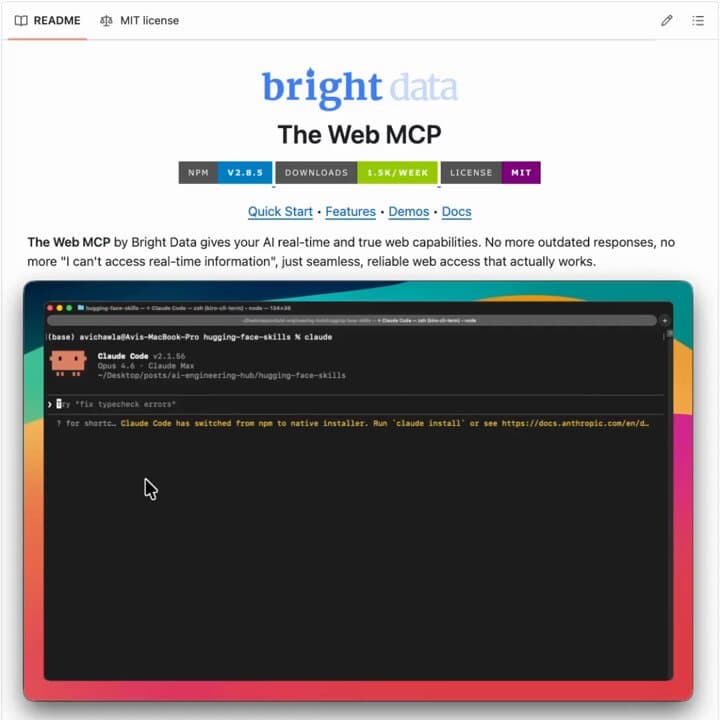
Pachaar's solution integrates Bright Data's Web MCP (Model Context Protocol) into the HuggingFace fine-tuning skill. This addition enables AI coding agents to:
- Scrape data from protected platforms with anti-bot systems handled automatically
- Structure the scraped content into formatted fine-tuning datasets
- Validate the dataset and select appropriate GPU hardware
- Submit training jobs to HuggingFace and monitor progress
- Push finished models to the HuggingFace Hub
The integration supports over 60 web data tools across 40+ platforms, effectively creating an end-to-end pipeline from raw web data to trained AI model.
How the Enhanced Workflow Functions
With this update, developers can now give instructions like: "Scrape the top 500 Python discussions from Reddit, convert them into instruction-response pairs, and fine-tune Qwen3-0.6B on that dataset using SFT." The AI agent then handles the entire process autonomously.
Bright Data's infrastructure solves the technical challenges that typically plague web scraping at scale. Their system manages IP rotation to avoid blocks, solves CAPTCHAs automatically, simulates real user behavior patterns, and provides access to both real-time and historical data. This reliability is crucial for AI agents that need consistent access to web data without manual intervention.
Implications for AI Development
This development represents more than just a technical integration—it signals a shift toward more autonomous AI development workflows. Previously, data collection and model training existed as separate, often manual processes. Now, they can be unified under a single instruction-based interface.
For businesses and researchers, this means:
- Rapid prototyping of domain-specific models using current web data
- Democratization of custom AI model creation beyond data engineering experts
- Real-time model updating based on evolving online conversations and trends
- Reduced dependency on pre-existing datasets that may be outdated or incomplete
The original HuggingFace skill excelled at the training aspect, and Pachaar intentionally left that functionality untouched. His contribution specifically addresses the data collection bottleneck that has long hampered AI development.
Technical Architecture and Implementation
The integration leverages Bright Data's MCP, which provides standardized interfaces for web data collection tools. This architecture allows the AI agent to treat web scraping as just another API call in the fine-tuning workflow. The agent determines what data it needs, requests it through the MCP, receives structured responses, formats them for training, and proceeds with the model fine-tuning process.
This approach maintains the original skill's strengths while adding crucial capabilities. Developers can access the updated implementation through the GitHub repository Pachaar has shared, allowing others to build upon this foundation.
Future Possibilities and Considerations
As this technology matures, we can expect to see:
- More sophisticated data filtering and preprocessing capabilities
- Integration with additional data sources beyond the current 40+ platforms
- Improved validation mechanisms to ensure data quality
- Ethical scraping frameworks to respect platform terms of service
The development raises important questions about data ownership, copyright, and fair use. While the technical capability exists to scrape and train on web data, responsible implementation will require careful consideration of legal and ethical boundaries.
Conclusion
Pachaar's integration of web scraping capabilities into HuggingFace's fine-tuning skill represents a significant step toward fully autonomous AI development workflows. By bridging the gap between data collection and model training, this innovation enables more dynamic, responsive, and accessible AI model creation. As these tools evolve, they promise to accelerate AI innovation while challenging us to develop appropriate frameworks for responsible data use.
Source: @akshay_pachaar on X