AI agents are hitting a fundamental wall: their memory is flat. Most agentic systems rely on a single vector database for semantic search, which excels at finding similar concepts but fails catastrophically at multi-hop reasoning—the kind required to answer real-world business questions. Developer Akshay Pachaar has released Cognee, an open-source framework designed to solve this by treating agent memory as a three-dimensional problem, combining vector, graph, and relational data stores behind a unified API.
Key Takeaways
- Developer Akshay Pachaar argues AI agent memory requires three data stores—vector, graph, and relational—to handle semantics, relationships, and provenance.
- His open-source project Cognee unifies them behind a simple API.
The Multi-Hop Reasoning Gap in Flat Memory
The core failure mode of vector-only memory is illustrated by a simple example. Store three facts:
- Alice is the tech lead on Project Atlas.
- Project Atlas uses PostgreSQL for its primary datastore.
- The PostgreSQL cluster went down on Tuesday.
Ask a logical question: "Was Alice's project affected by Tuesday's outage?"
A vector search, which finds documents based on semantic similarity, will likely retrieve fact 1 (contains "Alice") and fact 3 (contains "Tuesday"). The critical bridging fact—fact 2, which connects "Project Atlas" to "PostgreSQL"—mentions neither entity and is therefore missed. The agent cannot make the connection, leaving the question unanswered.
"This is the normal shape of business knowledge," Pachaar notes. "People belong to teams, teams own projects, projects depend on systems, systems have incidents. Any question crossing two hops breaks flat retrieval."
The Three Dimensions of Agent Memory
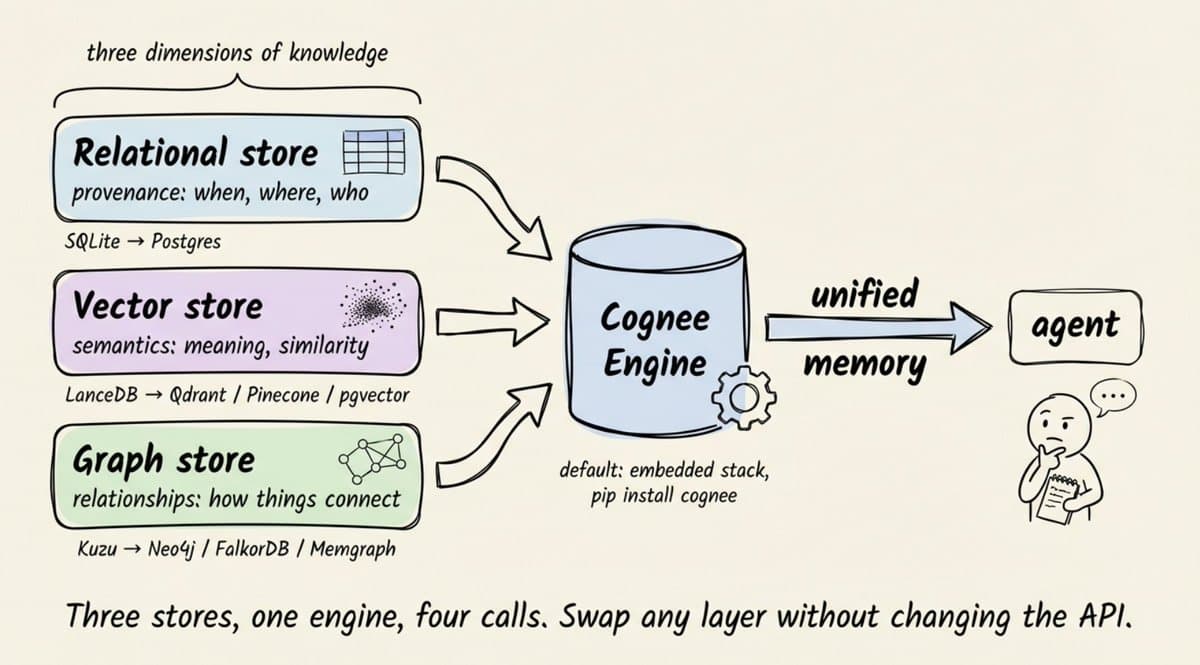
Pachaar argues that robust agent memory requires three distinct storage layers, each capturing a dimension that the others cannot:
- Vector Store for Semantics: Understands what content means and finds semantically similar items. It answers "what is this about?"
- Graph Store for Relationships: Maps how entities connect across multiple hops. It answers "how is X related to Y?"
- Relational Store for Provenance: Tracks where data came from, when, and who has access. It answers "what is the source and context of this fact?"
The proposed workflow leverages all three: an agent enters through the vector store to find semantically relevant content, traverses the graph to follow edges to connected entities, and uses the relational store to ground every result back to its source for trust and auditability.
What Cognee Provides
Cognee is an open-source Python framework that operationalizes this three-store architecture. Its primary value is abstraction: it provides a unified interface—reportedly just four async calls—over the underlying complexity of managing three different database technologies.
Key Technical Details:
- Default Embedded Stack: For local development and prototyping,
pip install cogneegets you a fully embedded system using SQLite (relational), LanceDB (vector), and Kuzu (graph). There are no external dependencies. - Production-Swappable: Each layer is pluggable. For production deployments, you can swap in more robust systems like Postgres (relational), Qdrant or Pinecone (vector), and Neo4j or Tigergraph (graph) without changing your agent's application code.
- Open Source: The project is available on GitHub under the MIT license.
The framework aims to let developers focus on agent logic rather than data infrastructure, making sophisticated, memory-aware agents significantly easier to build.
gentic.news Analysis
Pachaar's critique of vector-only memory hits on a well-known but often overlooked limitation in today's agent architectures. While frameworks like LangChain and LlamaIndex have popularized RAG (Retrieval-Augmented Generation), they often treat the "retrieval" component as a monolithic vector search. Cognee's tripartite model is a direct response to the growing pains of agents moving from demos to production, where questions are complex and audit trails are mandatory.
This development aligns with a broader industry trend toward hybrid retrieval systems. We've seen similar concepts in research, like the Self-RAG framework, which critiques naive retrieval, and in proprietary systems like Microsoft's GraphRAG, which uses LLMs to build knowledge graphs from unstructured data for deeper reasoning. Cognee differentiates itself by being an open-source, developer-first framework that bundles these concepts into a single, swappable package. It's less about a novel research breakthrough and more about pragmatic, accessible engineering.
For practitioners, the takeaway is clear: if your agents need to answer questions involving chains of relationships (e.g., "Which team should be paged for this service outage?"), a vector database alone is insufficient. Cognee provides a viable path forward. The major question for adoption will be performance and complexity: managing three synchronized data stores introduces overhead. The promise of Cognee is that it abstracts this complexity away, but its success will depend on the robustness of that abstraction under real-world load.
Frequently Asked Questions
What is the main problem Cognee solves?
Cognee solves the multi-hop reasoning failure in AI agents. When an agent's memory is just a vector database, it can find facts related to individual keywords but cannot connect facts across multiple steps (e.g., connecting a person to a project to a system failure). Cognee combines graph databases to trace these relationships, vector databases for semantic understanding, and relational databases for tracking data sources.
How does Cognee compare to LangChain or LlamaIndex?
LangChain and LlamaIndex are broader frameworks for building LLM applications that include tools for retrieval (among many other things). Cognee is a more focused library specifically for the memory and retrieval layer. It can be used within agents built with those frameworks. Think of LangChain as the toolbox and Cognee as a specialized, advanced wrench for the memory problem.
Is Cognee ready for production use?
Cognee is a new open-source project. Its default embedded stack (SQLite, LanceDB, Kuzu) is ideal for prototyping and local development. For production, the framework allows you to swap in enterprise-grade databases (Postgres, Qdrant, Neo4j), but the stability and performance of the Cognee abstraction layer itself at scale will need to be validated by the community as adoption grows.
Do I need to manage three databases separately if I use Cognee?
No, that's the core value proposition. Cognee provides a unified API (four main async calls, according to the author) to interact with the memory system. You configure which specific database technology to use for each layer (vector, graph, relational), and Cognee handles the underlying operations. You manage the connection to your chosen databases, but not the complex logic of coordinating queries across them.