Nvidia announced a new Windows SoC, per analyst @mweinbach. The chip targets on-device AI inference for the next generation of Windows PCs.
Key facts
- Nvidia announced a new Windows SoC for AI PCs.
- Chip targets on-device AI inference for Copilot+ PCs.
- No specs, pricing, or release date disclosed.
- Competes with Qualcomm Snapdragon X Elite and Intel Lunar Lake.
- AI PC market projected at 200M units by 2028.
Nvidia has announced a new Windows System-on-Chip (SoC), according to a tweet from analyst @mweinbach. The chip is designed to power the next generation of Windows PCs with on-device AI capabilities, a move that positions Nvidia to compete directly with Qualcomm's Snapdragon X Elite and Intel's Lunar Lake in the burgeoning AI PC market.
The announcement comes as Microsoft pushes its Copilot+ PC initiative, which requires a neural processing unit (NPU) capable of at least 40 TOPS for on-device AI workloads. Nvidia's SoC likely integrates a CPU, GPU, and a dedicated NPU, leveraging the company's expertise in AI accelerators from its data-center GPUs.
What's missing
Nvidia did not disclose the SoC's specifications, manufacturing process, or a release window. The tweet from @mweinbach provides no further details, and Nvidia has not issued a press release. This lack of information makes it difficult to assess how the SoC will compete on performance-per-watt against Qualcomm's Arm-based chips or Intel's x86 offerings.
The unique take
This is not Nvidia's first foray into Windows SoCs. The company previously shipped the Tegra 4 and Tegra K1 for Windows RT tablets, which failed commercially. The key difference today is the AI angle: Nvidia can leverage its CUDA ecosystem and TensorRT software stack to offer developers a familiar path for deploying models on Windows, potentially leapfrogging Qualcomm's AI Engine which lacks equivalent software maturity.
Market context
Nvidia's entry comes at a time when the AI PC market is projected to grow from 50 million units in 2025 to over 200 million by 2028, according to IDC. Qualcomm's Snapdragon X Elite, announced in 2024, has secured design wins with Dell, HP, and Lenovo. Intel's Lunar Lake, shipping in late 2024, integrates an NPU with up to 45 TOPS. Nvidia's SoC will need to match or exceed these metrics to be competitive.
The chip also signals Nvidia's broader strategy to extend its AI dominance beyond data centers into edge devices. If successful, it could disrupt the PC supply chain, which has long relied on Intel and AMD for CPUs and on discrete GPUs from Nvidia for gaming. An integrated Nvidia SoC could simplify designs for OEMs.
What to watch
Watch for Nvidia's GTC 2025 conference in March, where the company typically unveils new consumer hardware. If the SoC is announced there, expect details on TOPS performance, power consumption, and OEM partnerships. Also monitor Qualcomm's response—the company may accelerate its Snapdragon X Elite roadmap or cut pricing to defend its early lead.
Key Takeaways
- Nvidia announced a Windows SoC for AI PCs, per @mweinbach.
- Chip targets on-device inference, competing with Qualcomm and Intel.
What to watch
Watch Nvidia's GTC 2025 in March for detailed specs and OEM design wins. Qualcomm may accelerate Snapdragon X Elite pricing or roadmap to counter Nvidia's entry. Also monitor Microsoft's Copilot+ PC requirements—any change in TOPS threshold could shift the competitive landscape.
[Updated 01 Jun via serve_the_home]
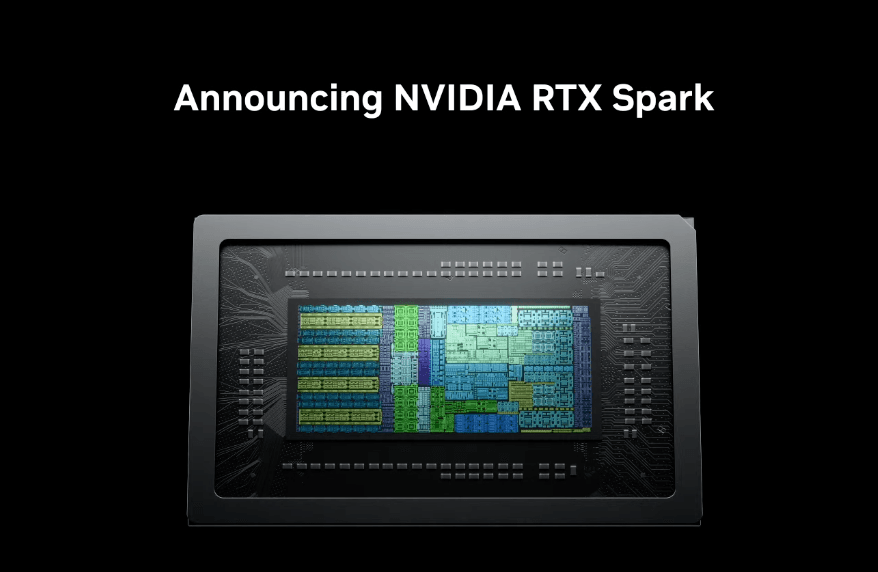
ServeTheHome reports that Nvidia introduced the RTX Spark at Computex, a 20-core Arm-based SoC combining a Grace CPU with a Blackwell GPU on a single package. This is the first naming and architectural detail for the Windows SoC, confirming an Arm design rather than x86. [per ServeTheHome]