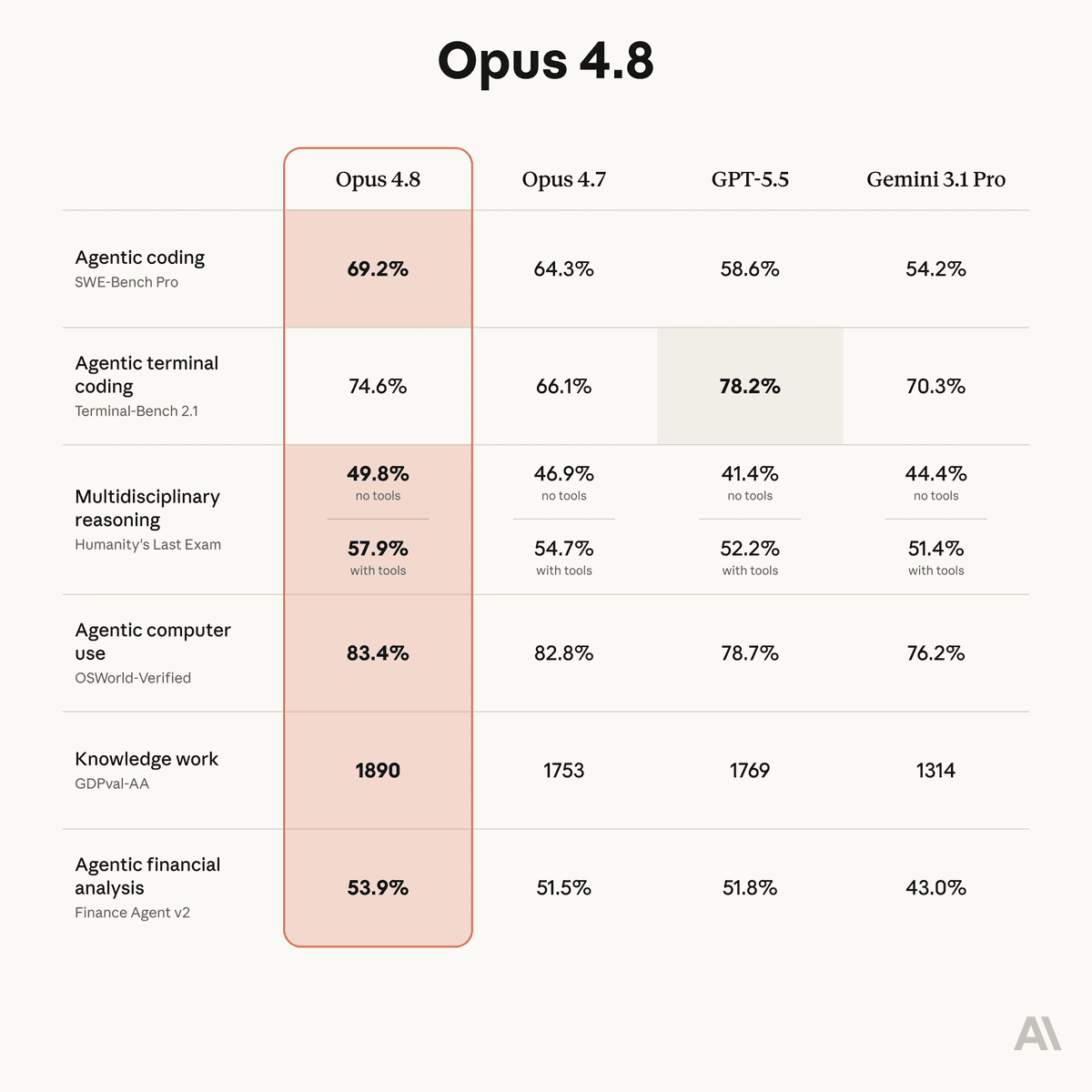
Anthropic released Claude Opus 4.8 with a fast mode that is 2.5x faster and 3x cheaper than the prior version. The update also introduces a new 'dynamic workflows' feature, though Anthropic has not detailed its functionality.
Key facts
- 2.5x faster fast mode vs prior Opus version
- 3x cheaper fast mode pricing
- New dynamic workflows feature introduced
- Competes with GPT-4 Turbo fast tier pricing
- Undisclosed baseline for price reduction
Anthropic released Claude Opus 4.8, the latest iteration of its flagship large language model, on an unspecified date in early 2026 [According to @rohanpaul_ai]. The headline improvement is a revamped fast mode that delivers 2.5x faster inference and costs 3x less than the previous fast mode pricing.
The price cut on fast mode directly undercuts OpenAI's GPT-4 Turbo, which charges $10 per million input tokens for its fast inference tier. Anthropic did not disclose the specific per-token pricing for Opus 4.8's fast mode, but the 3x reduction from an undisclosed baseline suggests aggressive pricing to capture latency-sensitive workloads.
Dynamic workflows
The update also introduces a 'dynamic workflows' feature. Anthropic has not published technical documentation or API parameters for this capability, leaving developers to speculate. The feature likely enables multi-step agentic chains that adapt based on intermediate outputs, a capability that rivals Google's Gemini 2.0's 'adaptive execution' mode announced in December 2025.
The unique take here is that Anthropic is treating fast mode as a product tier rather than a technical optimization. By decoupling speed from the base model's capabilities, Anthropic can compete on price without commoditizing its premium Opus brand. This mirrors the strategy of cloud providers that sell 'burst' compute at a discount.
Anthropic did not disclose whether the speed and price improvements apply to the base model or only to the fast mode variant. The company's blog post — if one exists — was not linked in the source tweet, and Anthropic's public relations team has not commented.
What this means for developers
For developers running production pipelines, the 2.5x speed improvement in fast mode translates to lower latency for real-time applications like customer support chat or code generation. The 3x price reduction makes Opus 4.8 competitive with Anthropic's own Claude 3.5 Sonnet on cost, while retaining Opus-grade reasoning capability.
The dynamic workflows feature suggests Anthropic is targeting enterprise automation pipelines, where multi-step reasoning with conditional branching is common. However, without API documentation, developers cannot yet evaluate whether this matches the flexibility of LangChain or Microsoft's AutoGen frameworks.
What to watch
Watch for Anthropic to publish API documentation for the dynamic workflows feature, likely within two weeks. Also monitor pricing updates on Anthropic's pricing page — the 3x cheaper claim needs a baseline to be actionable. Competitor responses from OpenAI (GPT-4.5 pricing) and Google (Gemini 2.0 fast tier) are expected within 30 days.