What IBM's Survey Covers
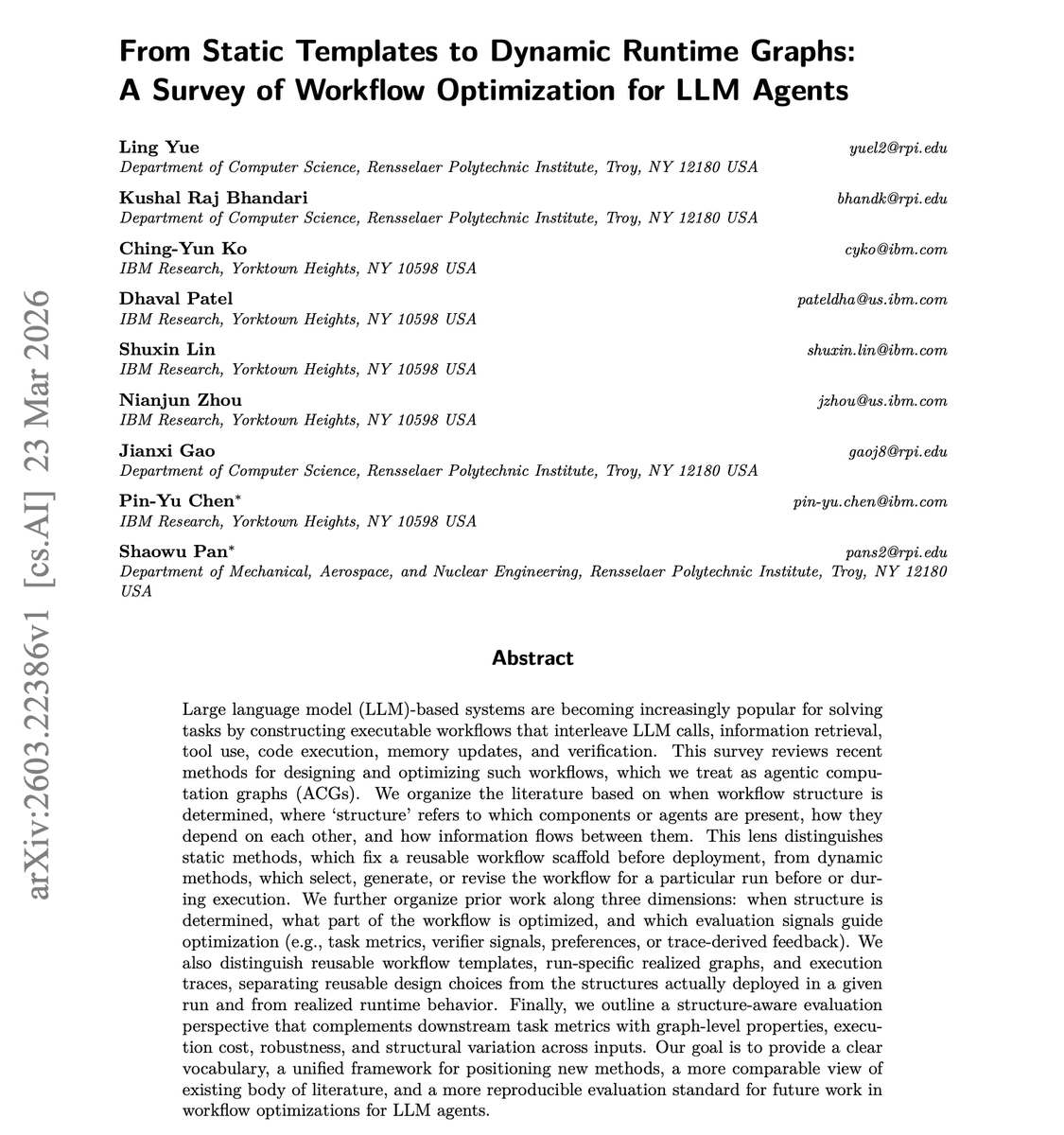
Researchers from IBM have published a comprehensive survey paper titled "Workflow Optimization for LLM Agents" that maps the landscape of how large language model (LLM) agents are structured and optimized. The paper addresses a critical gap in current AI agent development: most teams either hardcode their agent workflows or let them be fully dynamic with no principled middle ground between these extremes.
The survey argues that how agent workflows are "wired together"—interleaving model calls, retrieval, tool use, code execution, memory updates, and verification—matters more than most development teams realize. The researchers provide a unified vocabulary and framework for deciding where a system should sit on the static-to-dynamic spectrum.
Three-Dimensional Framework for Categorization
The survey categorizes optimization approaches along three primary dimensions:
When structure is determined: This spans from static templates (pre-defined at design time) to dynamic runtime graphs (constructed during execution). Most current implementations fall at one extreme or the other.
Which components get optimized: Different approaches focus on optimizing different parts of the workflow, including the LLM itself, the tools it uses, the retrieval mechanisms, or the overall workflow structure.
What signals guide the optimization: The paper identifies four primary signal types:
- Task metrics (success rate, accuracy)
- Verifier feedback (external validation)
- Preferences (human or learned)
- Trace-derived insights (from execution histories)
Proposed Evaluation Framework
The researchers propose moving beyond simple task completion metrics to what they call "structure-aware evaluation." This incorporates:
- Graph properties: Complexity, modularity, and other structural characteristics of the workflow
- Execution cost: Computational and financial costs of running the workflow
- Robustness: How well the workflow handles edge cases and errors
- Structural variation: How much the workflow adapts to different inputs
This approach recognizes that two workflows might achieve similar task completion rates but differ significantly in efficiency, cost, and reliability.
The Current State of Agent Development
According to the survey, most development teams currently take one of two suboptimal approaches:
- Hardcoded workflows: Pre-defined sequences of operations that lack flexibility
- Fully dynamic workflows: Completely unstructured approaches with no optimization principles
The paper argues that neither extreme is optimal for most real-world applications. Hardcoded workflows fail to adapt to novel situations, while fully dynamic workflows can be inefficient, unreliable, and difficult to debug.
Practical Implications for Developers
The survey provides practical guidance for teams building LLM agents:
- Assessment framework: A way to analyze existing workflows along the three dimensions
- Design principles: Guidance on when to use static vs. dynamic elements
- Optimization strategies: Methods for improving workflows based on different signal types
- Evaluation metrics: Beyond task completion to include structural and efficiency considerations
The paper serves as both a survey of existing approaches and a proposal for more systematic development practices in the rapidly evolving field of AI agents.
gentic.news Analysis
This IBM research arrives at a critical juncture in AI agent development. Over the past year, we've seen a proliferation of agent frameworks—from LangChain's structured approach to AutoGPT's more dynamic methodology—without clear consensus on optimal design patterns. This fragmentation mirrors what we observed in our coverage of the "AI Agent Wars" last November, where multiple companies were competing to establish dominant paradigms.
The survey's emphasis on finding a "principled middle ground" between static and dynamic approaches aligns with emerging industry trends. Just last month, our analysis of Anthropic's Claude 3.5 Sonnet highlighted how even leading model providers are struggling with workflow optimization challenges. The fact that IBM—a company with deep enterprise integration experience—is focusing on this problem suggests recognition that current agent implementations aren't yet production-ready for complex business workflows.
Interestingly, this research direction contrasts with some of the more speculative agent work we've covered. While many startups are chasing fully autonomous agents, IBM's framework suggests that carefully constrained, partially dynamic systems may deliver more reliable results. This pragmatic approach reflects IBM's historical strength in enterprise systems integration rather than the more experimental approaches seen in pure AI research labs.
The proposed structure-aware evaluation framework could become particularly valuable as agent systems move from demos to production. Our reporting on deployment challenges at companies like Microsoft and Google has consistently highlighted that efficiency and robustness matter as much as raw capability for enterprise adoption.
Frequently Asked Questions
What are LLM agent workflows?
LLM agent workflows are sequences of operations that combine language model calls with other capabilities like retrieval from databases, tool use (calculators, APIs), code execution, memory updates, and verification steps. These workflows enable AI systems to perform complex tasks beyond simple question-answering, such as data analysis, multi-step problem solving, and interacting with external systems.
How does IBM's framework differ from existing agent frameworks?
Most existing frameworks like LangChain or LlamaIndex focus on providing building blocks for creating agents. IBM's survey provides a higher-level framework for analyzing and optimizing how those building blocks are connected. It offers a systematic way to evaluate trade-offs between static and dynamic approaches, and proposes metrics that go beyond simple task completion to include structural properties, cost, and robustness.
Why is workflow optimization important for LLM agents?
Poorly optimized workflows can lead to several problems: excessive API costs from unnecessary LLM calls, slow response times, unreliable performance on edge cases, and difficulty debugging when things go wrong. As agents move from research demos to production systems, these practical considerations become critical. The right workflow design can mean the difference between a useful tool and an impractical novelty.
What types of signals can guide workflow optimization?
According to the IBM survey, four main signal types can guide optimization: task metrics (like success rate or accuracy), verifier feedback (external validation of outputs), preferences (human ratings or learned preferences), and trace-derived insights (patterns discovered from execution histories). Different optimization approaches may use different combinations of these signals depending on the application requirements and available data.