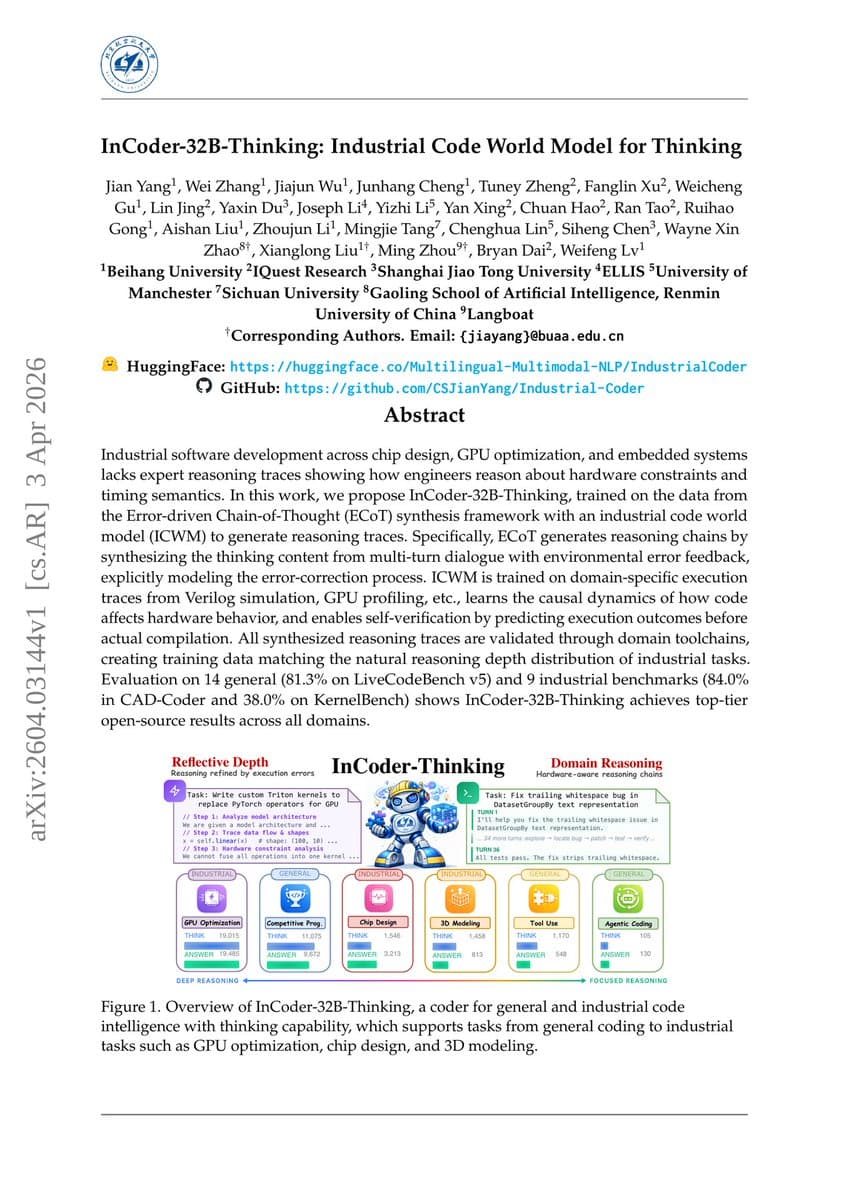
A new code generation model, InCoder-32B-Thinking, has been announced, positioning itself as the first 32-billion-parameter "thinking-augmented" model trained on an "Industrial Code World Model." Its distinctive training data—execution traces from hardware-centric domains like chip design, GPU kernels, and embedded systems—sets it apart from general-purpose code models. Initial benchmarks show it achieving 81.3% on LiveCodeBench V5 and an 84% compile pass rate on the CAD-Coder benchmark.
What's New: Targeting the Hardware Stack

InCoder-32B-Thinking is not another model fine-tuned on GitHub. Its core innovation is its training dataset, which includes execution traces from low-level, performance-critical domains:
- Chip Design: Code and traces related to hardware description languages (HDLs) and electronic design automation (EDA).
- GPU Kernels: Optimization traces from CUDA, OpenCL, or other parallel computing frameworks.
- Embedded Systems: Execution data from resource-constrained environments typical in IoT, automotive, and industrial control.
The "Thinking-Augmented" label suggests the model incorporates chain-of-thought or similar reasoning techniques during code generation, likely to handle the complex, multi-step logic required in systems programming.
Key Results: Strong Performance on Specialized Benchmarks
The reported benchmarks indicate strong capability in its target domain:
LiveCodeBench V5 81.3% General code generation & reasoning on evolving, realistic problems. CAD-Coder 84% Compile Pass Rate Specialized benchmark for hardware description and chip design code.An 81.3% score on LiveCodeBench V5 is highly competitive. For context, leading general code models like DeepSeek-Coder-V2-Lite (16B) score around 83-85% on LiveCodeBench. For a 32B model specialized on hardware traces to approach this performance suggests effective domain adaptation.
The 84% compile pass rate on CAD-Coder is the more telling metric. It demonstrates practical utility in generating syntactically correct and likely functionally valid code for a niche, high-complexity field where general models often struggle.
How It Works: The "Industrial Code World Model"
While architectural details are not fully disclosed in the announcement, the methodology can be inferred:
- Data Curation: Collecting not just source code, but execution traces (runtime states, memory patterns, I/O sequences) from industrial hardware/software projects.
- Training Objective: The model is likely trained to predict both the next token in code and aspects of its execution behavior, creating an internal "world model" of how code operates on hardware.
- Reasoning Integration: As a "thinking-augmented" model, it probably uses speculative decoding, chain-of-thought prompting, or an internal deliberation mechanism to plan complex code structures before generation.
This approach aims to move beyond statistical pattern matching of text to modeling the cause-and-effect relationships in system behavior.
Why It Matters: Bridging the AI and Hardware Gap

The development is significant for two reasons:
1. Domain Specialization at Scale: It proves that large language models can be effectively specialized for deeply technical, non-web-scale domains. The performance on CAD-Coder suggests this model could become a practical assistant for hardware engineers and systems programmers, reducing time spent on boilerplate and verification.
2. A New Training Paradigm: Using execution traces as training data is a growing research area (see: Execution-Based Code Generation). InCoder-32B-Thinking is one of the largest-scale applications of this idea for industrial code. If successful, it could push the industry beyond static code repositories toward dynamic, behavior-aware training datasets.
gentic.news Analysis
This release is a direct shot across the bow of generalist code models like GitHub Copilot, CodeLlama, and DeepSeek-Coder in the high-value systems programming niche. It follows a clear trend we've tracked: the fragmentation of the "one model for all code" paradigm into vertical-specific code models. Earlier this year, we covered AlphaCodium and its focus on iterative test-based code generation, which highlighted the limitations of single-pass generation for complex problems. InCoder-32B-Thinking takes vertical specialization further by baking domain-specific data (execution traces) directly into pre-training.
The mention of an "Industrial Code World Model" aligns with, but materially advances, research from entities like Google's AlphaCode and OpenAI's earlier forays into code execution environments for training. Those efforts focused on competition-level programming or general code. InCoder's focus on chip design and GPU kernels targets a sector with acute talent shortages and immense economic value—semiconductors and high-performance computing. This isn't just an academic exercise; it's a commercial positioning into a lucrative enterprise vertical.
Practitioners should watch this space closely. If the benchmark results hold under independent scrutiny, it validates a powerful recipe: domain-specific data + reasoning augmentation + scale. The next logical steps are integrations with EDA tools like Cadence or Synopsys and kernel profilers like Nsight. The model's success will ultimately be measured not by its LiveCodeBench score, but by its adoption in the design flows of major chip companies.
Frequently Asked Questions
What is InCoder-32B-Thinking?
InCoder-32B-Thinking is a 32-billion-parameter AI model for code generation, specifically trained on execution traces from hardware-focused domains like chip design, GPU programming, and embedded systems. It uses "thinking-augmented" reasoning techniques to generate complex, low-level code.
How does InCoder-32B-Thinking differ from GitHub Copilot?
While Copilot is a generalist model trained primarily on public GitHub repositories, InCoder is a specialist. Its training data includes dynamic execution traces (how code actually runs on hardware) from industrial systems, making it potentially more capable for generating correct, efficient code for semiconductors, parallel computing, and embedded devices.
What does an 81.3% score on LiveCodeBench mean?
LiveCodeBench is a rigorous, continuously updated benchmark for evaluating code generation models on realistic, diverse problems. An 81.3% score places InCoder-32B-Thinking in the top tier of code models, competitive with much larger general-purpose models, despite its specialized training focus.
What is the CAD-Coder benchmark?
CAD-Coder is a specialized benchmark for evaluating code generation in the context of computer-aided design (CAD) and hardware description languages (like Verilog or VHDL). InCoder's 84% compile pass rate on this benchmark indicates a high success rate in generating syntactically valid code for chip design tasks, a domain where general AI coding assistants typically perform poorly.