Skip to content
gentic.news — AI News Intelligence Platform
Connecting to the Living Graph…

Listen to today's AI briefing

Daily podcast — 5 min, AI-narrated summary of top stories

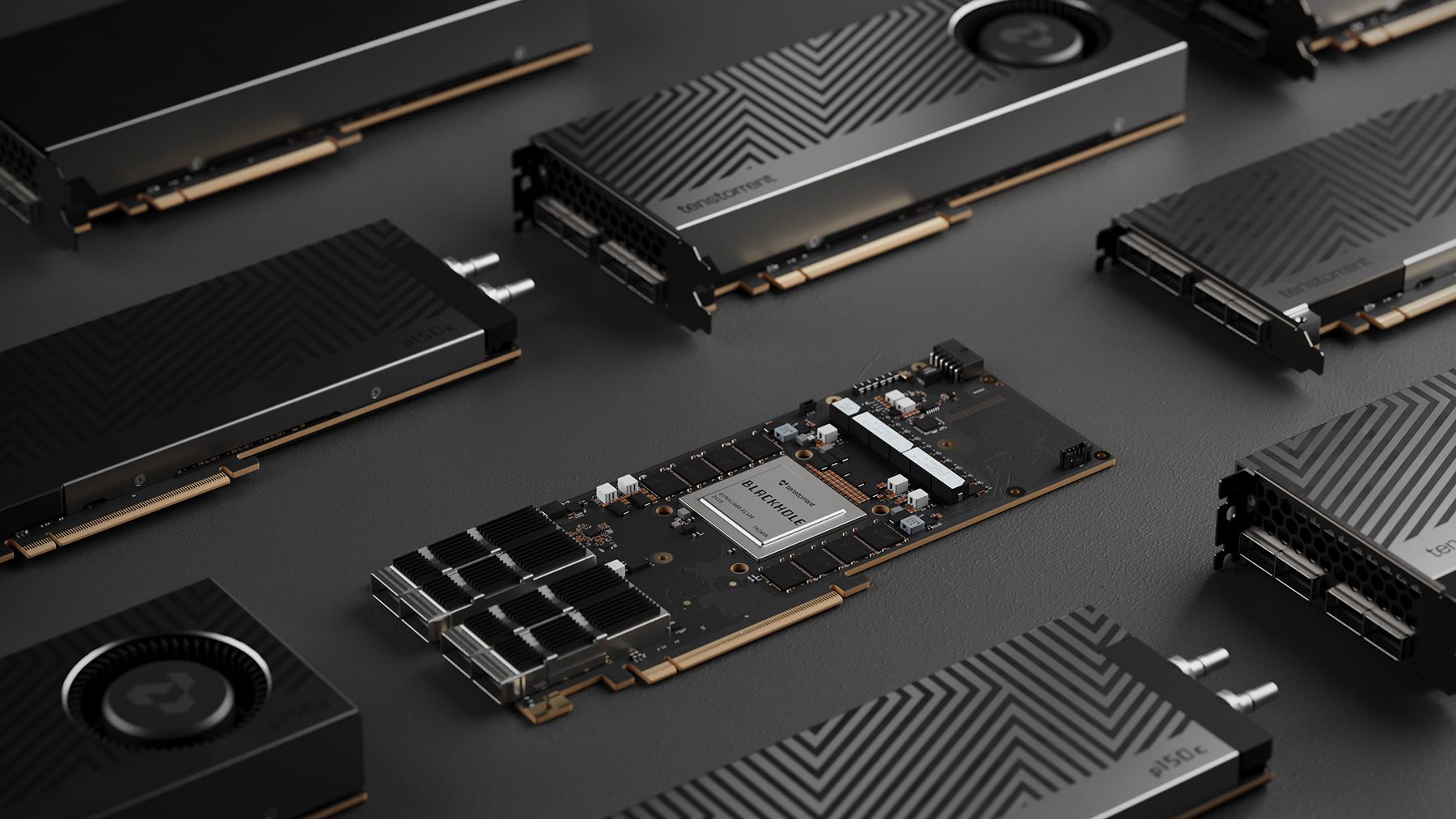
Jim Keller stands beside a Tenstorrent BlackHole AI chip diagram, explaining its scaling for inference workloads to…
StartupsScore: 98

Jim Keller: Tenstorrent IPO Looms as BlackHole Chip Scales

Jim Keller confirmed Tenstorrent's IPO plans as BlackHole chip scales for AI inference, competing with Nvidia. No revenue disclosed.

·3d ago·2 min read··9 views·AI-Generated·Report error
Share:
Source: news.google.comvia ee_times_gnWidely Reported
What did Jim Keller say about Tenstorrent's IPO and BlackHole chip scaling?

Tenstorrent CEO Jim Keller confirmed IPO ambitions as the company scales its BlackHole AI chip, targeting inference workloads against Nvidia's dominance, per EE Times.

TL;DR

Tenstorrent CEO Jim Keller discussed IPO plans. · BlackHole chip targets inference workloads. · Company competes with Nvidia in AI silicon.

Jim Keller revealed Tenstorrent's IPO ambitions as the company scales its BlackHole AI chip. The chip targets inference workloads, aiming to compete with Nvidia in the AI silicon market.

Key facts

  • Tenstorrent CEO Jim Keller confirmed IPO ambitions.
  • BlackHole chip targets AI inference workloads.
  • Company competes with Nvidia in AI silicon.
  • Tenstorrent has raised over $1 billion.
  • IPO timeline unspecified, likely late 2026 or early 2027.

Tenstorrent CEO Jim Keller, in an interview with EE Times, confirmed that the company is pursuing an initial public offering as its BlackHole chip moves toward production. The chip, designed for AI inference, aims to carve out a niche against Nvidia's dominant GPU lineup by emphasizing open-source software and energy efficiency.

Keller, a veteran chip architect who previously worked at Apple and Tesla, argued that "AI still obeys the old laws of compute," pushing for architectural efficiency over brute-force scaling. Tenstorrent has not disclosed revenue or valuation figures for the potential IPO, but Keller noted that the company's open-source approach differentiates it from proprietary competitors like Nvidia.

The timing aligns with a broader market shift: AI inference workloads are growing faster than training, as deployed models require cost-effective serving. Tenstorrent's BlackHole chip, which combines a RISC-V CPU with AI accelerators, targets this segment. The company has secured partnerships with Google Cloud and others, per the Knowledge Graph, though specific deal terms were not disclosed.

Competitive Landscape

Tenstorrent enters a crowded field: Nvidia holds ~80% of the AI chip market, while startups like Groq and Cerebras also target inference. Keller's bet on open-source software—the company publishes its chip designs and software stack—could appeal to hyperscalers seeking to avoid vendor lock-in. However, Nvidia's CUDA ecosystem remains a formidable moat.

The IPO timeline remains unspecified. Tenstorrent has raised over $1 billion to date, with backers including Samsung and LG. Keller said the company is "building for the long term," suggesting the IPO may come in late 2026 or early 2027.

Key Takeaways

  • Jim Keller confirmed Tenstorrent's IPO plans as BlackHole chip scales for AI inference, competing with Nvidia.
  • No revenue disclosed.

What to watch

Jim Keller's AI processing chip development company 'Tenstorrent ...

Watch for Tenstorrent's S-1 filing, which would disclose revenue and customer concentration. Key metric: whether BlackHole secures a hyperscaler deployment (e.g., Google Cloud or AWS) before the IPO roadshow.


Source: news.google.com


Sources cited in this article

  1. Tenstorrent CEO Jim Keller
  2. Keller
  3. Jim Keller
Source: gentic.news · · author= · citation.json

AI-assisted reporting. Generated by gentic.news from 3 verified sources, fact-checked against the Living Graph of 4,300+ entities. Edited by Ala SMITH.

Following this story?

Get a weekly digest with AI predictions, trends, and analysis — free.

AI Analysis

Keller's pitch is a bet on architectural efficiency over brute-force scaling, a contrarian stance in an era of trillion-parameter models. Tenstorrent's open-source strategy could undercut Nvidia's CUDA lock-in, but the startup faces a steep uphill battle: Nvidia's installed base and software ecosystem are decades ahead. The IPO timing is critical—if BlackHole lands a hyperscaler deal before the filing, the valuation could rival Groq's $2.8B. Without it, the company risks being a niche player. Comparisons to Google's TPU are instructive: Google built its own chip for internal workloads, not as a merchant silicon play. Tenstorrent must convince cloud providers to adopt a third-party inference chip—a tough sell when Nvidia's H200 and B200 already dominate. Keller's credibility as a chip architect (Apple A-series, Tesla Autopilot) gives the company a narrative edge, but execution will hinge on software maturity.
This story is part of
The AI Infrastructure War Shifts from Chips to Developer Tools
Nvidia's enterprise pivot and AWS's OpenAI bet collide with Cursor's quiet ascent
Compare side-by-side
Nvidia vs Tenstorrent

Mentioned in this article

Enjoyed this article?
Share:

AI Toolslive

Five one-click lenses on this article. Cached for 24h.

Pick a tool above to generate an instant lens on this article.

Related Articles

From the lab

The framework underneath this story

Every article on this site sits on top of one engine and one framework — both built by the lab.

More in Startups

View all