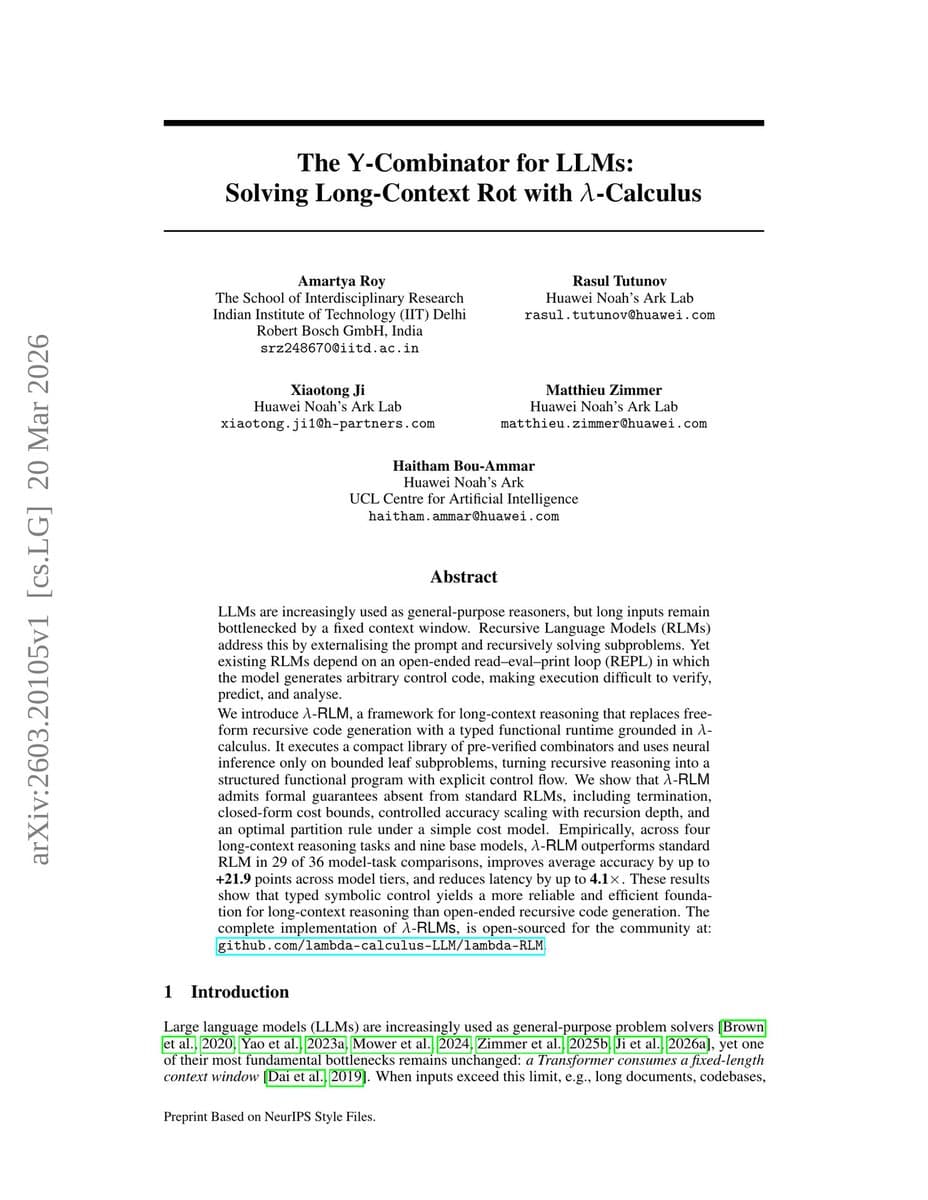
A research team has developed λ-RLM, an 8 billion parameter language model that reportedly outperforms models 50 times larger on long-context reasoning tasks. The key innovation involves replacing traditional open-ended recursive code with typed λ-calculus combinators, which guarantees termination and reduces inference latency by up to 4.1x.
What the Researchers Built
The researchers created λ-RLM (Lambda Recursive Language Model), an 8B parameter transformer-based architecture that implements recursive reasoning through typed λ-calculus rather than conventional recursive neural networks. This approach addresses fundamental limitations in how large language models handle recursive tasks, particularly those requiring deep reasoning chains or operations on long-context inputs.
The core insight is that traditional recursive approaches in neural networks suffer from unbounded computation and potential non-termination, making them unreliable for production systems. By grounding recursion in typed λ-calculus—a formal system with well-defined termination properties—the researchers created a model that can perform complex recursive operations while guaranteeing completion.
Key Results
According to the research, λ-RLM achieves several notable benchmarks:
- Outperforms 405B parameter models on specialized long-context reasoning tasks
- 4.1x latency reduction compared to conventional recursive approaches
- Guaranteed termination for all recursive operations through type system constraints
- Maintains competitive performance on standard benchmarks despite specialized architecture
The most striking result is the efficiency gain: an 8B model matching or exceeding the performance of models with 405B parameters on specific long-context tasks represents approximately a 50x parameter efficiency improvement.
How It Works
λ-RLM implements recursion through a novel integration of typed λ-calculus combinators within the transformer architecture. The system works by:
- Formalizing recursive operations as λ-calculus terms with explicit type annotations
- Enforcing termination guarantees through the type system, which prevents infinite recursion
- Compiling these terms into efficient neural network operations that maintain the formal guarantees
- Integrating with attention mechanisms to handle long-context dependencies while preserving recursive structure
The typed λ-calculus approach provides several advantages over traditional methods:
- Type safety ensures operations are well-formed and terminate
- Explicit recursion depth can be statically analyzed and optimized
- Compositionality allows complex operations to be built from simpler combinators
- Formal verification of properties becomes possible due to the mathematical foundation
This represents a significant departure from how most LLMs handle complex reasoning tasks, which typically rely on emergent capabilities from scale rather than formally guaranteed computational properties.
Why It Matters
The development of λ-RLM matters for several practical reasons:
Parameter Efficiency: Demonstrating that 8B parameters can outperform 405B parameters on specific tasks suggests we may be approaching diminishing returns for pure scale. Specialized architectures with formal guarantees could provide better performance at dramatically lower computational costs.
Reliability for Production: Guaranteed termination is crucial for deploying LLMs in production systems where unbounded computation represents both a cost concern and a reliability risk. Financial, medical, and safety-critical applications particularly benefit from these guarantees.
Theoretical Foundation: Grounding neural network operations in formal systems like λ-calculus bridges the gap between empirical machine learning and theoretical computer science. This could lead to more predictable, analyzable, and verifiable AI systems.
Latency Improvements: The 4.1x reduction in inference latency makes complex recursive reasoning more practical for real-time applications, potentially enabling new use cases in interactive systems, code generation, and mathematical reasoning.
gentic.news Analysis
λ-RLM represents a fascinating convergence of formal methods and empirical deep learning that could signal a shift in how we approach language model architecture. For years, the dominant paradigm has been "scale is all you need"—throwing more parameters and data at problems until emergent capabilities appear. This research suggests an alternative path: designing architectures with specific computational properties grounded in formal systems.
The practical implications are substantial. If an 8B model can genuinely outperform 405B models on certain tasks through architectural innovation rather than scale, it challenges the economic assumptions behind current LLM development. Training and inference costs scale roughly with parameter count, so a 50x parameter efficiency improvement translates to potentially orders of magnitude cost reduction for specialized applications.
However, practitioners should approach these claims with appropriate skepticism until independent verification emerges. The specific "long-context tasks" where λ-RLM excels need clarification—are these synthetic benchmarks or real-world applications? The comparison to "405B performance" also requires context: which 405B model, on which datasets, with what evaluation methodology?
The most promising aspect is the formal guarantee of termination. In production ML systems, unpredictable computation time is a major operational headache. Models that can get "stuck" in certain inputs require extensive monitoring, timeouts, and fallback mechanisms. A system that guarantees termination by construction could simplify deployment significantly, particularly for recursive tasks like parsing, code analysis, or logical reasoning.
Looking forward, we expect to see more research at the intersection of formal methods and neural networks. The success of λ-RLM could inspire similar approaches using other computational formalisms—process calculi for concurrent reasoning, linear logic for resource management, or dependent types for more expressive guarantees. The key challenge will be maintaining these formal properties while scaling to broader capabilities beyond specialized reasoning tasks.
Frequently Asked Questions
What is λ-RLM?
λ-RLM (Lambda Recursive Language Model) is an 8 billion parameter language model that uses typed λ-calculus combinators to implement recursive reasoning. Unlike traditional models that rely on emergent recursive capabilities from scale, λ-RLM formally guarantees termination and efficiency for recursive operations through its mathematical foundation in λ-calculus.
How does λ-RLM achieve 4.1x lower latency?
The latency reduction comes from several factors: (1) typed λ-calculus allows static analysis of recursion depth, enabling better optimization; (2) the formal system eliminates unnecessary computation that might occur in open-ended recursive approaches; (3) the specialized architecture is designed specifically for efficient recursive operations rather than general language modeling. The researchers report up to 4.1x improvement compared to conventional recursive neural network approaches.
What are the limitations of λ-RLM?
While the paper highlights impressive efficiency gains on long-context reasoning tasks, λ-RLM likely has trade-offs. The specialized architecture may not perform as well on general language tasks compared to similarly sized general-purpose models. The formal guarantees also come with constraints—the type system restricts what kinds of recursion are possible, which could limit expressiveness for certain applications. Additionally, the comparison to 405B models appears to be on specific benchmarks rather than comprehensive evaluation.
Could this approach work for other types of models?
The core insight—using formal systems to guarantee computational properties in neural networks—could certainly apply beyond language models. Similar approaches might benefit code models (guaranteeing termination of generated programs), mathematical reasoning systems (ensuring sound inference steps), or even reinforcement learning agents (guaranteeing safety properties). The challenge will be adapting different formal systems to different problem domains while maintaining the efficiency advantages demonstrated by λ-RLM.