What Happened
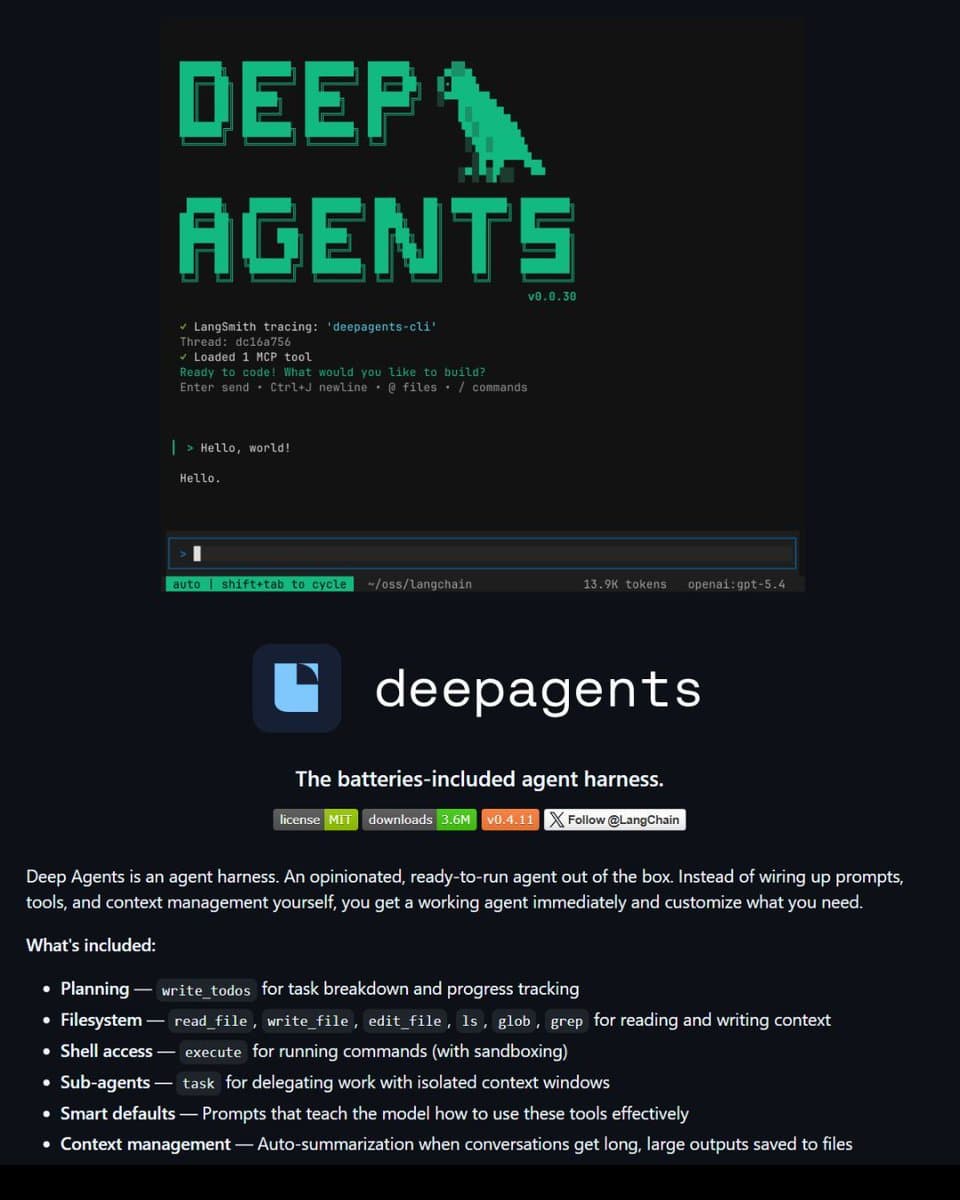
LangChain has open-sourced Deep Agents, a framework designed to replicate the core workflow behind proprietary coding agents like Anthropic's Claude Code. The project is released under the MIT license, making it freely available for inspection, modification, and commercial use.
The framework provides a structured implementation of the components typically found in advanced coding assistants, offering developers a reference architecture they can study and extend.
What's Inside the Framework
According to the repository examination, Deep Agents includes several modular components:
- Planning tools for breaking down complex coding tasks into manageable steps
- File system access capabilities for reading, writing, and editing code files
- Shell command execution with sandboxing for safe code execution
- Sub-agents architecture for handling complex work in parallel
- Auto-summarization functionality to manage context length when working with large codebases
Key Technical Characteristics
Model-Agnostic Design: Unlike proprietary systems tied to specific models, Deep Agents allows developers to plug in different LLMs through LangChain's existing integration system. This enables experimentation with various foundation models while maintaining the same agent architecture.
Open System Architecture: The framework provides full visibility into how coding agents are structured, from task decomposition to execution flow. This contrasts with closed systems like Claude Code where the implementation details remain proprietary.
Reference Implementation Value: For developers trying to understand how advanced coding agents work, Deep Agents serves as a practical reference implementation that demonstrates common patterns in agent-based coding assistance.
Repository Status
The project appears to be in early release stages, with the initial implementation focusing on core workflow recreation rather than performance optimization or extensive benchmarking. As an open-source project, its development trajectory will depend on community contributions and adoption.
Context
This release continues LangChain's pattern of creating open-source abstractions for emerging AI workflows. Previous frameworks from the company have focused on retrieval-augmented generation (RAG), agent orchestration, and tool integration. Deep Agents represents their entry into the coding assistant architecture space, which has been dominated by proprietary systems from Anthropic (Claude Code), GitHub (Copilot), and others.
Open-source alternatives in this space include OpenDevin and Aider, though Deep Agents appears positioned more as a modular framework than a complete end-to-end solution.