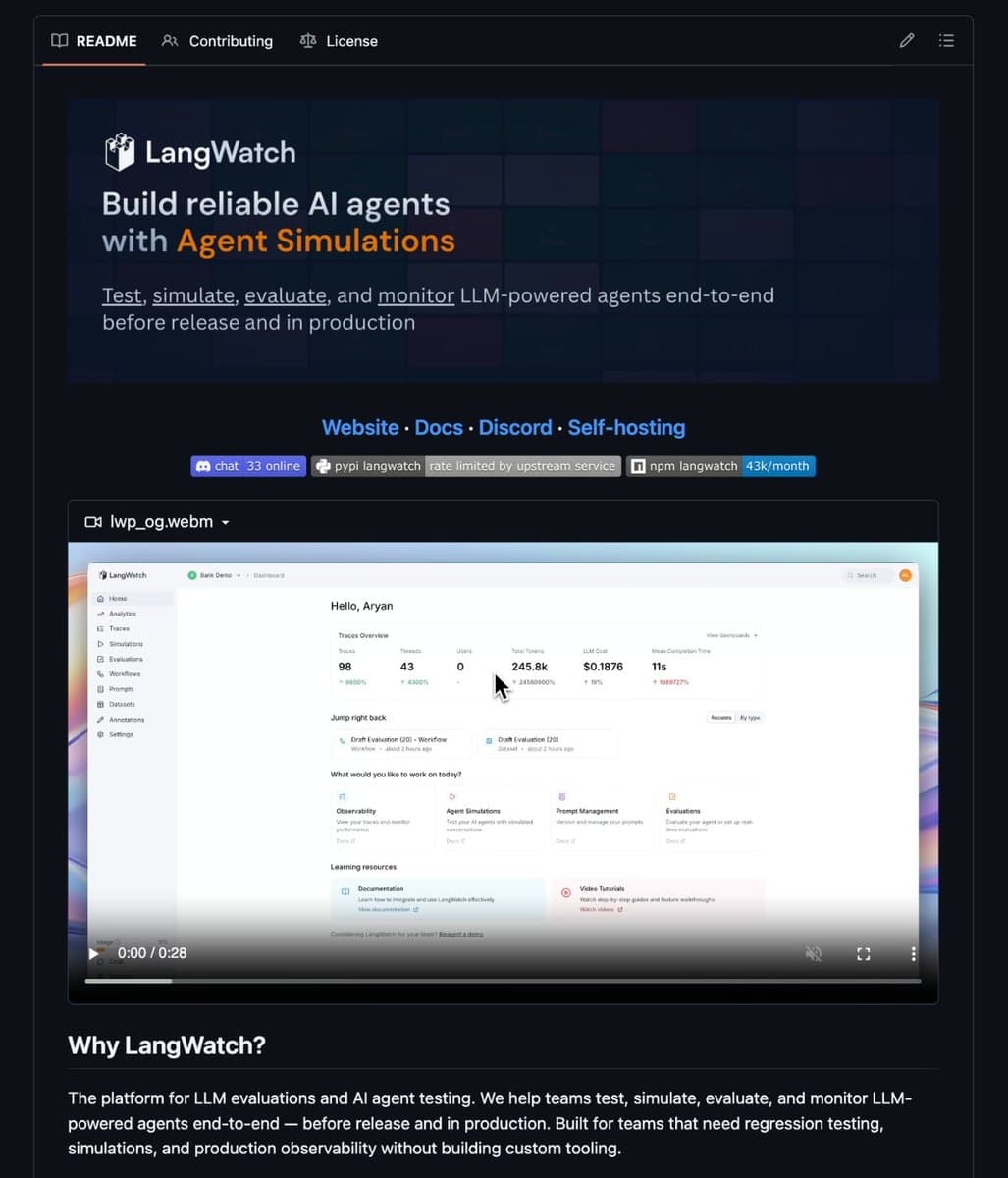
In a significant development for the AI agent ecosystem, an open-source platform called LangWatch has emerged to address what many developers have identified as a critical gap in the current landscape: systematic testing and evaluation of AI agents before they reach users. The platform, which was recently open-sourced, provides what its creators describe as "the missing layer for AI agents"—a comprehensive solution for tracing, evaluating, simulating, and monitoring AI agents throughout their development lifecycle.
The AI Agent Testing Problem
Most teams currently shipping AI agents operate with what amounts to zero regression testing, no systematic simulations, and no closed evaluation loop. This testing gap has become increasingly problematic as AI agents grow more complex and are deployed in production environments where failures can have significant consequences. As noted in the announcement, many teams only discover their agents have broken when users publicly complain about failures on social media platforms.
This testing deficiency stems from several factors: the complexity of agent systems that combine multiple tools, state management, and decision-making processes; the lack of standardized testing frameworks; and the rapid pace of development that often prioritizes feature delivery over robust testing infrastructure.
LangWatch's Comprehensive Solution
LangWatch addresses these challenges through several key components:
End-to-End Agent Simulations: The platform enables developers to run full-stack scenarios that include tools, state management, user simulators, and evaluation judges. This allows teams to pinpoint exactly where their agents break, decision by decision, rather than discovering failures in production.
Closed Evaluation Loop: LangWatch implements a complete trace → dataset → evaluate → optimize prompts → re-test workflow that requires zero glue code and eliminates tool sprawl. This systematic approach ensures that improvements are measurable and reproducible.
Optimization Studio: Developers can iterate on prompts and models with real evaluation data backing every change, moving beyond guesswork to data-driven optimization.
Annotations & Queues: The platform includes functionality for domain experts to label edge cases and catch failures that automated evaluations might miss, combining human expertise with automated testing.
GitHub Integration: Prompt versions live directly in Git repositories and are linked to traces, providing version control and traceability for AI agent development.
Technical Architecture and Compatibility
One of LangWatch's most significant advantages is its framework-agnostic design. The platform is OpenTelemetry-native and works seamlessly with popular AI development frameworks including LangChain, LangGraph, CrewAI, Vercel AI SDK, Mastra, and Google ADK. It's also model-agnostic, supporting OpenAI, Anthropic, Azure, AWS, Groq, and Ollama models.
This compatibility across frameworks and models makes LangWatch particularly valuable in an ecosystem where developers often work with multiple tools and need testing solutions that don't lock them into specific technologies.
Deployment and Enterprise Features
LangWatch can be self-hosted with a single Docker Compose command, lowering the barrier to adoption for teams concerned about data privacy and control. The platform also includes full MCP (Model Context Protocol) support for Claude Desktop and is ISO 27001 certified, addressing enterprise security requirements.
The Open Source Advantage
By being 100% open source, LangWatch enables community contributions, transparency in its development, and avoids vendor lock-in concerns that often accompany proprietary testing solutions. This approach aligns with broader trends in the AI development community toward open, collaborative tooling.
Implications for AI Agent Development
The introduction of LangWatch represents a maturation point for AI agent development. As agents move from experimental projects to production systems serving real users, the need for robust testing and evaluation becomes critical. LangWatch provides the infrastructure necessary for this transition, potentially accelerating the adoption of AI agents in enterprise and consumer applications by increasing reliability and reducing deployment risks.
For development teams, LangWatch offers the possibility of shifting from reactive debugging (responding to user-reported failures) to proactive quality assurance (identifying and fixing issues before deployment). This shift could significantly improve user experiences and reduce the reputational damage that can occur when AI systems fail publicly.
Looking Forward
As AI agents become increasingly sophisticated and integrated into critical workflows, tools like LangWatch will likely become essential components of the development stack. The platform's open-source nature suggests it could evolve rapidly through community contributions, potentially setting new standards for how AI agents are tested and evaluated.
The success of LangWatch will depend on several factors: adoption by development teams, continued maintenance and enhancement by its creators and community, and its ability to keep pace with the rapidly evolving AI agent landscape. However, its comprehensive approach to a widely recognized problem positions it well to become a foundational tool in AI agent development.
Source: @hasantoxr on X