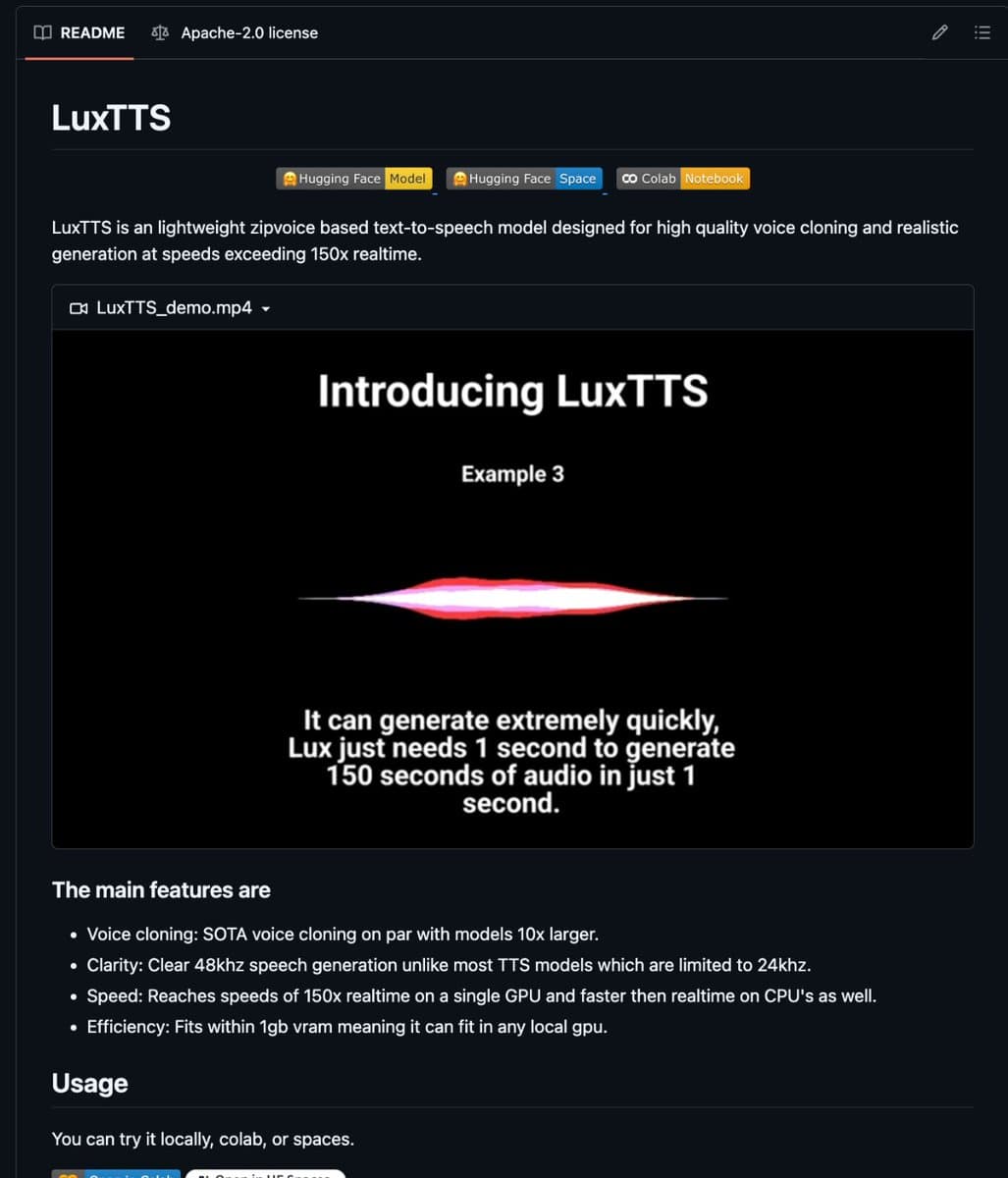
A new development in speech synthesis technology is poised to dramatically lower the barriers to high-quality voice cloning. LuxTTS, an open-source text-to-speech system, now enables users to clone any voice using just 3 seconds of audio sample—all while running efficiently on consumer-grade hardware with as little as 1GB of VRAM. This advancement challenges the dominance of proprietary services like ElevenLabs and could fundamentally reshape the landscape of voice AI applications.
Technical Breakthroughs in Accessibility
According to developer reports, LuxTTS achieves several significant technical milestones that distinguish it from previous voice cloning systems. Most notably, the model operates at approximately 150 times real-time speed, meaning it can generate speech far faster than it would take to speak the text naturally. This efficiency extends across both GPU and CPU implementations, with the system reportedly running "faster than realtime even on CPU"—a remarkable feat for neural speech synthesis.
The hardware requirements represent perhaps the most democratizing aspect of LuxTTS. While many contemporary voice AI models demand high-end graphics cards with substantial memory, LuxTTS fits within just 1GB of VRAM, making it accessible to users with entry-level gaming cards or even integrated graphics solutions. The source specifically notes compatibility with "a 4GB GPU," placing this technology within reach of millions of existing computers worldwide.
Superior Audio Quality and Open-Source Philosophy
Beyond its efficiency, LuxTTS reportedly produces 48kHz audio output, doubling the 24kHz industry standard that has dominated many text-to-speech systems. This higher sampling rate potentially translates to richer, more natural-sounding speech with better preservation of vocal nuances and harmonics.
The project's open-source nature represents a philosophical departure from the subscription-based models that have dominated commercial voice cloning services. As the source declares, "LuxTTS just killed the 'you need ElevenLabs' excuse," highlighting how this development could disrupt the current market dynamics where access to advanced voice cloning has typically required monthly payments to proprietary platforms.
Potential Applications and Implications
The implications of accessible, high-quality voice cloning are profound and multifaceted. Content creators could generate voiceovers in specific tones or accents without hiring voice actors. Educators might create personalized audio materials. Game developers could implement dynamic dialogue systems previously limited by recording budgets. Accessibility tools could provide more natural text-to-speech options for visually impaired users.
However, this democratization also raises important ethical considerations. The same technology that enables creative applications could potentially be misused for creating convincing deepfake audio, impersonation, or fraudulent content. The open-source nature of LuxTTS means these capabilities will be available without the safeguards or monitoring that commercial platforms might implement.
The Changing Voice AI Ecosystem
The emergence of LuxTTS signals a broader trend toward the democratization of AI capabilities that were once exclusively available through well-funded corporations or expensive APIs. Similar to how Stable Diffusion disrupted image generation, LuxTTS appears positioned to challenge the business models of voice cloning services by providing comparable quality without ongoing costs.
This development may accelerate innovation in the voice AI space as more developers gain access to capable tools. We may see rapid iteration and specialization as the community builds upon the open-source foundation, creating customized models for specific languages, accents, or applications.
The source material emphasizes the practical implications: users can now "clone any voice locally with no subscription," suggesting a shift toward decentralized voice synthesis that doesn't depend on cloud services or recurring payments. This local operation also addresses privacy concerns, as sensitive audio data need not be uploaded to external servers.
Looking Forward
As LuxTTS gains adoption, we can expect to see both creative applications and necessary discussions about ethical guidelines for voice cloning technology. The balance between innovation and responsibility will likely become a central theme in the voice AI community.
The technology's efficiency—running on modest hardware while producing high-quality output—suggests that voice cloning may soon become a standard feature in various software applications rather than a specialized service. This integration could make synthetic voices commonplace in everything from messaging apps to productivity tools.
Source: @hasantoxr on X