Researchers at the Mohamed bin Zayed University of Artificial Intelligence (MBZUAI) have unveiled MediX-R1, a groundbreaking open-ended reinforcement learning framework designed to teach medical AI models to generate clinically grounded free-form answers. This development represents a significant advancement in how artificial intelligence can be trained to handle complex medical reasoning tasks with remarkable efficiency.
The Challenge of Medical AI Training
Traditional approaches to training medical AI systems have typically required massive datasets—often millions of examples—to achieve acceptable performance. This presents substantial challenges in the medical domain where high-quality, annotated data is scarce due to privacy concerns, regulatory restrictions, and the specialized expertise required for accurate labeling. The medical field's complexity demands that AI systems not only provide correct answers but also demonstrate clinically sound reasoning that healthcare professionals can trust.
Previous medical AI systems have often been limited to multiple-choice formats or constrained response patterns, which don't fully capture the nuanced reasoning required in actual clinical practice. Real medical decision-making involves synthesizing information from various sources, considering probabilities and uncertainties, and explaining reasoning in natural language.
How MediX-R1 Works: Group-Based Reinforcement Learning
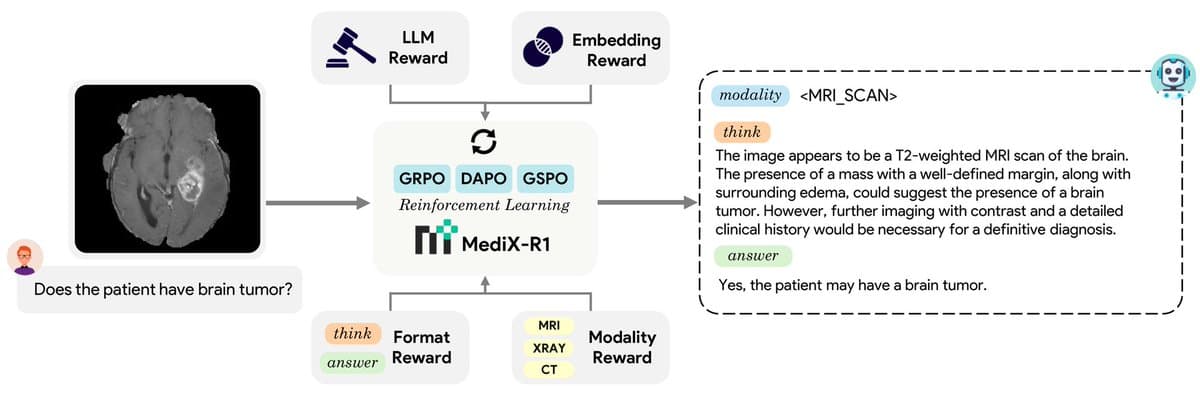
MediX-R1 introduces an innovative Group-Based Reinforcement Learning (RL) approach that fundamentally changes how medical AI models learn. The framework trains models to generate free-form answers by using composite rewards that evaluate multiple dimensions of response quality simultaneously.
The composite reward system includes:
- LLM Accuracy Reward: Measures factual correctness against established medical knowledge
- Semantic Reward: Evaluates the meaning and clinical relevance of responses
- Format Reward: Ensures responses follow appropriate medical communication patterns
- Modality Reward: Assesses how well responses integrate different types of information
This multi-faceted evaluation approach allows the model to learn not just what to say, but how to say it in a clinically appropriate manner. The Group-Based RL component organizes training examples into semantically similar groups, allowing the model to learn more efficiently from limited data by recognizing patterns across related medical scenarios.
Remarkable Efficiency with Limited Data
Perhaps the most impressive aspect of MediX-R1 is its data efficiency. The framework achieves 73.6% accuracy on standard medical benchmarks using only approximately 51,000 training examples. This represents a dramatic improvement in data efficiency compared to previous approaches that might require orders of magnitude more data to achieve similar performance.
This efficiency breakthrough has profound implications for medical AI development. It means that researchers and healthcare institutions can develop sophisticated medical AI systems without needing to amass prohibitively large datasets. This is particularly important for rare diseases, specialized medical fields, and healthcare systems in resource-limited settings where comprehensive medical data may be unavailable.
Performance and Applications
MediX-R1 has demonstrated strong performance across multiple medical reasoning tasks, including diagnosis suggestion, treatment planning, and patient education. The system's ability to generate free-form answers allows it to provide more nuanced and clinically useful responses than multiple-choice systems.
Potential applications include:
- Clinical Decision Support: Assisting healthcare providers with diagnostic reasoning and treatment planning
- Medical Education: Creating interactive learning tools for medical students and professionals
- Patient Triage: Helping patients understand their symptoms and when to seek medical care
- Medical Documentation: Assisting with clinical note generation and summarization
The open-ended nature of the framework means it can be adapted to various medical specialties and healthcare contexts, from primary care to specialized hospital medicine.
Implications for Healthcare AI Development
MediX-R1 represents a paradigm shift in how we approach medical AI training. By focusing on efficient learning from limited data, the framework addresses one of the most significant barriers to widespread AI adoption in healthcare. The ability to train effective models with smaller datasets reduces concerns about data privacy and security while making development more accessible to a wider range of institutions.
The composite reward system also establishes a new standard for evaluating medical AI responses. Rather than simply measuring factual accuracy, it considers the clinical appropriateness and communication effectiveness of responses—factors that are crucial for real-world healthcare applications.
Future Directions and Challenges
While MediX-R1 represents significant progress, challenges remain. The framework will need to be validated across diverse healthcare settings and patient populations. There are also important questions about how to ensure the system's recommendations align with evolving medical guidelines and how to handle cases where medical evidence is conflicting or incomplete.
Future developments may include:
- Integration with electronic health record systems
- Adaptation to different languages and healthcare systems
- Specialization for particular medical specialties
- Development of explainability features to help users understand the AI's reasoning process
As the framework continues to evolve, it will be important to maintain rigorous evaluation standards and ensure that the technology enhances rather than replaces human clinical judgment.
Conclusion
MBZUAI's MediX-R1 framework represents a major step forward in medical artificial intelligence. By enabling efficient training of clinically grounded free-form medical AI with limited data, it opens new possibilities for AI-assisted healthcare. The innovative Group-Based RL approach with composite rewards provides a more nuanced and clinically relevant way to train and evaluate medical AI systems.
As healthcare systems worldwide face increasing demands with limited resources, technologies like MediX-R1 could help bridge gaps in medical expertise and improve healthcare accessibility. The framework's development demonstrates how thoughtful AI research can address real-world constraints while advancing the state of the art in medical technology.
Source: MBZUAI research on MediX-R1 framework as reported by HuggingPapers