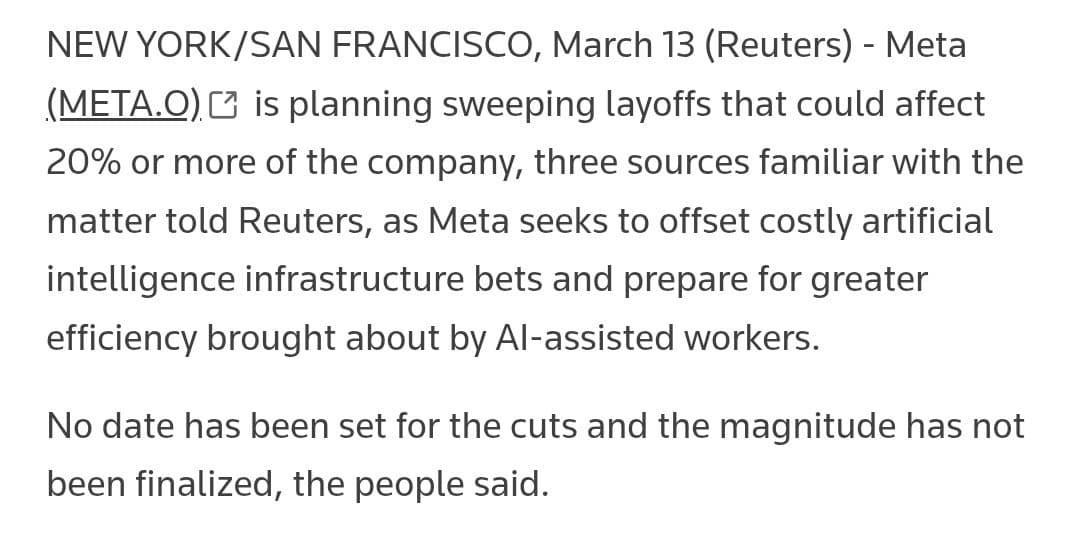
According to a recent report circulating on social media, Meta Platforms, Inc. is preparing for a significant workforce reduction, potentially affecting 20% or more of its employees. The reported figure of approximately 15,770 employees facing layoffs is attributed to what the company describes as "greater efficiency brought about by AI-assisted workers." This development, if confirmed, would represent one of the most substantial corporate restructurings directly linked to artificial intelligence integration in recent years.
The Reported Figures and Context
The source indicates that Meta's planned layoffs would impact roughly 15,770 employees, constituting about 20% of the company's workforce. This follows a period of aggressive hiring and expansion during the pandemic, which Meta and other tech giants have since scaled back. The explicit connection to AI-assisted efficiency marks a notable shift in how companies frame workforce reductions, moving from economic pressures to technological transformation narratives.
Meta has been investing heavily in AI research and development, particularly in areas like large language models, computer vision, and metaverse technologies. The company's AI initiatives include projects like Llama, its open-source large language model, and various AI tools integrated into its advertising platforms, content moderation systems, and internal productivity software.
The AI Efficiency Argument
The reported justification—"greater efficiency brought about by AI-assisted workers"—suggests that Meta believes AI tools can either augment human productivity to such an extent that fewer employees are needed for the same output, or that AI can directly automate tasks previously performed by humans. This aligns with broader industry trends where companies are implementing AI for coding assistance, content creation, customer service automation, and data analysis.
In Meta's case, AI integration likely affects multiple departments: AI might streamline ad targeting and optimization (reducing needs in marketing and sales), automate content moderation (affecting trust and safety teams), enhance developer productivity through coding assistants (impacting engineering roles), and improve operational efficiency across administrative functions.
Historical Context and Precedents
This wouldn't be Meta's first major workforce reduction. In 2022-2023, the company laid off approximately 21,000 employees as part of what CEO Mark Zuckerberg called the "Year of Efficiency." Those cuts were framed as responding to economic conditions and over-hiring during the pandemic boom. The current reported layoffs differ in their explicit attribution to AI-driven efficiency gains, potentially signaling a new phase in corporate AI adoption where technology directly displaces human roles at scale.
Other tech companies have made similar moves, though rarely with such explicit AI attribution. IBM's CEO recently stated the company might pause hiring for roles AI could automate, while Dropbox cut 16% of its workforce citing AI efficiency. However, a 20% reduction explicitly tied to AI assistance would be among the most substantial examples to date.
Implications for the Tech Industry
If accurate, Meta's move could establish a precedent for other technology companies to justify workforce reductions through AI efficiency narratives. This might accelerate similar announcements across the sector, particularly among companies with significant AI investments. The timing is notable as many tech firms face pressure to demonstrate profitability and operational efficiency to investors amid economic uncertainty.
The development also raises questions about the balance between AI as a productivity tool versus a replacement technology. While AI proponents often emphasize augmentation—humans working with AI to achieve more—Meta's reported justification suggests replacement is becoming a more openly acknowledged outcome of AI integration.
Employee and Societal Impact
For the approximately 15,770 employees potentially affected, this represents significant disruption. Tech layoffs have cascading effects on local economies, housing markets, and related industries. The psychological impact on remaining employees—often called "survivor's guilt"—can affect morale and productivity, potentially offsetting some efficiency gains from AI implementation.
Societally, this development contributes to ongoing debates about AI's impact on employment. While economists disagree about whether AI will create net job growth or loss long-term, high-profile cases like this demonstrate that displacement is already occurring in significant numbers within specific sectors.
Verification and Company Response
As of this writing, Meta has not officially confirmed these specific layoff figures or the AI efficiency justification. The company typically announces major workforce changes through official channels, and previous layoffs were communicated via internal memos and public statements. The 20% figure circulating on social media should be treated as unverified until confirmed by the company or reliable business publications.
However, the report aligns with Meta's stated direction. During the company's first-quarter 2024 earnings call, Zuckerberg emphasized continued investment in AI while maintaining efficiency discipline. He noted that Meta would "continue to resize our organization intelligently" as it invests in AI, suggesting further workforce adjustments were possible.
Looking Ahead
Whether confirmed or not, this report highlights a critical juncture in AI adoption. As AI systems become capable of performing increasingly complex tasks, companies face decisions about how to balance technological advancement with human employment. Meta's approach—if accurately reported—represents one end of the spectrum: substantial workforce reduction justified by AI efficiency gains.
Other companies might pursue different strategies: retraining employees for AI-augmented roles, implementing gradual transitions, or using AI to enable growth without proportional hiring increases. The coming months will likely reveal which approach becomes dominant as AI capabilities continue advancing.
For now, the reported Meta layoffs serve as a stark reminder that the AI revolution has concrete human consequences. As companies pursue efficiency through artificial intelligence, thousands of workers face uncertain futures—a reality that will shape both corporate strategies and policy debates around AI governance, worker protections, and economic transformation.