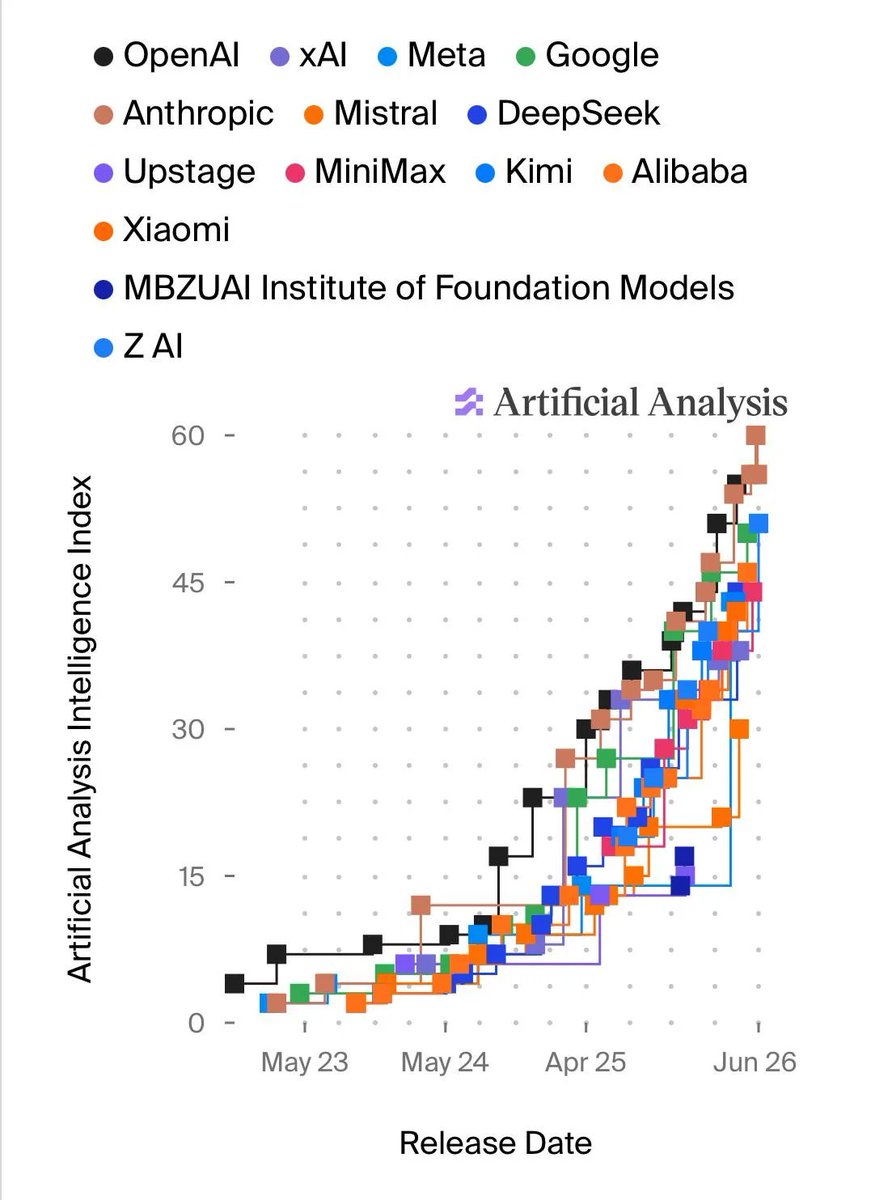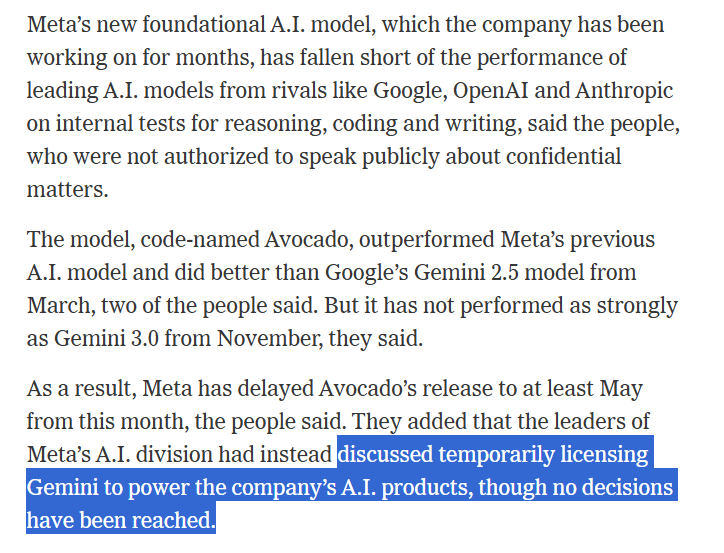
According to a recent report from industry observer @kimmonismus on X (formerly Twitter), Meta's internally developed large language model, codenamed "Avocado," is delivering disappointing performance in evaluations. The model is said to be barely outperforming Google's Gemini 2.5, raising questions about Meta's substantial investments in AI research and development.
The Evaluation Results
The core revelation centers on benchmark performance where Avocado reportedly shows only marginal improvements over Google's established Gemini 2.5 model. While specific evaluation metrics weren't detailed in the source, the characterization of "barely outperforming" suggests Meta's latest internal offering isn't achieving the breakthrough capabilities the company might have anticipated given its significant resource allocation to AI development.
This performance gap is particularly notable considering Meta's public commitment to open-source AI through models like Llama, and its positioning as a major competitor to industry leaders like OpenAI and Google. The Avocado project represents Meta's attempt to develop proprietary, cutting-edge technology that could power future products across its ecosystem of social platforms and emerging technologies.
Internal Response and Strategic Implications
Perhaps more surprising than the evaluation results themselves is Meta's reported internal response. According to the source, the company is considering licensing and using competitor models like Gemini instead of relying exclusively on its own technology. This represents a potentially significant strategic shift for a company that has invested billions in AI research and infrastructure.
Such a move would acknowledge that even with massive investment, catching up to or surpassing the current market leaders in certain AI capabilities may require pragmatic partnerships rather than purely internal development. It also suggests Meta's leadership is willing to prioritize product capabilities and user experience over complete technological independence when necessary.
The Financial Context
The source characterizes Meta's AI investments as "next level cash burn," highlighting the enormous financial commitment required to compete in the current AI landscape. Meta has reportedly been spending aggressively on AI infrastructure, including acquiring hundreds of thousands of specialized processors and building massive data centers dedicated to AI training and inference.
This expenditure comes alongside significant investments in AI research talent and the development of increasingly large and complex models. The disappointing performance of Avocado relative to these investments raises questions about the efficiency of Meta's AI development pipeline and whether the company is achieving adequate returns on its substantial AI spending.
Industry Context and Competitive Landscape
The reported struggles with Avocado occur against a backdrop of intense competition in the AI space. Google continues to advance its Gemini family of models, OpenAI maintains its position with GPT models, and Anthropic has emerged as another significant player with Claude. Meanwhile, several well-funded startups are also pushing the boundaries of what's possible with large language models.
Meta's potential consideration of licensing competitor technology reflects the practical challenges of maintaining parity across all aspects of AI capability. Different companies have developed strengths in different areas—some excel at reasoning, others at coding, creative tasks, or multimodal understanding. For a company like Meta with diverse product needs across social media, advertising, virtual reality, and more, accessing best-in-class capabilities across domains may require a hybrid approach.
Potential Impact on Meta's Product Roadmap
If Meta does move forward with licensing competitor models, this could have significant implications for its product development. The company has been integrating AI across its platforms—from AI assistants in WhatsApp and Messenger to content recommendation algorithms in Facebook and Instagram, to AI-powered creative tools and advertising products.
The choice of which AI capabilities to develop internally versus license externally will shape the user experience across Meta's ecosystem. It could also influence the company's approach to AI safety, transparency, and customization, as externally licensed models may offer less flexibility for modification compared to internally developed alternatives.
Looking Ahead
The Avocado situation highlights the complex realities of AI development at scale. Even with substantial resources and talent, creating state-of-the-art AI models remains exceptionally challenging, with unpredictable breakthroughs and setbacks. Meta's reported response—considering licensing alongside continued internal development—represents a pragmatic approach that other technology giants may increasingly adopt as the AI landscape continues to evolve.
As the AI race intensifies, we may see more companies embracing hybrid strategies that combine proprietary research with strategic partnerships and licensing agreements. This could lead to a more interconnected AI ecosystem where capabilities flow between organizations in ways that benefit end users while still allowing companies to maintain competitive differentiation in their core areas of focus.
Source: @kimmonismus on X (formerly Twitter)