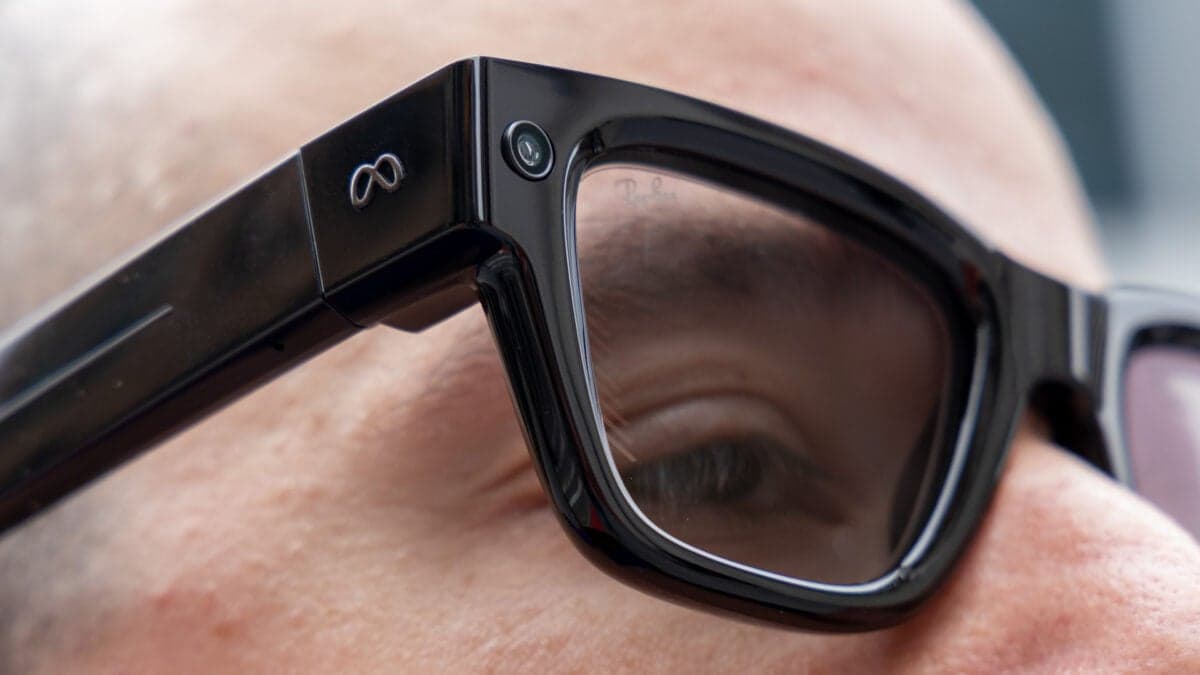
An open-source project has emerged that transforms Meta Ray-Ban smart glasses into a real-time, vision-enabled AI assistant. The system, highlighted by developer Rohan Paul, combines the glasses' hardware with Google's Gemini Live API and the OpenClaw agent framework to create a multimodal assistant that can see, converse, and act.
The core workflow is initiated by a user tapping the AI button on their glasses and speaking. The assistant then performs a sequence of agentic actions:
- Visual Perception: The camera on the Meta Ray-Ban glasses streams video at approximately 1 frame per second to the Gemini Live API. Gemini analyzes this visual feed and generates a descriptive context of the user's surroundings.
- Agentic Delegation: This visual context, combined with the user's audio query, is passed to the OpenClaw agent framework.
- Action Execution: OpenClaw can then execute tasks by interfacing with connected applications and services. Demonstrated capabilities include:
- Sending messages via connected platforms like WhatsApp, Telegram, or iMessage.
- Performing web searches and having the results spoken back to the user through the glasses.
The audio flows bidirectionally in real-time, enabling a natural conversational interface. The entire stack is available as an open-source repository on GitHub, providing a blueprint for developers to build upon.
How the System Works
The integration is a technical orchestration of several components:
- Hardware: Meta Ray-Ban smart glasses provide the always-available form factor, microphone, speaker, and crucially, the forward-facing camera.
- Vision Model: Google's Gemini Live API serves as the "eyes." The ~1fps video stream provides sufficient temporal context for Gemini to understand dynamic scenes and answer questions about the user's environment in real time.
- Agent Framework: OpenClaw acts as the "brain" and "hands." It receives the structured understanding from Gemini (the user's query + a description of the visual scene) and decides on a course of action. Its ability to connect to third-party apps via APIs is what enables the actionable outcomes, moving beyond a simple Q&A chatbot.
- Real-Time Audio: The glasses' audio system facilitates a continuous, low-latency voice conversation, making the interaction feel like talking to a human assistant.
What This Enables
This project demonstrates a practical implementation of a perceptual, agentic AI system in a wearable form factor. Instead of being limited to pre-programmed commands or requiring a smartphone screen, the user can interact contextually with their environment. For example, a user could look at a restaurant, ask "What are the reviews for this place?" and have OpenClaw perform a web search and read the results aloud. They could then say "Share this info with Alex," triggering OpenClaw to send the summary via a connected messaging app.
The open-source nature of the project is significant. It provides a functional reference architecture for combining multimodal LLMs (Gemini) with agent frameworks (OpenClaw) on edge-adjacent hardware (smart glasses). Developers can clone the repo to experiment with their own action integrations or modify the vision-processing pipeline.
gentic.news Analysis
This project is a tangible step toward the long-envisioned future of ambient, contextual computing. While AI-powered smart glasses from Meta and others have featured basic voice assistants, this integration explicitly adds two critical layers: continuous visual context and programmatic action-taking. The choice of OpenClaw as the agent is notable; it suggests a move toward frameworks that can manage state, reason about tools, and execute multi-step plans, which is a more complex paradigm than simple function-calling.
Technically, the decision to stream at ~1fps is a pragmatic engineering trade-off. It balances the need for visual continuity with the constraints of mobile bandwidth, latency, and API cost. It implies the system is optimized for scene understanding and object recognition rather than high-frame-rate tasks like gesture detection. The real test will be in the robustness of OpenClaw's reasoning—can it correctly interpret complex user intents that combine visual scene data with a request for action? Hallucinations or misrouted actions in a real-world wearable could break the user experience quickly.
From an industry perspective, this is a classic "glue code" innovation. It doesn't present new core AI models but creatively integrates existing, powerful APIs (Gemini Live) with an emerging agent framework and consumer hardware. It validates the utility of Gemini's real-time multimodal capabilities and serves as a beacon for other developers, showing what's possible immediately with available tools. The next logical iterations will involve on-device or hybrid models to reduce latency and dependency on cloud APIs, and more sophisticated agent memory to maintain context across long interactions.
Frequently Asked Questions
What are Meta Ray-Ban smart glasses?
Meta Ray-Ban smart glasses are a wearable device developed in partnership with Ray-Ban. They look like classic sunglasses or prescription glasses but contain built-in cameras, speakers, microphones, and an AI assistant accessible via a button on the frame. They are designed for hands-free photo/video capture, music listening, and voice interactions.
What is the Gemini Live API?
Gemini Live is an API from Google that provides multimodal, real-time conversational capabilities. It can process simultaneous audio and visual (video) streams, allowing for a live, back-and-forth dialogue where the AI model can see what the user sees. It's a more interactive and contextual interface compared to standard text-in, text-out LLM APIs.
What is OpenClaw?
OpenClaw is an open-source AI agent framework. Think of it as a system that can take a high-level user goal (often provided in natural language), break it down into steps, decide which tools or applications to use (like a search engine or messaging app), and execute the sequence to complete the task. It acts as an autonomous "doer" that connects AI understanding to real-world actions.
Is this an official feature from Meta or Google?
No. This is a third-party, open-source project built by developers using the publicly available APIs from Google (Gemini) and Meta (which provides SDKs for its smart glasses). It is not an official integration or product offered by either company, though it demonstrates the potential of their platforms.