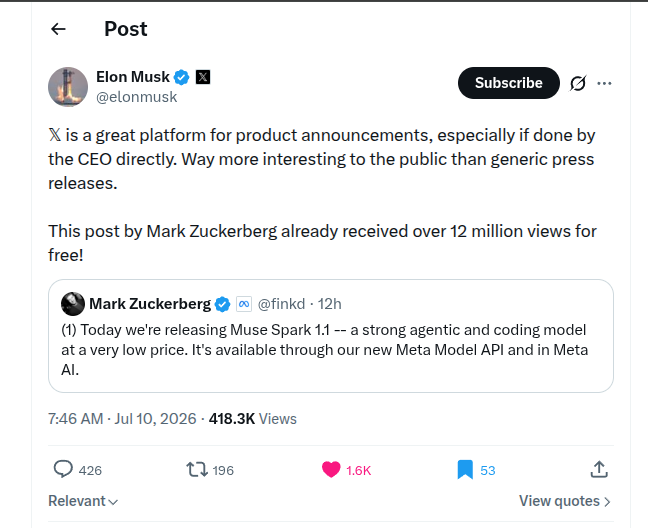
A new analysis circulating in AI circles posits a significant shift in the large language model landscape: Meta's reported development of a new model internally called "Spark" could represent a direct, existential threat to OpenAI's consumer business, not through technical superiority in coding or reasoning, but through massive, free distribution to Meta's existing user base.
The argument, detailed in a viral analysis thread, hinges on a simple premise: for the vast majority of users, the primary use case for LLMs is not frontier tasks like coding or advanced mathematics, but everyday assistance—answering questions, brainstorming, help with documents, and casual chat. For these tasks, the analysis claims Spark is "at least as useful for everyday use as ChatGPT."
The Threat: Distribution, Not Just Capability
The core of the threat lies in Meta's unparalleled distribution moat. The company can roll out Spark free of charge to its ecosystem of approximately one billion users across Facebook, Instagram, and WhatsApp. This immediate access stands in stark contrast to the need for users to seek out and sign up for a separate service like ChatGPT.
The analysis cites a critical vulnerability for OpenAI: its user base is overwhelmingly in the consumer market. It claims OpenAI currently has "900 weekly users" (a figure that appears to be an error or placeholder, as OpenAI reported over 100 million weekly users in late 2023), with 95% still on the free tier. If Meta successfully integrates a competent AI assistant into the daily flow of its apps and users realize it satisfies their core needs, a massive migration could occur without a change in user behavior.
The Competitive Landscape: A Three-Way Split
The thread outlines a perceived trifurcation of the LLM market:
- Anthropic: Positioned as the leader in the business and enterprise sector, with models like Claude 3 Opus favored for sensitive, high-stakes applications.
- OpenAI: Deeply rooted in the consumer market with ChatGPT, but struggling for share in the enterprise space against Anthropic.
- Meta: Poised to leverage its social graph and messaging platforms to dominate mass-market, casual AI use.
In this view, OpenAI is caught in a pincer movement: it can't easily dislodge Anthropic's enterprise foothold, and its core consumer territory is now under assault from Meta's distribution engine. The launch of a capable, free model like Spark into Meta's apps could trigger what the analysis calls "alarm bells" at OpenAI.
What We Know (and Don't Know) About 'Spark'
It's crucial to note that "Spark" is not an officially announced Meta product. The details are sourced from analysis and rumor. Based on the thread and related reporting, the presumed attributes of Spark are:
- Target Use Case: Everyday questions, brainstorming, casual chat, and simple assistance (e.g., tax return questions, understanding legal documents).
- Key Advantage: Free, instant access within Meta's family of apps for ~1 billion users.
- Performance Claim: Positioned as functionally equivalent to ChatGPT for common, non-specialist tasks.
No technical specifications, model size, architecture, or benchmark data against ChatGPT are provided in the source material.
gentic.news Analysis
This analysis, while speculative, touches on the most critical non-technical battlefront in AI: distribution and user habit formation. Our previous reporting on Meta's Llama 3.1 model suite launch highlighted the company's strategy of open-weight releases to foster ecosystem development. The "Spark" initiative, if real, represents the complementary closed, integrated product arm of that strategy—a direct shot across the bow of ChatGPT's freemium model.
Historically, this follows Meta's pattern of leveraging its infrastructure to absorb features pioneered by competitors (e.g., Stories from Snapchat). The integration of a capable AI into WhatsApp's status, Facebook's news feed, and Instagram's DMs could be seamless and devastatingly effective. This aligns with a trend we've noted: platform companies (Google, Meta, Apple) are moving to bake AI directly into their OS and app layers, making standalone apps vulnerable.
The claim that Anthropic owns the enterprise sector while OpenAI owns consumers is an oversimplification but contains truth. Anthropic's constitutional AI and strong safety focus, as covered in our analysis of Claude 3.5 Sonnet's launch, have indeed won significant enterprise trust. OpenAI has made strong inroads with ChatGPT Enterprise and Microsoft's Copilot stack, but faces fierce competition. A Meta move on the consumer front would force OpenAI to defend its home turf while still trying to expand commercially, a difficult strategic position.
Ultimately, the "Spark" scenario underscores that the LLM wars are no longer just about whose model tops the MMLU or GPQA benchmark. The next phase is about embedding, accessibility, and daily utility. The company that owns the user's attention and communication channels holds a formidable, perhaps decisive, advantage in delivering AI utility. For OpenAI, which sparked the consumer AI revolution, the rise of integrated rivals like a potential Meta Spark may be its greatest strategic challenge yet.
Frequently Asked Questions
What is Meta's 'Spark' AI model?
"Spark" is the rumored/internal name for a new large language model being developed by Meta. According to analysis, it is designed for everyday tasks like answering questions, brainstorming, and casual chat, and its key strategy is to be offered for free to Meta's vast user base (around 1 billion people) directly within apps like Facebook, Instagram, and WhatsApp.
How could Meta's Spark threaten OpenAI?
The threat is primarily based on distribution, not just AI capability. OpenAI's ChatGPT, especially its free tier, dominates the consumer AI chat market. If Meta pre-installs a similarly capable AI assistant for free into the apps billions already use daily, users may have no reason to seek out or switch to a separate service like ChatGPT. This could erode OpenAI's user growth, engagement, and its ability to convert free users to paying subscribers.
Is Anthropic really the leader in enterprise AI?
The analysis presents a simplified view. Anthropic, with its Claude models, has gained significant traction in the enterprise sector due to a strong focus on safety, reliability, and its Constitutional AI approach. However, OpenAI's ChatGPT Enterprise and its deep partnership with Microsoft (via Azure OpenAI and Copilot) also command a huge enterprise presence. The market is competitive, but Anthropic is widely recognized as a top-tier contender for business-critical applications.
Has Meta officially announced the Spark model?
No. As of now, "Spark" is not an officially announced product from Meta. The discussion is based on analysis and industry rumors. Any specific capabilities, launch dates, or integration plans remain speculative until confirmed by Meta.