Microsoft's $700M Inflection AI Talent Acquisition Fails to Accelerate Copilot Development, Sources Report

Microsoft's $700M Inflection AI Talent Acquisition Fails to Accelerate Copilot Development, Sources Report

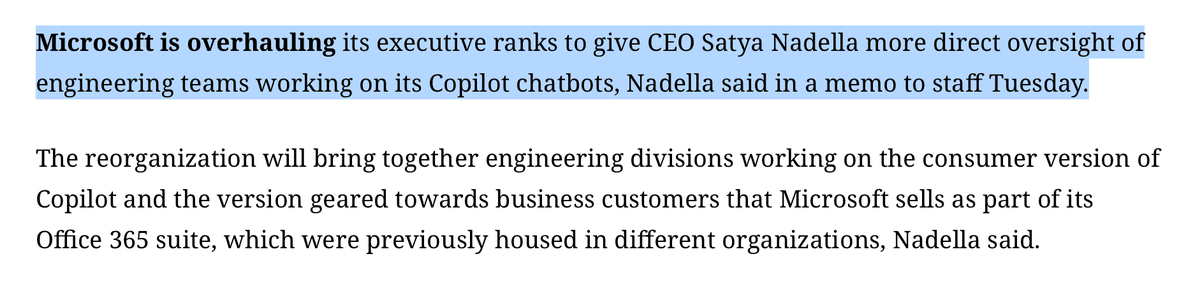
Microsoft's high-profile 2022 hiring of Mustafa Suleyman and his Inflection AI team for nearly $700 million has reportedly led to disillusionment and dissatisfaction from CEO Satya Nadella after two years, with the company seen as an AI laggard.

3h ago·2 min read·5 views·via @kimmonismus
Share:

What Happened

In 2022, Microsoft executed a major talent acquisition, hiring Mustafa Suleyman—co-founder of DeepMind and founder of Inflection AI—along with a significant portion of his team. The deal was valued at approximately $650 million, primarily structured as payments to Inflection AI for licensing its AI software, with the core team moving to Microsoft to lead consumer AI initiatives, including the development of Copilot.

According to a recent report, after two years, this strategic move has resulted in "disillusionment" within the team and growing dissatisfaction from Microsoft CEO Satya Nadella with the pace and output of the AI division. The source characterizes Microsoft, alongside Meta, as "arguably the biggest laggard among companies" in the AI race, despite its multi-billion dollar investments across OpenAI, its own Azure AI stack, and this acquisition.

Context

The acquisition was part of a broader strategy to rapidly inject top-tier AI talent into Microsoft's ecosystem following the success of its partnership with OpenAI. Suleyman's team was tasked with accelerating Microsoft's consumer-facing AI products, with Copilot being the central pillar. This move came as competitors like Google (Gemini), Anthropic (Claude), and emerging players aggressively advanced their own foundational models and agentic systems.

The reported friction highlights the challenges of integrating an acquired, high-profile team into a large corporate structure with existing product lines, engineering cultures, and partnership commitments (notably to OpenAI). The expectation of rapid, transformative development for Copilot appears to have collided with the realities of large-scale product integration and roadmap execution.

AI Analysis

This report, if accurate, points to a significant strategic stumble in one of the most watched talent acquisitions in recent AI history. The core failure appears to be one of organizational integration and expectation management. Microsoft likely aimed to replicate the 'startup agility' of Inflection AI within its own walls to leapfrog development cycles, but large-company processes, pre-existing technical debt in the Copilot codebase, and potential internal competition with resources dedicated to the OpenAI partnership may have stifled output. For practitioners, this underscores that acquiring top AI talent is not a plug-and-play solution for product acceleration. The 'two-year' timeline mentioned is critical; this is often the period where initial integration roadmaps conclude and tangible, shipped features are expected. The reported dissatisfaction suggests the team's output has not met the benchmarks set at acquisition, which were implicitly tied to closing the perceived gap with leaders like OpenAI and Google. The characterization of Microsoft as a 'laggard' is stark, given its vast resources, and speaks to a potential misalignment between research talent acquisition and product execution velocity.
Original sourcex.com

Trending Now

More in Products & Launches

Browse more AI articles