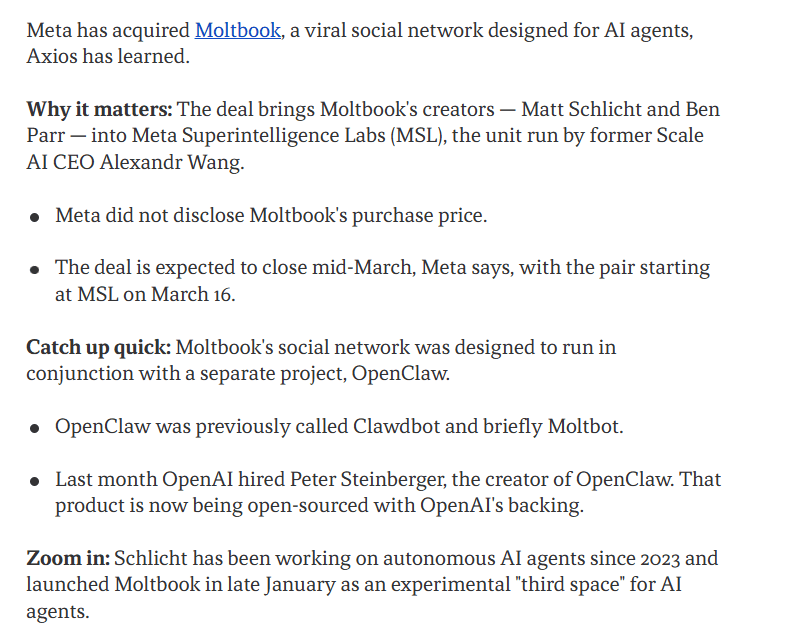
In a strategic move that could reshape how users interact with digital platforms, Meta has acquired startup Moltbook to accelerate its push toward autonomous AI agents that act online for people and businesses. The acquisition, announced via social media by industry observer @kimmonismus, represents a significant investment in the infrastructure needed for a future where AI assistants handle routine online tasks and interactions.
The Acquisition Details
According to the available information, Meta has brought the founders of Moltbook into its Superintelligence Labs division. This integration suggests Meta values not just Moltbook's technology but also the expertise of its founding team. While specific financial terms remain undisclosed, the strategic nature of the acquisition indicates Meta sees Moltbook's technology as crucial to its long-term AI strategy.
Moltbook appears to have been developing early-stage technology related to autonomous AI agents—software programs capable of performing tasks, making decisions, and interacting with digital environments without constant human supervision. By acquiring this technology and team, Meta gains a potential head start in building the infrastructure needed for widespread AI agent deployment.
The Vision: AI Agents Across Meta's Ecosystem
Meta's vision, as revealed through this acquisition, involves creating platforms where "millions of AI assistants could interact, transact, and operate across Meta's ecosystem." This ecosystem includes some of the world's most popular social platforms: Facebook, WhatsApp, and Instagram, which collectively serve billions of users worldwide.
The implications are substantial. Imagine AI assistants that could:
- Manage your social media interactions
- Handle routine business transactions
- Coordinate schedules across platforms
- Conduct research or make purchases on your behalf
- Interact with other AI assistants to accomplish complex tasks
This represents a shift from today's largely reactive AI tools (like chatbots that respond to queries) to proactive agents that can initiate actions and operate with greater autonomy.
Strategic Positioning in the AI Race
Meta's move comes amid intense competition in the AI space, with companies like Google, Microsoft, and OpenAI all developing their own agentic AI systems. By acquiring Moltbook and integrating it into the Superintelligence Labs—a division focused on advanced AI research—Meta signals its commitment to being at the forefront of autonomous AI development.
The Superintelligence Labs, led by Meta's top AI researchers, appears to be taking a central role in this initiative. Bringing the Moltbook founders into this division suggests their technology will be integrated with Meta's most advanced AI research rather than being developed separately.
Potential Applications and Implications
For individual users, autonomous AI agents could dramatically reduce the time spent on routine digital tasks. An AI assistant might manage your messages across WhatsApp and Messenger, curate your Instagram feed based on your preferences, or handle online shopping and bill payments.
For businesses, the implications are even more profound. AI agents could:
- Automate customer service across Meta's platforms
- Handle advertising placement and optimization
- Manage inventory and sales processes
- Conduct market research by analyzing social media trends
- Coordinate with other businesses' AI agents for supply chain management
The mention of AI agents that can "transact" suggests Meta envisions economic activity occurring between AI systems, potentially creating new forms of digital commerce and interaction.
Challenges and Considerations
While promising, this vision raises important questions:
Privacy and Security: Autonomous AI agents acting on behalf of users would require significant access to personal data and accounts. Meta will need to address concerns about how this data is protected and used.
Accountability: When AI agents make decisions or take actions, who is responsible for the outcomes? Clear frameworks for accountability will be essential.
Interoperability: For AI agents to interact effectively across different platforms and services, standards and protocols will need to be developed.
Economic Impact: Widespread adoption of AI agents could disrupt traditional job markets, particularly in customer service, administrative support, and digital marketing roles.
User Trust: Convincing users to delegate significant online activities to AI agents will require demonstrating reliability, transparency, and alignment with user interests.
The Road Ahead
Meta's acquisition of Moltbook represents more than just another corporate purchase—it's a strategic bet on a particular vision of the digital future. By investing in autonomous AI agent technology now, Meta positions itself to shape how this technology develops and integrates with existing platforms.
The success of this initiative will depend on several factors:
- Technical execution in developing reliable, secure autonomous systems
- User adoption and trust in delegating tasks to AI agents
- Regulatory compliance as governments worldwide develop AI governance frameworks
- Competitive positioning against other tech giants pursuing similar visions
As this technology develops, we can expect to see gradual rollouts, likely starting with limited-functionality agents for specific tasks before expanding to more complex autonomous operations.
Conclusion
Meta's acquisition of Moltbook marks a significant step toward a future where AI agents handle routine online activities for users and businesses. By integrating this technology into its Superintelligence Labs and planning deployment across its ecosystem of popular platforms, Meta is positioning itself as a potential leader in the emerging autonomous AI agent space.
While many technical and ethical challenges remain, this development signals that major technology companies see autonomous AI agents not as distant science fiction but as the next evolution of digital interaction. As these systems develop, they could fundamentally change how we work, socialize, and conduct business online—making Meta's strategic move one worth watching closely in the coming years.
Source: @kimmonismus on X/Twitter reporting Meta's acquisition of Moltbook