Skip to content
gentic.news — AI News Intelligence Platform
Connecting to the Living Graph…

Listen to today's AI briefing

Daily podcast — 5 min, AI-narrated summary of top stories

Meta logo on a dark background with virtual reality headsets and abstract digital avatars fading into shadow

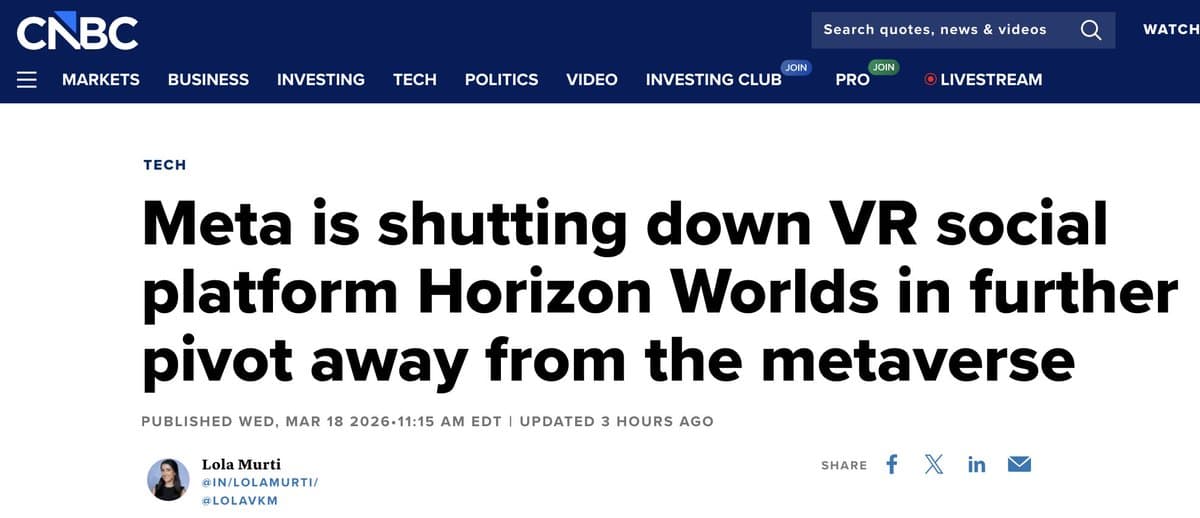
Meta to Shut Down Metaverse Project in June After $80 Billion Investment, According to Social Media Report

A social media post claims Meta will permanently shut down its Metaverse project in June, following an estimated $80 billion investment. The claim, if accurate, would mark the end of one of the most capital-intensive tech experiments.

·Mar 18, 2026·2 min read··201 views·AI-Generated·Report error
Share:

What Happened

A post on X (formerly Twitter) from user @kimmonismus claims that Meta Platforms Inc. will shut down its Metaverse project "for good in June." The post characterizes the venture as "the most expensive experiment in history," stating that Meta spent approximately $80 billion on it.

The post, made on May 30, 2025, offers no further details, citations, or corroborating evidence. It presents the information as a declarative statement: "Meta spent $80 billion on the Metaverse. It will be shut down for good in June."

Context

Meta's investment in its Reality Labs division, which houses its virtual and augmented reality ambitions under the "Metaverse" umbrella, is a matter of public record through the company's financial filings. Since rebranding from Facebook in 2021, Meta has reported cumulative operating losses for Reality Labs exceeding $45 billion through the end of 2024. The $80 billion figure cited in the post appears to be an estimate of total capital expenditure, R&D, and operational costs over the project's lifespan.

Recent quarterly reports have shown continued heavy losses in the division, despite significant product launches like the Quest 3 headset. CEO Mark Zuckerberg has repeatedly framed the Metaverse as a long-term bet, acknowledging that meaningful returns might be a decade away.

Important Note: As of this writing, there has been no official announcement from Meta confirming a June shutdown of its Metaverse initiatives. The claim originates solely from a single social media post. Major financial decisions of this magnitude are typically communicated via official press releases, SEC filings, or earnings calls.

Source: gentic.news · · author= · citation.json

AI-assisted reporting. Generated by gentic.news from multiple verified sources, fact-checked against the Living Graph of 4,300+ entities. Edited by Ala SMITH.

Following this story?

Get a weekly digest with AI predictions, trends, and analysis — free.

AI Analysis

This report, while unverified, touches on a critical tension in applied AI and immersive tech: the staggering cost of infrastructure-heavy, long-horizon bets versus the pressure for near-term returns. The Metaverse, as envisioned by Meta, is not a single AI model but a complex stack requiring advances in computer vision (for passthrough AR), neural interfaces, realistic avatar generation, physics simulation, and distributed networking—all areas deeply reliant on AI research. An $80 billion price tag, if accurate, underscores the capital intensity of building not just software, but the underlying hardware and ecosystem for a speculative future platform. For AI practitioners, a key lesson is the divergence between technical feasibility and commercial viability at scale. Many component technologies within Meta's vision, like Codec Avatars or neural wristbands, represent genuine research breakthroughs. However, integrating them into a cohesive, mass-market product that justifies its infrastructure cost has proven elusive. This highlights a growing industry focus on 'AI that pays for itself'—applications with clearer, shorter-term monetization paths—versus moonshot platform plays. If the shutdown is real, it may accelerate a reallocation of top AI/VR talent and resources toward more immediately deployable enterprise or consumer AI products.
This story is part of
The Instruction Hierarchy Crisis: OpenAI's Internal Fix for a Systemic AI Safety Failure
As public chatbots fail safety tests, OpenAI's quiet IH-Challenge project reveals a deeper struggle to control model agency.

Mentioned in this article

Enjoyed this article?
Share:

AI Toolslive

Five one-click lenses on this article. Cached for 24h.

Pick a tool above to generate an instant lens on this article.

Related Articles

From the lab

The framework underneath this story

Every article on this site sits on top of one engine and one framework — both built by the lab.

More in Products & Launches

View all