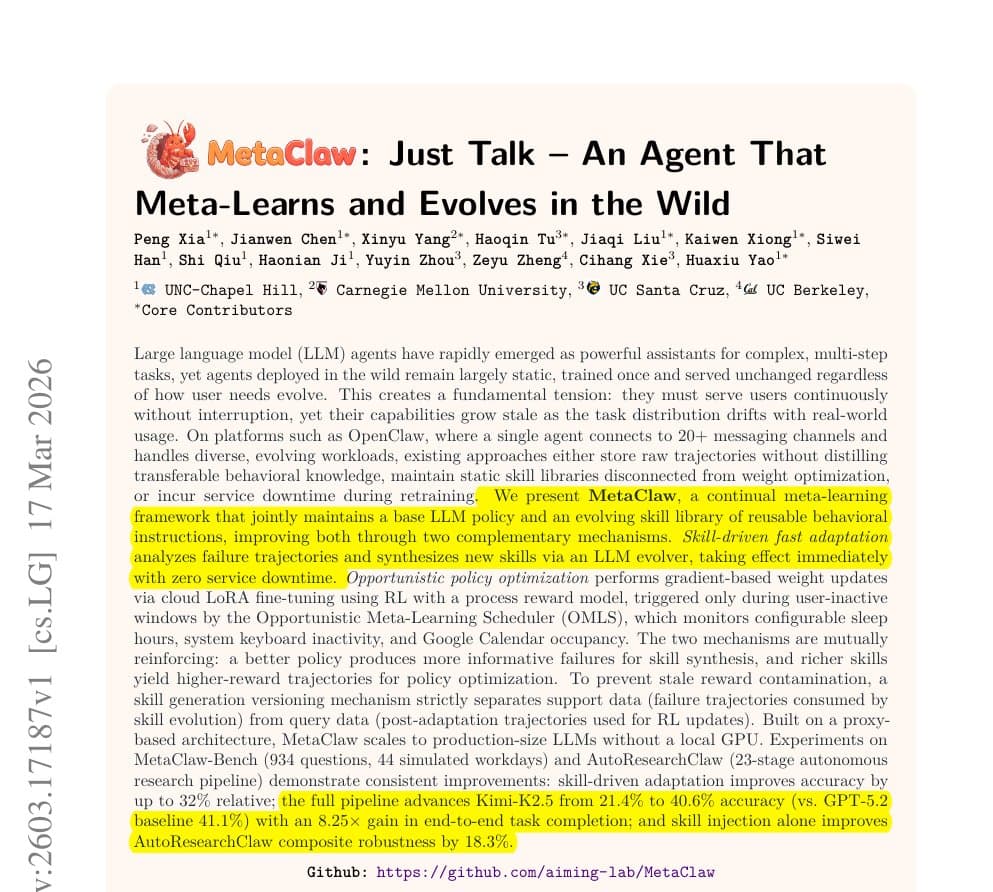
A new research framework called MetaClaw proposes a solution to a critical limitation of current production AI agents: their inability to learn once deployed. Most agents operate with a frozen model, meaning they cannot adapt to shifting user needs or correct recurring mistakes. MetaClaw addresses this by implementing a dual-loop learning system that allows an agent to improve continuously without requiring service downtime.
What Happened: The Two-Loop Architecture
The core innovation of MetaClaw is the separation of learning into two distinct cycles:
- Fast Loop (Skill Writing): When the agent encounters a failure or a novel task it cannot handle, this loop triggers immediately. The system analyzes the failure and writes a new, reusable "skill"—essentially a piece of executable code or a detailed instruction set—that solves that specific problem. This new skill is stored in a library and can be invoked by the agent for similar future tasks, providing an immediate performance fix.
- Slow Loop (Model Updating): This loop operates asynchronously and offline. It aggregates successful skills and other learning signals over time (e.g., during periods of user inactivity, "sleep," or meetings). This collected data is then used to fine-tune or update the agent's underlying foundation model. This update happens without interrupting the live service.
This split is crucial. The fast loop delivers instant utility and error correction, while the slow loop enables deeper, more generalized learning during idle compute cycles.
Key Results: Significant Accuracy Gains
The paper validates MetaClaw on two benchmarks:
- A 934-question benchmark designed to simulate 44 workdays of activity.
- A separate automated research pipeline comprising 23 distinct stages.
The results were substantial:
- The addition of the skill library alone improved task accuracy by up to 32% relative.
- The full MetaClaw system (skills + model updates) lifted the performance of the Kimi-K2.5 model from 21.4% to 40.6% on the workday simulation benchmark.
- It also improved robustness on the complex research pipeline by 18.3%.
Context: The Frozen Agent Problem
The research directly tackles the "frozen agent" paradigm dominant in production today. Deploying a large language model (LLM) as an agent typically involves creating a fixed set of prompts, tools, and heuristics. Once live, the system cannot learn from its interactions; it will repeat the same errors and cannot handle task distributions that drift over time. MetaClaw provides a blueprint for moving from static, brittle agents to adaptive, learning systems that improve from real-world use.
gentic.news Analysis
MetaClaw enters a rapidly evolving space focused on making LLM agents more reliable and autonomous. This work connects directly to two major trends we've been tracking: agentic workflow durability and continuous fine-tuning. It follows the trajectory set by projects like OpenAI's o1, which emphasized learning from reasoning traces, and Anthropic's research on constitutional AI, which iteratively improves model behavior. However, MetaClaw's contribution is its pragmatic, production-oriented architecture. It doesn't just show that an agent can learn; it provides a concrete engineering pattern for how to implement continuous learning in a live service without breaking it.
The use of a "skill library" is reminiscent of earlier symbolic AI systems or tool-use frameworks, but here it's dynamically generated and integrated with modern LLM fine-tuning. This hybrid approach—combining fast, discrete skill caching with slow, continuous model updates—is likely to be influential. It acknowledges that full model retraining is computationally expensive and slow, while also recognizing that a simple cache of solutions is insufficient for deep adaptation.
For practitioners, the key takeaway is the validation of the two-loop pattern. Teams building production agents can now look to implement a similar fast-feedback skill system as a first step toward greater autonomy, even before setting up a full continuous training pipeline. The significant performance lift (nearly doubling accuracy for Kimi-K2.5) on a substantial benchmark suggests this is more than a marginal improvement—it's a potential step change in how we think about deploying and maintaining LLM agents.
Frequently Asked Questions
What is MetaClaw?
MetaClaw is a research framework that enables a deployed Large Language Model (LLM) agent to learn and improve continuously without service downtime. It uses a two-loop system: a fast loop that writes immediate fix-it "skills" from failures, and a slow loop that uses idle time to update the core model with accumulated knowledge.
How does MetaClaw's "fast loop" work?
When the LLM agent fails at a task, the fast loop is triggered. It analyzes the failure, generates a solution, and codifies that solution into a reusable "skill"—a piece of code or a detailed instruction set. This skill is saved to a library, allowing the agent to successfully execute similar tasks immediately in the future, thereby fixing errors in real-time.
What benchmarks were used to test MetaClaw?
The researchers tested MetaClaw on two primary benchmarks: 1) A 934-question benchmark designed to simulate 44 workdays of diverse tasks, and 2) A separate, complex automated research pipeline consisting of 23 distinct stages. This was done to evaluate both general task accuracy and robustness in multi-step workflows.
How much did MetaClaw improve agent performance?
The improvements were significant. The skill library alone provided up to a 32% relative increase in accuracy. The full MetaClaw system boosted the Kimi-K2.5 model's performance on the workday simulation from 21.4% to 40.6%—nearly doubling its accuracy. It also improved robustness on the research pipeline by 18.3%.