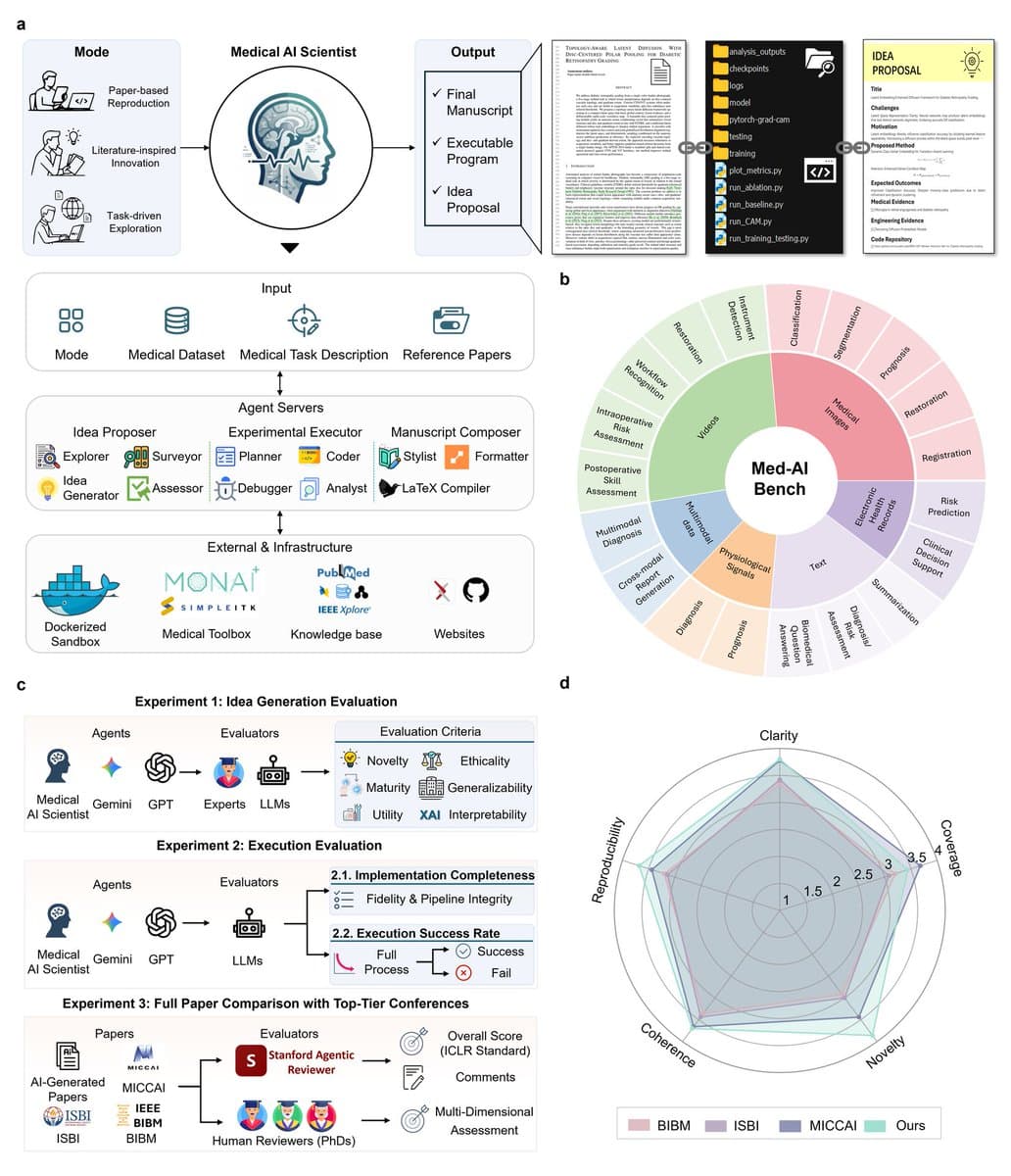
Microsoft Research, in collaboration with The Chinese University of Hong Kong (CUHK), has introduced what they describe as the first autonomous "Medical AI Scientist." This AI agent is designed to automate core scientific research functions: generating novel ideas, designing and running computational experiments, and writing academic papers. According to the announcement, the system's output reached "near-MICCAI quality" when evaluated on 171 clinical cases spanning 19 distinct medical imaging and diagnostic tasks. MICCAI (Medical Image Computing and Computer Assisted Intervention) is a top-tier conference in the field, indicating a high bar for technical and clinical relevance.
What the System Does
The Medical AI Scientist is not a single model but an integrated agentic framework. Its stated pipeline mirrors the workflow of a human researcher:
- Idea Generation: The system can analyze existing literature and clinical data to propose novel research hypotheses or problem formulations.
- Experiment Execution: It can design an experimental protocol (e.g., selecting model architectures, defining training splits, specifying evaluation metrics) and then run the corresponding computational experiments, likely involving training and validating AI models on medical datasets.
- Paper Writing: The agent synthesizes the results, contextualizes them within the broader literature, and drafts a complete academic manuscript, including figures, tables, and citations.
The benchmark of "near-MICCAI quality" on 171 cases across 19 tasks suggests the system was tested on a diverse set of medical AI problems, such as lesion segmentation, disease classification, or report generation. The quality assessment likely involves both automated metrics and human expert review comparing the AI-generated papers to those accepted at the prestigious MICCAI conference.
Technical Implications and Context
This work sits at the convergence of large language models (LLMs), automated machine learning (AutoML), and scientific AI. The core technical challenge is creating a reliable, closed-loop system where an LLM's planning and reasoning capabilities can robustly control complex, multi-step computational workflows involving code execution, model training, and data analysis—all while adhering to the rigorous standards of medical research.
Developing such an agent requires solving several hard problems: ensuring the experimental designs are sound and reproducible, preventing cascading errors in the pipeline, and generating text that is not only fluent but scientifically accurate and appropriately nuanced. The claim of near-MICCAI-quality writing is particularly significant, as it implies the AI can navigate the specific jargon, formatting, and argumentative style required in top-tier medical computer science publications.
Potential Impact and Cautions
If the capabilities hold under broader scrutiny, this system could accelerate research cycles in medical AI by automating routine aspects of the experimental process. It could serve as a powerful assistant for researchers, rapidly prototyping ideas or conducting large-scale ablation studies. It also raises immediate questions about authorship, verification, and the role of human oversight in AI-driven science. The medical domain, with its high stakes for patient safety, necessitates extreme caution; any AI-generated research would require thorough validation by human experts before influencing clinical practice.
The research, detailed in a paper linked from the announcement, represents a bold step toward automating scientific discovery. Its performance on a multi-task clinical benchmark provides a concrete, if initial, measure of its competence.
gentic.news Analysis
This development from Microsoft Research and CUHK is a direct escalation in the trend toward AI agents for science, a domain where Microsoft has been particularly active. It follows Microsoft's heavy investment in and integration of OpenAI's models, which provide the foundational reasoning and language capabilities necessary for such an agent. The collaboration with CUHK taps into significant expertise in medical imaging, aligning with Microsoft's broader health AI initiatives, such as its partnerships with Nuance and ongoing work in computational biology.
The concept of an "AI scientist" has been explored in foundational chemistry and physics (e.g., for autonomous materials discovery), but its application to the complex, multi-modal domain of clinical medicine is a notable advance. It also intersects with the growing field of AI for scientific writing, but moves far beyond simple literature review or summarization to encompass the full research lifecycle.
However, this announcement must be contextualized within a crowded field of AI research automation. Other players, including Google's AI-driven efforts in protein folding (AlphaFold) and material science, as well as various academic labs working on autonomous experimental design, are pursuing similar visions. The key differentiator here is the claimed end-to-end automation—from idea to publication draft—within the stringent domain of medicine. The benchmark against MICCAI acceptance standards is a clever and domain-relevant metric, but the community will need to examine the evaluation details closely. The real test will be whether pipelines built by this agent can produce novel, peer-reviewed discoveries that stand independently in the literature without extensive human revision.
Frequently Asked Questions
What is the "Medical AI Scientist"?
The Medical AI Scientist is an autonomous AI agent framework developed by Microsoft Research and CUHK. It is designed to automate the core loop of scientific research: generating a novel hypothesis based on literature and data, designing and running the computational experiments to test it, and then writing a complete academic paper detailing the methods and results.
What does "near-MICCAI quality" mean?
MICCAI is a top-tier international conference for medical image computing and computer-assisted intervention. Papers accepted there undergo rigorous peer review. "Near-MICCAI quality" suggests that the papers drafted by the AI system were evaluated (likely by human experts) and found to be close to the standard of papers that get accepted at this prestigious venue. The evaluation was conducted on 171 clinical cases across 19 different medical AI tasks.
Is this AI replacing medical researchers?
No. This is best viewed as a powerful research assistant or co-pilot. It can automate time-consuming, repetitive aspects of the research process, such as running large-scale model comparisons or drafting initial manuscript sections. The critical tasks of defining high-impact research directions, ensuring ethical and clinical validity, and providing ultimate oversight and interpretation of results remain firmly in the human domain, especially in medicine.
What are the biggest technical challenges for such a system?
Key challenges include ensuring the robustness and reproducibility of its automated experiments, preventing error propagation through its multi-step pipeline, and generating text that is not just fluent but scientifically precise and nuanced. It must also navigate the complex, often private, nature of medical datasets and adhere to strict ethical and regulatory standards inherent to healthcare research.