What Happened

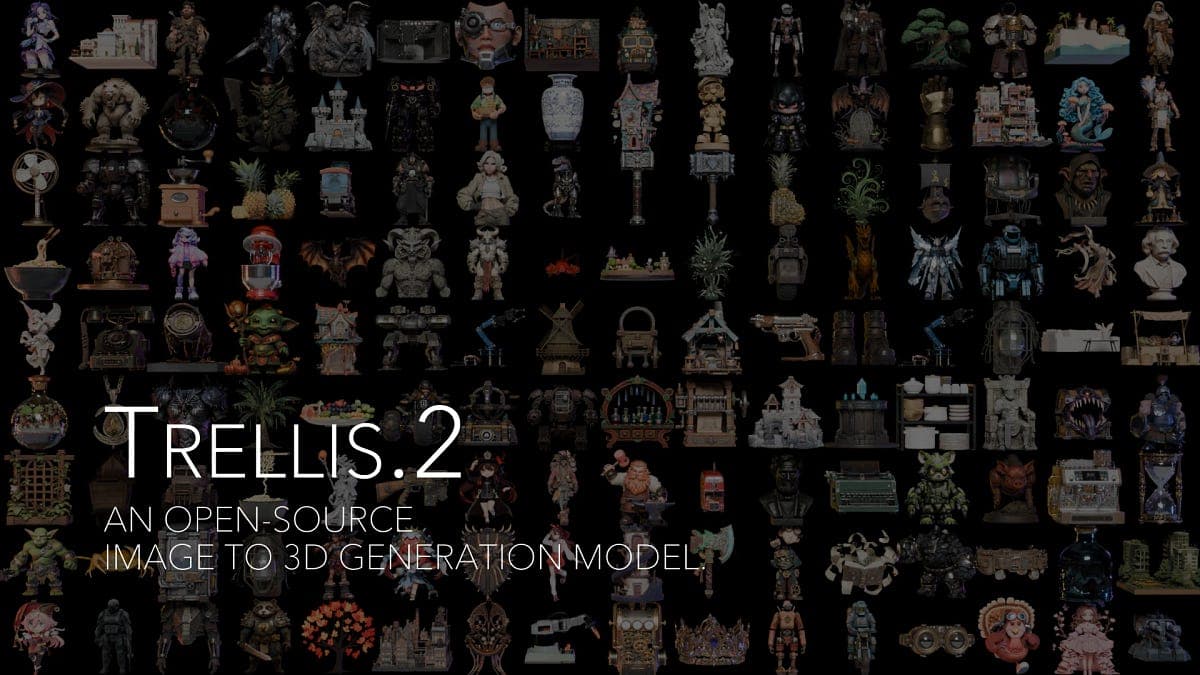
Microsoft dropped TRELLIS.2, a 4 billion parameter open-source model that turns a single 2D image into a fully textured 3D asset in roughly 3 seconds. The model produces physically accurate models with PBR (physically based rendering) textures — roughness, metallic, opacity maps — out of the box. Unlike many single-image-to-3D tools that output rough meshes or placeholder geometry, TRELLIS.2 generates production-ready assets.
The model is available on GitHub and a live demo is running on Hugging Face. The announcement came via a tweet from the VMLops account, highlighting that the model handles "open surfaces, hollow interiors, geometry that breaks every other tool."
Technical Details
TRELLIS.2 is a 4B parameter model. Key capabilities:
- Input: Single 2D image
- Output: Fully textured 3D model with PBR materials (roughness, metallic, opacity maps)
- Speed: ~3 seconds per asset
- Geometry handling: Open surfaces, hollow interiors, complex structures that typically break other tools
- Licensing: Open source
The PBR textures are a significant differentiator. Most single-image-to-3D models produce untextured meshes or simple color textures. PBR textures include multiple maps that define how light interacts with the surface, enabling realistic rendering under any lighting conditions.
How It Compares
Parameters 4B Often 0.5B–2B Output Full PBR textures Often untextured or simple color Speed ~3 seconds 10–60 seconds Complex geometry Handles open surfaces, hollow interiors Often fails on non-watertight geometry Open source Yes Often proprietaryThe model's ability to handle non-watertight geometry — open surfaces, hollow interiors — is notable. Most 3D reconstruction methods assume watertight (closed) meshes. This limitation breaks many real-world use cases where objects have holes, thin structures, or interior cavities.
What This Means in Practice
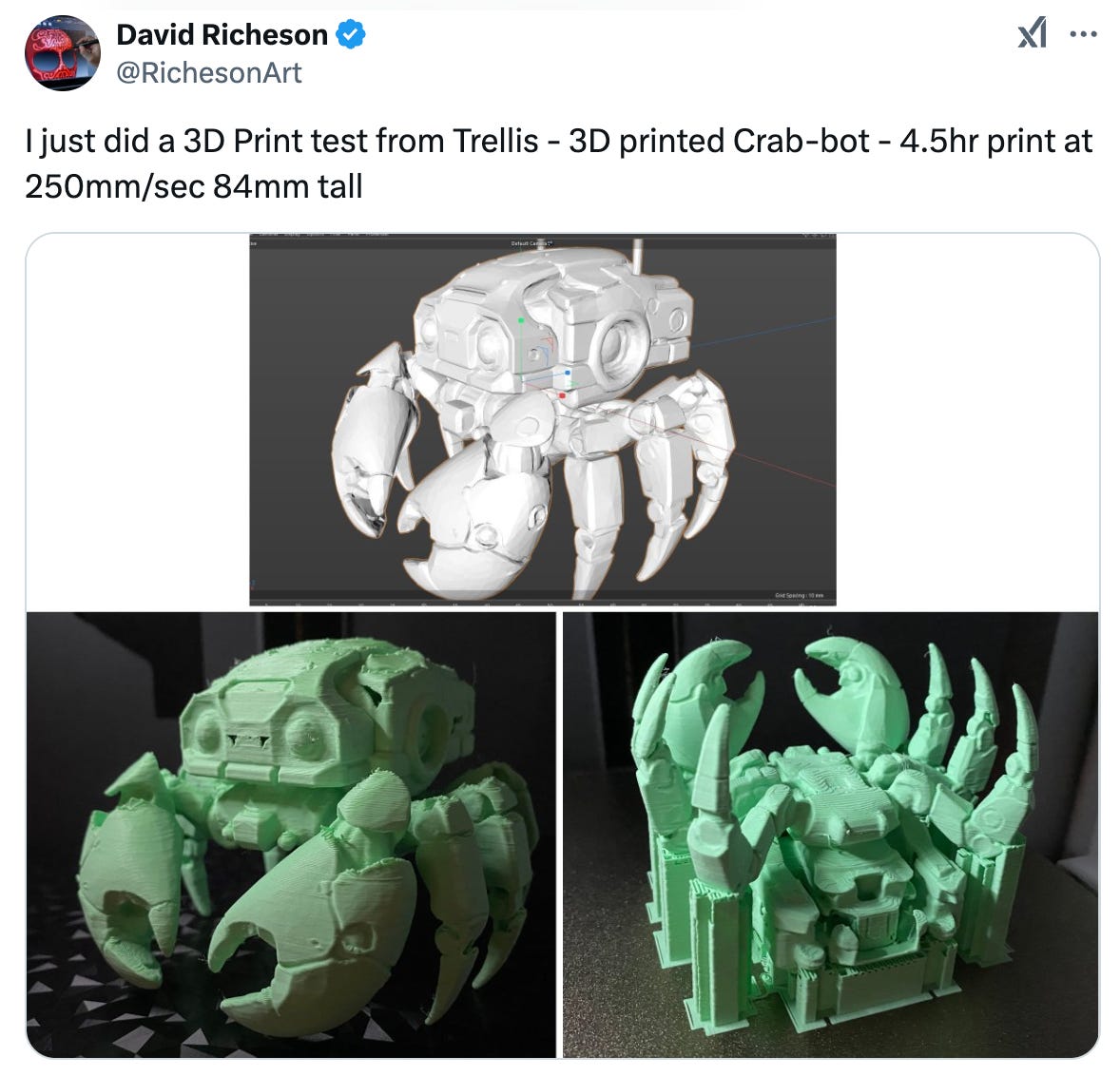
For game developers, VFX artists, and 3D content creators, TRELLIS.2 could dramatically reduce the time from concept art to production-ready 3D asset. Instead of spending hours modeling and texturing, a single concept image can seed a textured 3D model in seconds. The open-source nature means it can be integrated into pipelines, fine-tuned, or deployed on-premises.
Limitations and Caveats
- No published benchmarks on standard 3D reconstruction metrics (Chamfer distance, F-score, etc.)
- Quality on highly complex or ambiguous inputs is unverified
- 4B parameters requires significant GPU memory for inference
- The source is a tweet, not a paper or official blog post — details may be incomplete
gentic.news Analysis
Microsoft's open-source release of TRELLIS.2 continues a pattern we've tracked closely: the rapid commoditization of 3D generation. In recent months, we've covered Stability AI's Stable Fast 3D and OpenAI's Point-E, both pushing single-image-to-3D capabilities. Microsoft's entry at 4B parameters with PBR textures raises the bar on output quality.
The PBR texture capability is particularly strategic. Most single-image-to-3D models produce assets that look good in a viewer but break under realistic lighting. PBR textures are the industry standard for game engines (Unity, Unreal) and rendering pipelines. By outputting PBR-ready assets, TRELLIS.2 targets the professional pipeline, not just hobbyist demos.
The handling of non-watertight geometry is another pragmatic advance. Real-world objects rarely have clean closed meshes. This suggests the model was trained on a diverse dataset that includes scans of real objects with holes, thin structures, and interior cavities — likely leveraging Microsoft's internal 3D data assets.
The open-source release is notable given Microsoft's recent investment in AI infrastructure and partnerships. It positions TRELLIS.2 as a potential default tool for 3D asset generation, similar to how Segment Anything became the default for image segmentation. Expect fine-tuned versions for specific domains (architecture, product design, game assets) to emerge quickly.
Frequently Asked Questions
How does TRELLIS.2 compare to other single-image-to-3D models?
TRELLIS.2 is unique in outputting full PBR textures (roughness, metallic, opacity maps) rather than just a mesh or simple color texture. It also handles complex geometry like open surfaces and hollow interiors that break most other tools. At 4B parameters, it's one of the largest models in this category.
Can I run TRELLIS.2 on my own hardware?
Yes, the model is open source. However, with 4B parameters, it requires significant GPU memory — likely 16GB+ VRAM for inference. A live demo is available on Hugging Face for testing without local hardware.
What are PBR textures and why do they matter?
PBR (physically based rendering) textures include multiple maps that define how light interacts with a surface: roughness (how shiny), metallic (conductivity), and opacity (transparency). These maps enable realistic rendering under any lighting condition, which is essential for game engines, VFX, and product visualization.
Is TRELLIS.2 suitable for production use?
For rapid prototyping and concept visualization, yes. For final production assets, you'll likely need manual cleanup and refinement. The quality on ambiguous inputs is unverified, and no standard benchmarks have been published. However, the speed and PBR output make it a strong starting point for professional pipelines.