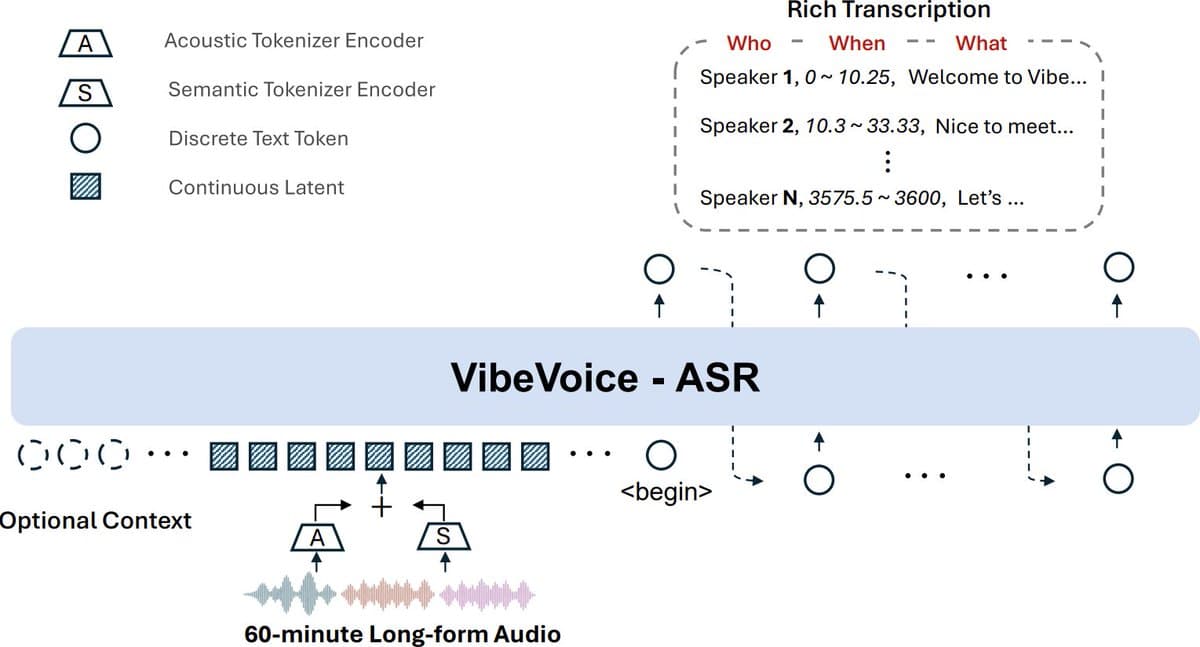
In a significant advancement for speech recognition technology, Microsoft has released VibeVoice-ASR on the Hugging Face platform, introducing capabilities that fundamentally change how we process long-form audio content. The model's headline feature—transcribing 60-minute audio files in a single pass—represents a technical breakthrough that addresses one of the most persistent limitations in automatic speech recognition systems.
Breaking the Chunking Barrier
Traditional speech recognition systems have long struggled with processing extended audio recordings. The conventional approach involves dividing lengthy audio into smaller segments (typically 10-30 seconds), processing each chunk separately, then attempting to stitch the results back together. This method introduces multiple problems: context loss between segments, inconsistent speaker identification across chunks, and accumulated errors that degrade overall accuracy.
VibeVoice-ASR eliminates this fragmentation entirely. By processing 60 minutes of continuous audio in one computational pass, the model maintains contextual coherence throughout the entire recording. This architectural achievement suggests Microsoft has developed novel approaches to memory management and attention mechanisms that allow the model to handle exceptionally long sequences without sacrificing performance.
Multilingual Intelligence Without Configuration
Perhaps equally impressive is the model's language handling capability. VibeVoice-ASR supports over 50 languages and, crucially, requires no language setting from users. The system automatically detects and transcribes speech in whatever language it encounters, removing a significant barrier to global accessibility.
This zero-configuration multilingual capability represents a departure from most speech recognition systems that require users to specify the input language. The technology likely employs sophisticated language identification algorithms that operate in tandem with the transcription engine, possibly using a multi-task learning approach that simultaneously identifies language while transcribing content.
Advanced Features Beyond Basic Transcription
Microsoft hasn't just improved transcription length—they've packed VibeVoice-ASR with professional-grade features:
Speaker Diarization: The model identifies and distinguishes between different speakers throughout the recording, labeling each segment with speaker identifiers. This is particularly valuable for meeting recordings, interviews, and multi-participant conversations where knowing "who said what" is as important as the content itself.
Timestamps: Every transcribed segment receives precise timing markers, enabling easy navigation and synchronization with the original audio. This feature transforms transcripts from static documents into interactive media companions.
Hotwords Support: Users can specify particular terms or phrases that require special attention or accuracy, ensuring critical terminology (like technical terms, names, or product references) receives prioritized recognition accuracy.
Technical Implications and Architecture
While Microsoft hasn't released detailed architectural specifications, several technical achievements are evident from the described capabilities:
Memory Optimization: Processing 60 minutes of audio (approximately 90MB of compressed data) in one pass requires exceptional memory efficiency, suggesting innovations in streaming architectures or selective attention mechanisms.
Context Window Expansion: The model likely employs transformer architectures with significantly expanded context windows, possibly using techniques like hierarchical attention or memory-augmented networks.
Multi-Task Learning: The simultaneous handling of transcription, language identification, speaker diarization, and timestamping suggests a sophisticated multi-task framework where different capabilities reinforce one another.
Practical Applications and Impact
VibeVoice-ASR's capabilities open new possibilities across multiple domains:
Legal and Medical Transcription: Lengthy depositions, court proceedings, and patient interviews can now be transcribed with maintained context and speaker identification.
Media Production: Podcasters, journalists, and content creators can process full episodes without manual segmentation.
Academic Research: Qualitative researchers analyzing lengthy interviews benefit from coherent transcripts with accurate speaker attribution.
Accessibility Services: Real-time captioning for extended events becomes more feasible with reduced processing latency.
Enterprise Meetings: Corporate meetings and conference calls gain searchable, navigable transcripts with participant identification.
The Hugging Face Ecosystem Advantage
By releasing VibeVoice-ASR on Hugging Face, Microsoft ensures immediate accessibility to developers, researchers, and organizations worldwide. The platform's standardized interface allows for easy integration into existing workflows, while community feedback and contributions can drive rapid improvements. This open approach contrasts with keeping such advanced technology proprietary, potentially accelerating innovation in the speech recognition space.
Competitive Landscape and Future Directions
VibeVoice-ASR enters a competitive field including OpenAI's Whisper, Google's Speech-to-Text, and Amazon Transcribe. While Whisper pioneered robust multilingual capabilities, Microsoft's offering distinguishes itself with the 60-minute single-pass processing and integrated speaker diarization. The absence of language configuration requirements also represents a user experience improvement over systems requiring explicit language selection.
Future developments might include:
- Even longer processing capabilities (2+ hours)
- Real-time streaming with the same features
- Emotion and sentiment analysis integrated with transcription
- Domain-specific optimizations for legal, medical, or technical vocabulary
- Lower computational requirements for edge device deployment
Accessibility and Ethical Considerations
As with any powerful transcription technology, ethical considerations emerge around privacy, consent, and potential misuse. Microsoft will need to provide clear guidelines about appropriate use cases, particularly regarding recording individuals without consent. The model's accuracy across different accents, dialects, and speech patterns will also require ongoing evaluation to ensure equitable performance.
Conclusion
Microsoft's VibeVoice-ASR represents more than an incremental improvement in speech recognition—it redefines what's possible with long-form audio processing. By eliminating the need for artificial segmentation while adding professional features like speaker diarization and automatic language detection, the model addresses real-world pain points that have persisted for years.
The release on Hugging Face democratizes access to this advanced capability, potentially accelerating innovation in applications from accessibility tools to enterprise solutions. As organizations begin integrating VibeVoice-ASR into their workflows, we may see a fundamental shift in how we capture, process, and utilize spoken information.
Source: Microsoft's release of VibeVoice-ASR on Hugging Face as reported by @HuggingPapers