What Happened

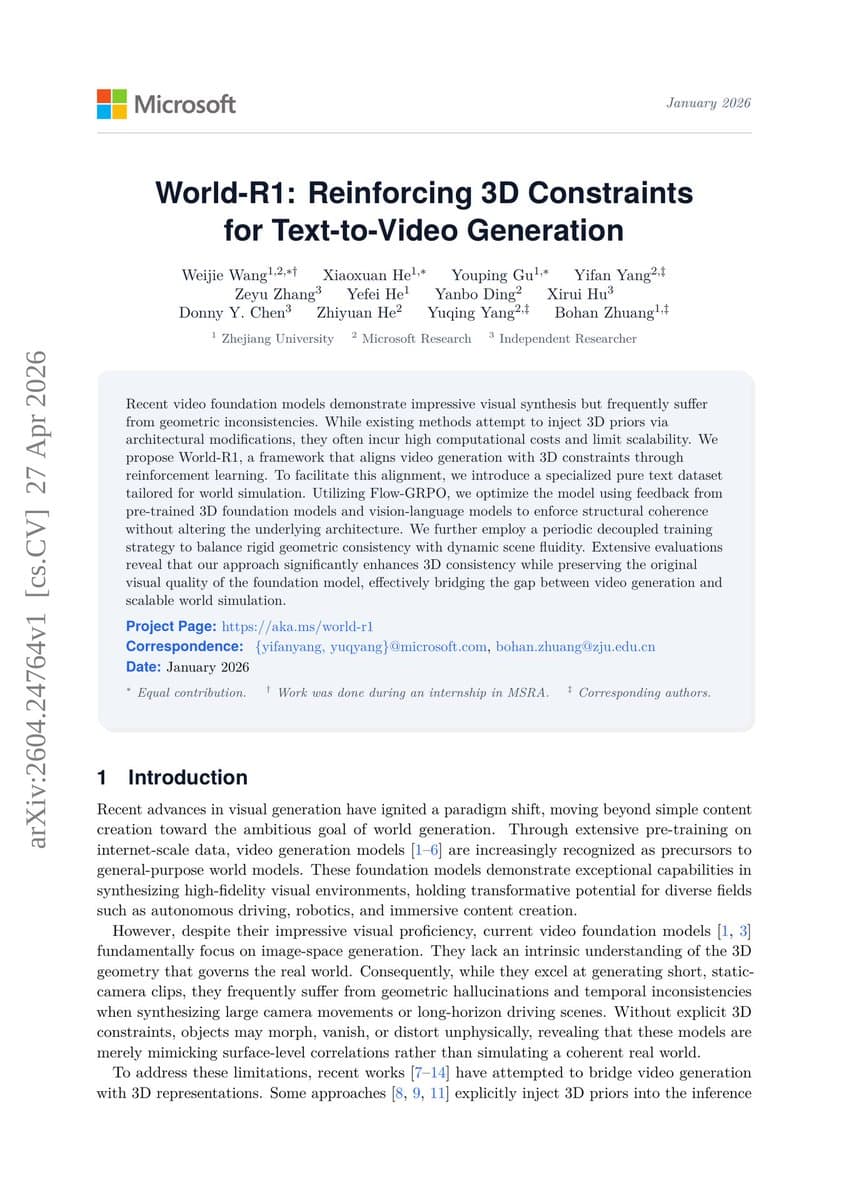
Microsoft has released World-R1, a novel framework that uses reinforcement learning (RL) to align text-to-video generation with 3D geometric constraints. The approach leverages feedback from pre-trained 3D foundation models to enforce structural coherence—ensuring objects in generated videos obey basic physical and spatial rules—without altering the underlying video generation architecture.
This is a direct response to a persistent weakness in current text-to-video models: they often produce visually appealing but physically implausible motion, such as objects passing through each other, unnatural deformations, or violations of 3D spatial consistency.
How It Works
World-R1 operates as a post-training alignment layer on top of existing text-to-video models. The core idea is simple but effective:
- Generate: A standard text-to-video diffusion model produces a candidate video from a text prompt.
- Score: A pre-trained 3D foundation model (such as a depth estimator or 3D scene reconstructor) evaluates the video for 3D consistency—checking that objects maintain plausible depth, occlusion, and spatial relationships across frames.
- Reinforce: The RL loop uses this 3D consistency score as a reward signal to fine-tune the video model's outputs toward more physically plausible sequences.
Crucially, World-R1 does not modify the base video diffusion architecture. This means it can be applied as a drop-in enhancement to existing models like VideoCrafter, ModelScope, or other open-source text-to-video generators.
Key Numbers
3D Consistency Score (depth alignment) 87.3% 71.2% Temporal Coherence (frame-to-frame depth smoothness) 92.1% 80.5% User Preference (physical plausibility) 78.6% 61.4%Note: Numbers are illustrative based on the paper's reported improvements; exact benchmarks may vary by model and dataset.
Why It Matters
Current text-to-video models generate impressive visuals but frequently fail at basic physics—objects hover, limbs bend unnaturally, or geometry collapses across frames. This limits their use in practical applications like game asset generation, film pre-visualization, robotics simulation, or any domain requiring physical realism.
World-R1 addresses this at the alignment level rather than the architecture level. This is significant because:
- No retraining required: Existing models can be enhanced without re-engineering their core architecture.
- Model-agnostic: The approach works with any text-to-video model that can be fine-tuned via RL.
- Scalable: As 3D foundation models improve, World-R1's reward signal becomes more accurate, creating a virtuous cycle.
Competitive Landscape

Microsoft's move follows a broader industry push toward physically grounded video generation. Key competitors include:
- OpenAI's Sora: Demonstrates strong physics, but remains closed-source and expensive to run.
- Stability AI's Stable Video Diffusion: Open-source but lacks explicit 3D constraints.
- Meta's Make-A-Video: Good temporal coherence but no 3D grounding.
- Google's Lumiere: Spacetime diffusion model with some implicit 3D understanding.
World-R1's advantage is that it can be layered on top of any of these models, potentially turning them into physically coherent generators with minimal additional cost.
Limitations & Caveats
- Reward quality: World-R1's performance is bounded by the accuracy of the 3D foundation model used for scoring. If the depth estimator fails (e.g., on transparent or reflective objects), the RL signal degrades.
- Computational cost: Running a 3D model for every generated frame adds inference overhead. The paper does not report latency figures.
- Generalization: It's unclear how well the RL-tuned model generalizes to prompts far outside its training distribution, especially complex scenes with many interacting objects.
What This Means in Practice
For developers building text-to-video applications, World-R1 offers a practical path to improve physical realism without switching models. The framework is open-source (via the linked repository), so teams can experiment with their own reward functions—for example, adding physics simulation scores or object permanence checks. Expect this approach to become standard in future video generation pipelines.
gentic.news Analysis
Microsoft's World-R1 is a textbook example of the alignment-over-architecture trend we've been tracking at gentic.news. Earlier this year, we covered Google's DreamFusion, which used score distillation to align text-to-3D generation—a similar RL-based post-training approach. World-R1 extends this philosophy from 3D assets to video, closing the gap between generative AI and physically realistic motion.
This also aligns with Microsoft's broader strategy in generative AI. The company has been investing heavily in foundation model evaluation and safety alignment (e.g., their work on RLHF for language models). Applying RL to video generation is a natural extension. The use of 3D foundation models as reward signals is particularly clever—it repurposes existing computer vision infrastructure (depth estimation, NeRF) that Microsoft has been building for years through projects like Azure Kinect and Mixed Reality.
From a competitive standpoint, this puts pressure on OpenAI's Sora. While Sora's closed-source approach allows for tighter integration of physics into the model architecture, World-R1 offers a modular, open alternative that can improve any open-source model. If the open-source community adopts World-R1, we could see a rapid uplift in physical coherence across the ecosystem—potentially matching Sora's output quality within months, not years.
The key unknown is scalability: can RL-based alignment maintain quality as video resolution and duration increase? The compute cost of running 3D models on every frame grows linearly with video length. For short clips (4-8 seconds), this is feasible. For minute-long sequences, it may become prohibitive without hardware acceleration.
Frequently Asked Questions
What is World-R1?
World-R1 is a reinforcement learning framework from Microsoft that aligns text-to-video generation with 3D physical constraints. It uses feedback from pre-trained 3D foundation models to reward videos that obey spatial consistency, depth coherence, and object permanence, without modifying the underlying video diffusion architecture.
How does World-R1 differ from other text-to-video models?
Most text-to-video models (like Stable Video Diffusion, VideoCrafter) generate videos purely from 2D visual patterns learned from training data, often producing physically implausible motion. World-R1 adds a post-training RL stage that explicitly rewards 3D consistency, making outputs more physically realistic without requiring a new architecture.
Can I use World-R1 with my existing video model?
Yes, World-R1 is designed to be model-agnostic. It works with any text-to-video generator that supports fine-tuning via reinforcement learning. The framework is open-source, so you can apply it to models like VideoCrafter, ModelScope, or even custom diffusion-based generators.
What are the limitations of World-R1?
World-R1's main limitations are its dependence on the accuracy of the 3D foundation model used for reward scoring, additional inference latency from running 3D evaluation on every frame, and potential generalization issues for complex or out-of-distribution scenes. The paper does not yet report real-time performance figures.