What Happened
According to a report from Kimmo Kärkkäinen (@kimmonismus), the Chinese AI company MiniMax has implemented a novel self-improvement pipeline for its M2.7 model. The core claim is that the model was used as an active participant in its own development process.
The process involved running the model through over 100 autonomous development loops. In each loop, M2.7 was tasked with:
- Analyzing failure trajectories from previous runs
- Modifying scaffold or base code
- Running evaluations on the modified versions
- Making autonomous decisions on which changes to keep or revert
The reported outcome of this bootstrapping process was a 30% performance improvement on MiniMax's internal benchmarks.
The Expanded Role in Research
Beyond the self-improvement experiment, MiniMax's reinforcement learning team has integrated M2.7 into their daily research operations. The model is reportedly used for:
- Experiment monitoring
- Debugging assistance
- Metric analysis
- Handling merge requests
The source states that M2.7 now covers 30-50% of the total research workflow for the team.
External Benchmark Performance
To test the model's general capabilities, MiniMax evaluated M2.7 on MLE Bench Lite, a collection of 22 machine learning competitions. The test protocol involved three separate 24-hour trials.
Across these trials, models trained or guided by M2.7 achieved a 66.6% medal rate (presumably meaning they placed within medal-winning positions). This performance reportedly ties that of Google's Gemini 3.1 model on the same benchmark.
Strategic Context and Cost Claim
The report frames this development within MiniMax's broader strategic direction: pursuing full autonomy across the AI development stack, including data processing, training, evaluation, and inference.
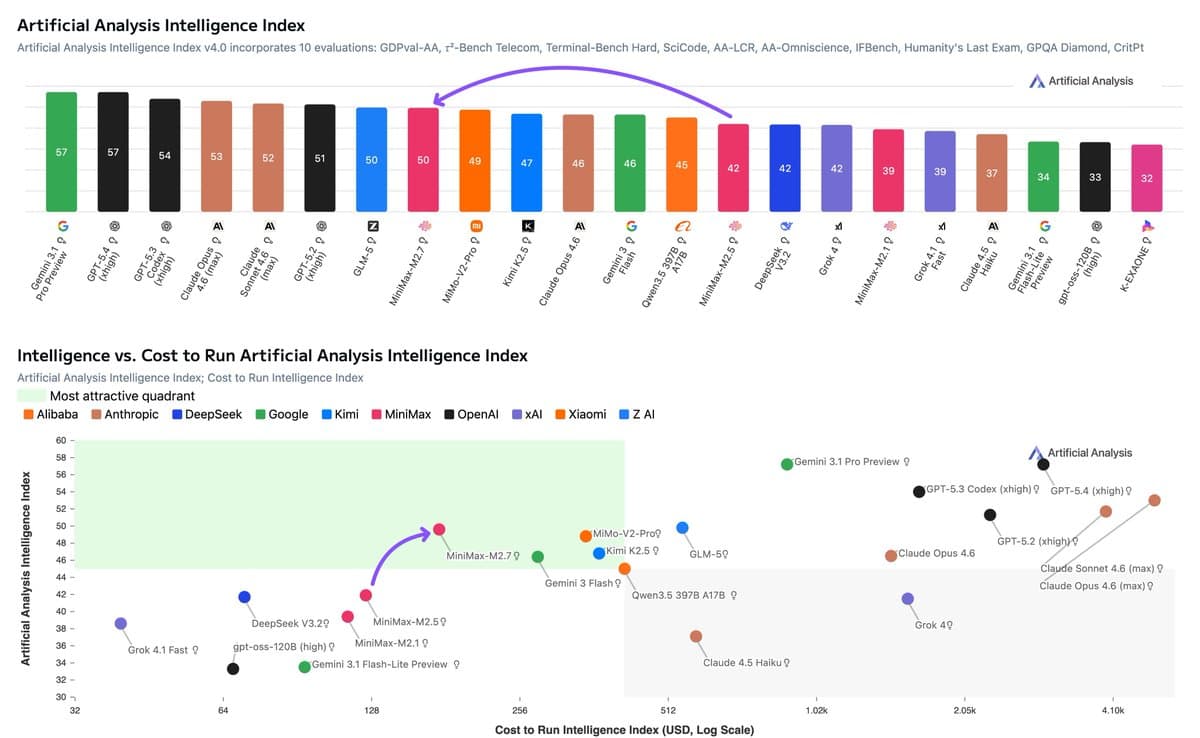
An additional claim is made regarding cost efficiency: that M2.7 delivers "GLM-5 intelligence at less than 1/3 its cost." This appears to be a comparative claim against Zhipu AI's GLM series, though no specific performance metrics or cost calculations are provided to substantiate this.