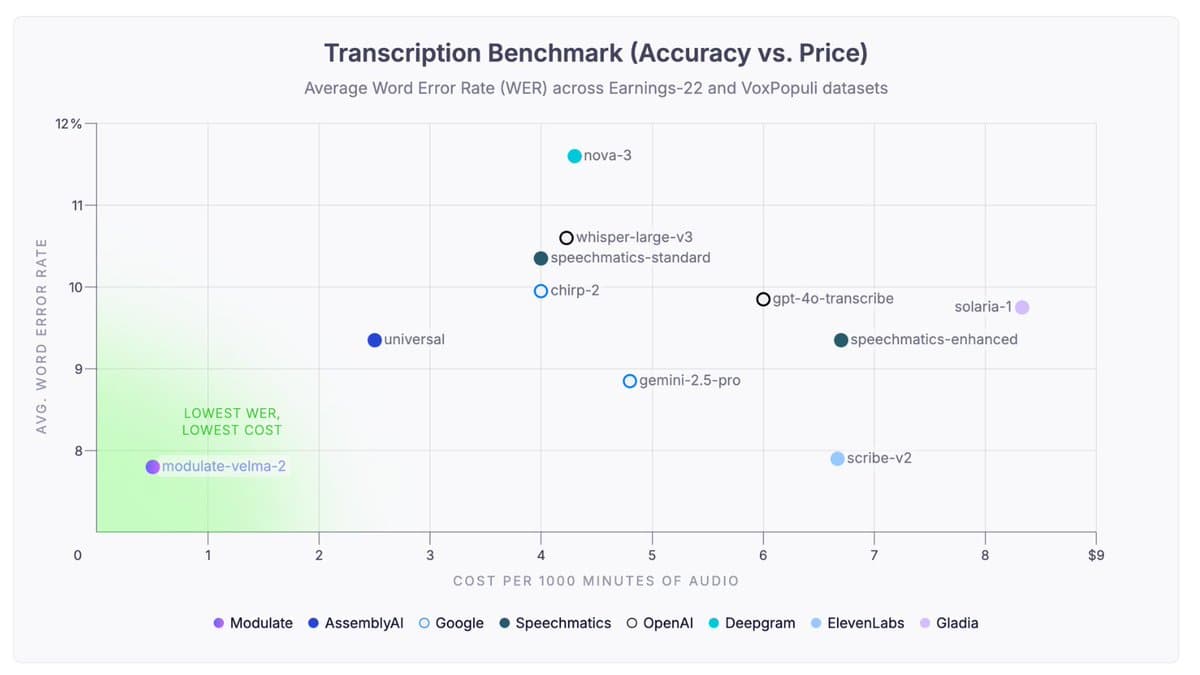
In a move that could dramatically reshape the economics of voice-based artificial intelligence, startup Modulate has launched a new API that reportedly offers transcription services at 10 to 90 times lower cost than established market leaders. This development, highlighted by AI commentator Hasaan Tohid (@hasantoxr), targets what he describes as "one of the biggest hidden costs in AI voice products" and has the potential to make sophisticated voice technology accessible to a much wider range of applications and developers.
The Established Market Landscape
For years, companies like Deepgram, AssemblyAI, and ElevenLabs Scribe have dominated the AI transcription space, offering high-quality speech-to-text services at premium prices. These services have become essential infrastructure for countless applications—from meeting transcription and content creation to customer service analytics and accessibility tools. However, their pricing structures have created a significant barrier to entry for smaller developers, startups, and projects with limited budgets, effectively making advanced voice AI a luxury good in the technology ecosystem.
According to industry analysis, transcription costs have remained stubbornly high despite advances in AI model efficiency, creating what observers call a "hidden tax" on voice-enabled innovation. Many developers have had to carefully ration their use of transcription APIs or seek alternative, often less accurate, solutions to manage costs.
Modulate's Disruptive Approach
Modulate's new API appears to challenge this status quo not with incremental improvements but with what Tohid describes as "orders of magnitude" price reductions. While specific pricing details weren't provided in the source material, the 10-90x cost reduction claim suggests Modulate has achieved a fundamental breakthrough in either their technical architecture, business model, or both.
This isn't merely a "slightly cheaper" alternative—it represents a potential paradigm shift in how voice transcription is priced and consumed. Such dramatic reductions could enable use cases previously considered economically unviable, from real-time transcription of lengthy video content to always-on voice interfaces for consumer applications.
Technical and Market Implications
The immediate question for the industry is how Modulate achieved such dramatic cost advantages. Potential factors could include:
- Novel model architectures that maintain accuracy while requiring significantly less computational resources
- Efficient inference techniques that reduce per-request costs
- Alternative business models that decouple pricing from traditional cost structures
- Specialized optimization for specific use cases or languages
Whatever their technical approach, the market implications are substantial. Established players will face pressure to justify their premium pricing or develop competitive responses. Meanwhile, developers who have been priced out of the transcription market may suddenly find voice features economically feasible for their applications.
Broader Impact on Voice AI Economics
Tohid's assertion that this development "could change voice AI economics overnight" points to several potential ripple effects:
Democratization of voice technology: Lower costs could enable smaller companies, independent developers, and educational institutions to incorporate sophisticated voice features into their products
New application categories: Previously cost-prohibitive use cases like real-time transcription for live events, extensive media archives processing, or always-listening interfaces might become economically viable
Increased competition: The entire voice AI stack—from transcription to synthesis to analysis—could see increased price competition as cost expectations reset
Accelerated innovation: With lower infrastructure costs, developers can experiment more freely with voice interfaces, potentially leading to novel applications and user experiences
Challenges and Considerations
While the price advantage is compelling, several questions remain unanswered in the initial announcement:
Accuracy and reliability: How does Modulate's transcription quality compare to established providers at various price points?
Feature parity: Does the API offer comparable features like speaker diarization, punctuation, profanity filtering, and multilingual support?
Scalability and latency: Can the service maintain its cost advantages at enterprise scale while meeting performance requirements?
Long-term sustainability: Is this pricing model sustainable, or is it an introductory offer to gain market share?
Developers considering switching to Modulate's API will need to evaluate these factors alongside the dramatic cost savings.
The Future of Voice AI Infrastructure
Modulate's move represents more than just another competitor entering the transcription market—it signals a potential inflection point where voice AI infrastructure transitions from premium service to commodity. Similar patterns have played out in other technology sectors, from cloud storage to basic machine learning inference, where dramatic cost reductions preceded massive market expansion.
If Modulate can deliver on its promise while maintaining quality and reliability, we may be witnessing the beginning of a new era for voice technology—one where sophisticated voice interfaces become as economically accessible as other forms of digital interaction.
Source: Hasaan Tohid (@hasantoxr) on X/Twitter