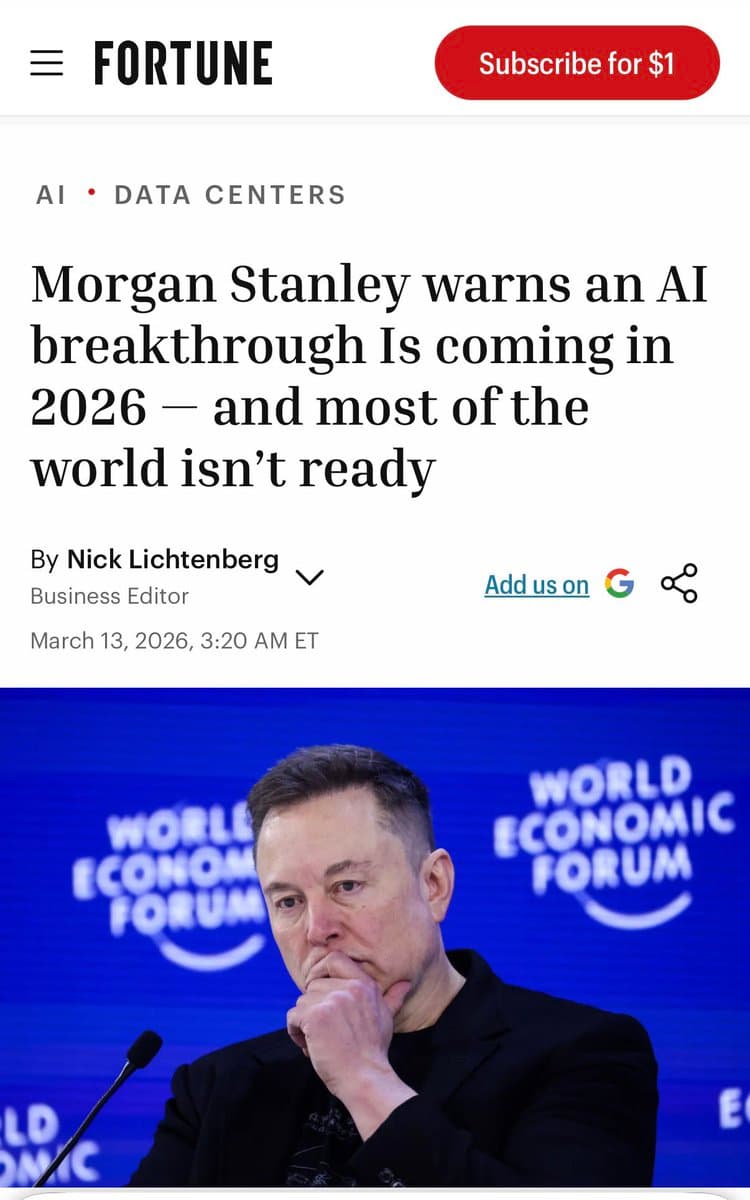
According to a recent analysis highlighted by financial experts, Morgan Stanley is sounding the alarm about a predicted "massive AI breakthrough" expected to arrive in the first half of 2026. The investment bank warns that this leap in capability, driven by an unprecedented scale-up in computational power at leading U.S. research labs, could catch much of the world unprepared for its profound economic and societal consequences.
The Nature of the Predicted Breakthrough
While the specific technical details of the anticipated advancement remain unspecified in the available reporting, the core driver is identified as unprecedented compute scaling. This suggests a move beyond incremental improvements in existing AI models toward a fundamental shift in capability, potentially enabled by orders-of-magnitude increases in training compute, novel hardware architectures, or algorithmic efficiencies that unlock new qualitative behaviors in artificial intelligence.
Morgan Stanley's warning implies this is not merely the next iteration of a large language model but a discontinuity—a "capability jump" that could redefine the potential applications and impact of AI technology. The focus on U.S. labs underscores the continued concentration of cutting-edge AI research and development within a handful of well-funded corporate and academic institutions.
The Triple-Impact Forecast: Productivity, Jobs, and Power
The analysis outlines three primary, interconnected areas of impact that could unfold rapidly following this technological inflection point.
1. Rapid Productivity Gains:
The most immediate positive effect would be a significant acceleration in productivity across sectors. AI systems with substantially enhanced reasoning, planning, or creative capabilities could automate complex cognitive tasks, optimize systems in real-time, and accelerate scientific discovery and R&D. This could lead to a surge in economic output, but one that may be unevenly distributed.
2. Severe Job Disruption:
This surge in productivity has a direct corollary: profound labor market disruption. If AI can perform a wider array of non-routine cognitive tasks at or above human level, the scope of jobs susceptible to automation expands dramatically. Morgan Stanley's warning suggests the displacement could be faster and more widespread than current adaptation plans account for, affecting white-collar professions previously considered safe.
3. Critical Power Shortages:
Perhaps the most tangible and immediate infrastructural warning is the prediction of severe power shortages. Training and running next-generation AI models are extraordinarily energy-intensive. A sudden, large-scale deployment of vastly more powerful AI would place immense, unforeseen strain on national power grids. This highlights a growing recognition that the AI revolution is as much an energy challenge as a software one, with data centers potentially competing with cities for electricity.
Intelligence as the Key Economic Resource
Underpinning these forecasts is a broader thesis: that intelligence itself is becoming the key economic resource. In this emerging paradigm, access to advanced AI—and the compute power to run it—could become a primary determinant of economic competitiveness, national security, and geopolitical influence. This shifts the focus from traditional resources like capital and labor to digital infrastructure, semiconductor supply chains, and energy capacity.
This transition could exacerbate existing inequalities, creating a divide between entities (companies, nations) that control frontier AI and those that do not. It also raises urgent questions about governance, control, and the alignment of increasingly powerful AI systems with broad human interests.
The Readiness Gap
Morgan Stanley's central message is a preparedness gap. While the tech industry races toward this horizon, broader societal structures—educational systems, regulatory frameworks, energy infrastructure, and social safety nets—are evolving at a much slower pace. The warning implies that the economic and social shocks of 2026 could be mitigated with proactive planning, but that such planning is currently insufficient.
The call to action, implicit in this analysis, is for policymakers, business leaders, and institutions to look beyond the current AI hype cycle and begin concrete preparations for a world where advanced, general-purpose AI is a operational reality. This includes investing in grid resilience, rethinking workforce transition strategies, and developing robust governance models for powerful AI systems.
The predicted timeline of "the first half of 2026" sets a clear, near-term horizon for these challenges, moving the conversation about AI's future impact from abstract speculation to imminent strategic planning.
Source: Analysis based on reporting from Morgan Stanley, as highlighted by @kimmonismus on X.