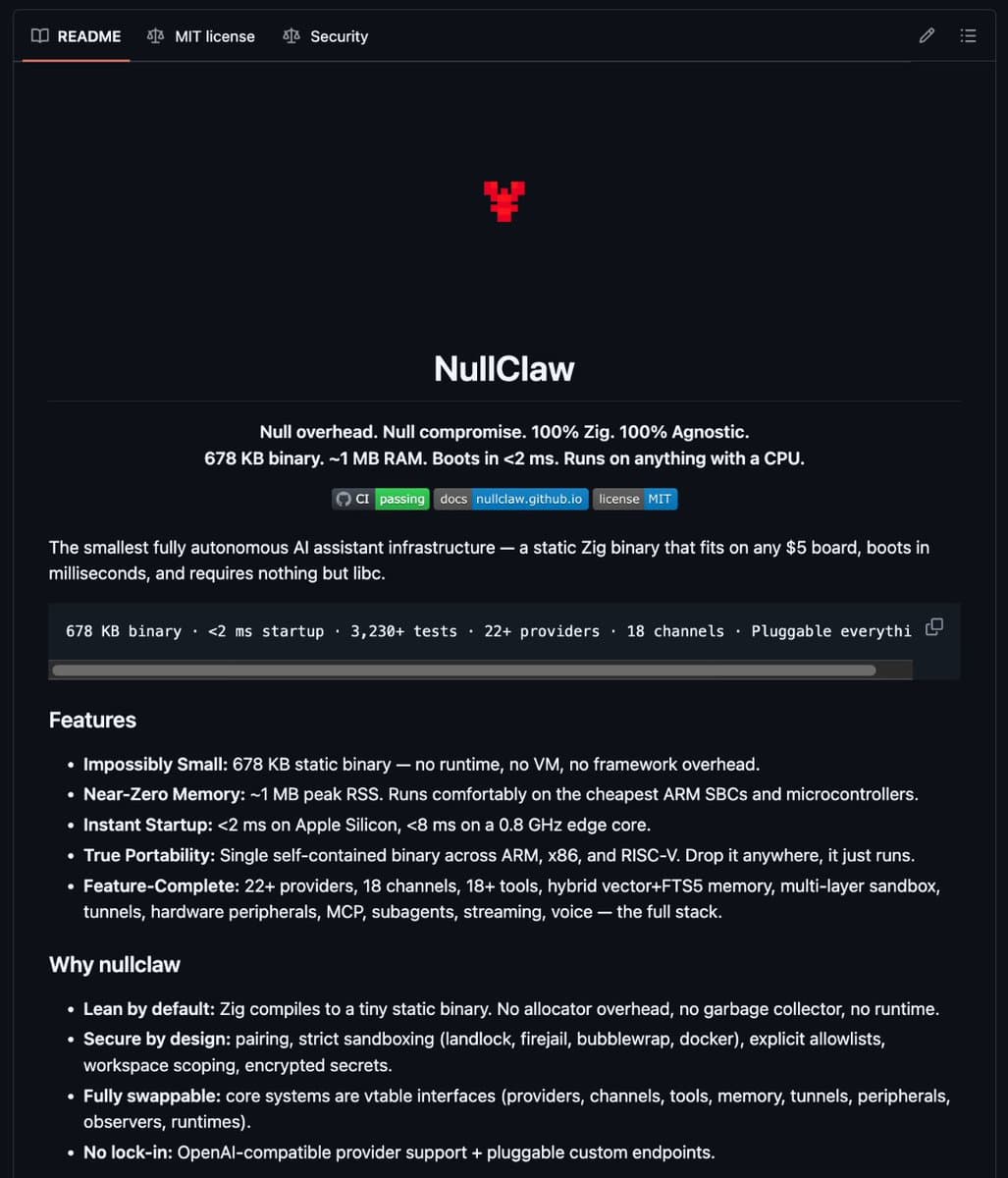
In a remarkable breakthrough for edge AI deployment, developers have created NullClaw—a fully autonomous AI agent that runs on just 1 megabyte of RAM with a binary size smaller than most profile pictures. This development represents a paradigm shift in how artificial intelligence can be deployed, moving away from resource-intensive cloud solutions toward truly distributed, edge-native intelligence.
The Technical Breakthrough
NullClaw's most striking feature is its minimal resource footprint: a 678KB binary that consumes approximately 1MB of peak RAM during operation. To put this in perspective, a typical browser tab uses about 100 times more memory. The agent achieves this efficiency through several key architectural decisions:
Pure Zig Implementation: Unlike most AI systems built on Python, Node.js, or even Rust/Go runtimes, NullClaw is written entirely in Zig—a systems programming language designed for optimal performance and minimal overhead. This eliminates the "runtime tax" that typically adds megabytes or even gigabytes to deployment sizes.
Zero External Dependencies: The entire system operates without relying on external libraries or frameworks, further reducing its footprint and improving security through reduced attack surfaces.
Exceptional Performance Metrics: On modest 0.8 GHz edge hardware, NullClaw starts up in under 8 milliseconds—orders of magnitude faster than traditional AI frameworks that can take seconds to initialize.
Deployment Flexibility
What makes NullClaw particularly revolutionary is where it can run:
Ultra-Low-Cost Hardware: The agent operates seamlessly on $5 ARM boards, making AI accessible in environments previously considered impossible due to cost or power constraints.
Cloud-Native Environments: It runs on Cloudflare Workers via WebAssembly (WASM), enabling serverless AI at the edge of cloud networks.
Containerized and Sandboxed: Docker support allows for secure, isolated deployments in enterprise environments.
Multiple Interface Modes: Both CLI and gateway modes provide flexibility for different use cases, from embedded systems to API endpoints.
Feature-Rich Despite Minimal Size
Remarkably, NullClaw packs a comprehensive feature set into its tiny footprint:
Multi-Provider AI Support: Integration with 22+ AI providers ensures flexibility in model selection without increasing base size.
Hybrid Memory System: Combining vector search with SQLite's FTS5 (Full-Text Search) provides sophisticated memory capabilities without external database dependencies.
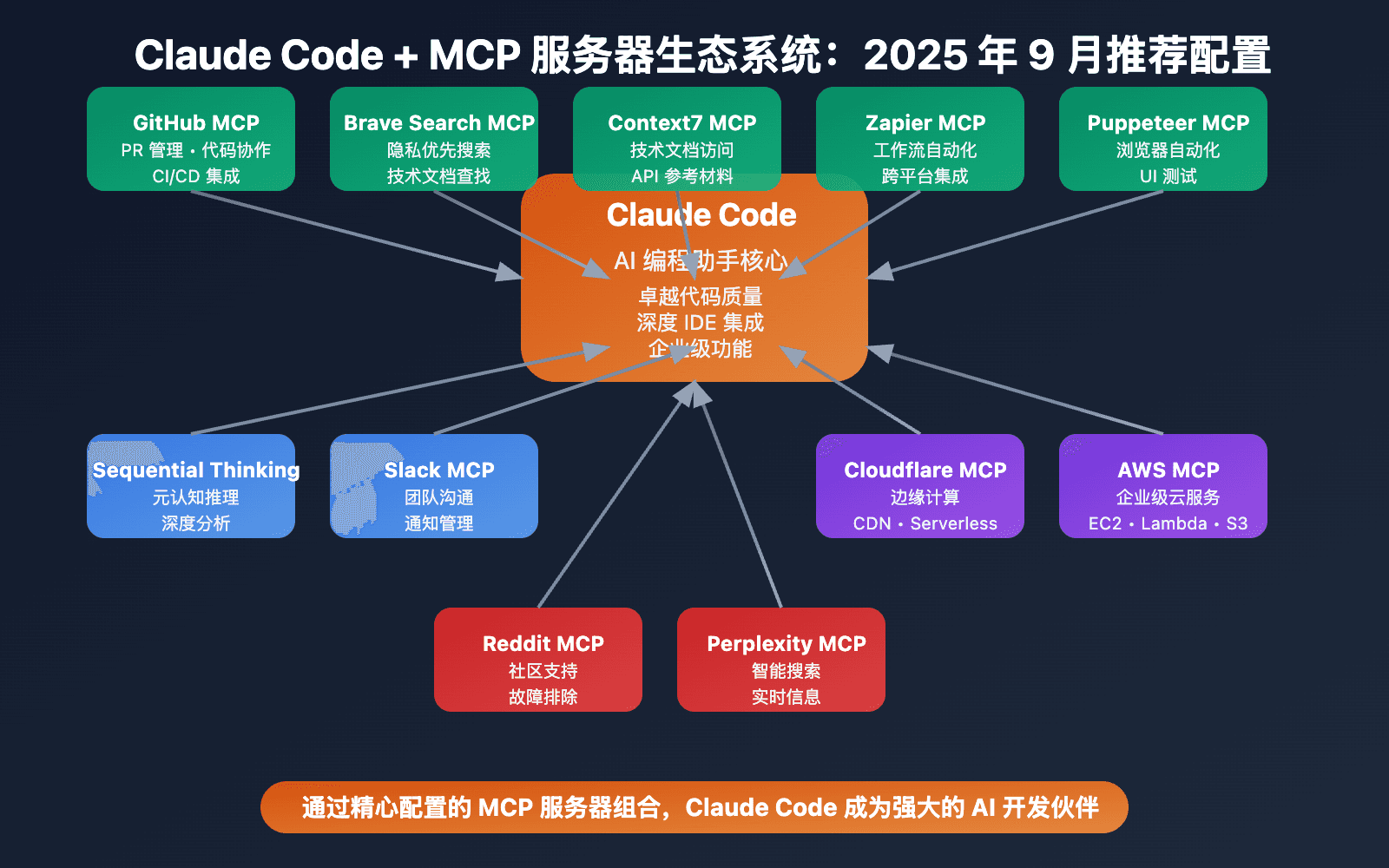
Model Context Protocol (MCP) Support: This allows the agent to connect to various tools and data sources, expanding its capabilities dynamically.
Multi-Channel Communication: Native support for Telegram, Discord, Signal, WhatsApp, Slack, iMessage, and 17 total channels enables human-AI interaction across platforms.
Security Features: ChaCha20-Poly1305 encryption protects secrets and communications at rest and in transit.
Advanced Agent Architecture: Subagent support, streaming capabilities, and voice functionality provide sophisticated AI behaviors typically associated with much larger systems.
Performance Dominance
Benchmark comparisons against equivalent implementations in TypeScript, Python, Go, and Rust show NullClaw winning "every single category" according to developer reports. The 3,230+ tests conducted validate its reliability across diverse scenarios.
Implications for AI Deployment
This development has profound implications for several domains:
Internet of Things (IoT): Suddenly, even the most constrained IoT devices can host intelligent agents, enabling local decision-making without cloud dependency.
Disaster and Remote Scenarios: In environments with limited or no connectivity, NullClaw-powered devices can provide AI capabilities independently.
Cost-Sensitive Applications: The ability to run on $5 hardware dramatically lowers the barrier to AI integration in products and services.
Privacy-First AI: By processing data locally, NullClaw enables AI applications that don't require sending sensitive information to cloud servers.
The Zig Advantage
The choice of Zig as the implementation language is particularly significant. Zig's focus on explicit resource management, compile-time execution, and minimal runtime overhead makes it uniquely suited for such constrained environments. As AI continues to expand into edge computing, we may see increased adoption of systems languages like Zig for AI infrastructure.
Open Source Accessibility
As a 100% open-source project, NullClaw invites community examination, contribution, and adaptation. This transparency is crucial for security-critical applications and accelerates innovation through collaborative development.
Future Trajectory
NullClaw represents more than just a technical achievement—it points toward a future where AI is truly ubiquitous, running not just in data centers but in every device around us. As the project evolves, we can expect to see:
- Further optimization and feature expansion
- Specialized versions for particular industries
- Integration with emerging hardware platforms
- New applications we haven't yet imagined
Source: @hasantoxr on X
Conclusion
NullClaw's achievement of packing a fully autonomous AI agent into less than 1MB of memory challenges fundamental assumptions about AI deployment. By eliminating runtime bloat and optimizing for minimal resource consumption, it opens possibilities for intelligent systems in environments previously considered impossible. As edge computing continues to grow alongside AI advancement, solutions like NullClaw will play a crucial role in making artificial intelligence truly pervasive, private, and accessible.