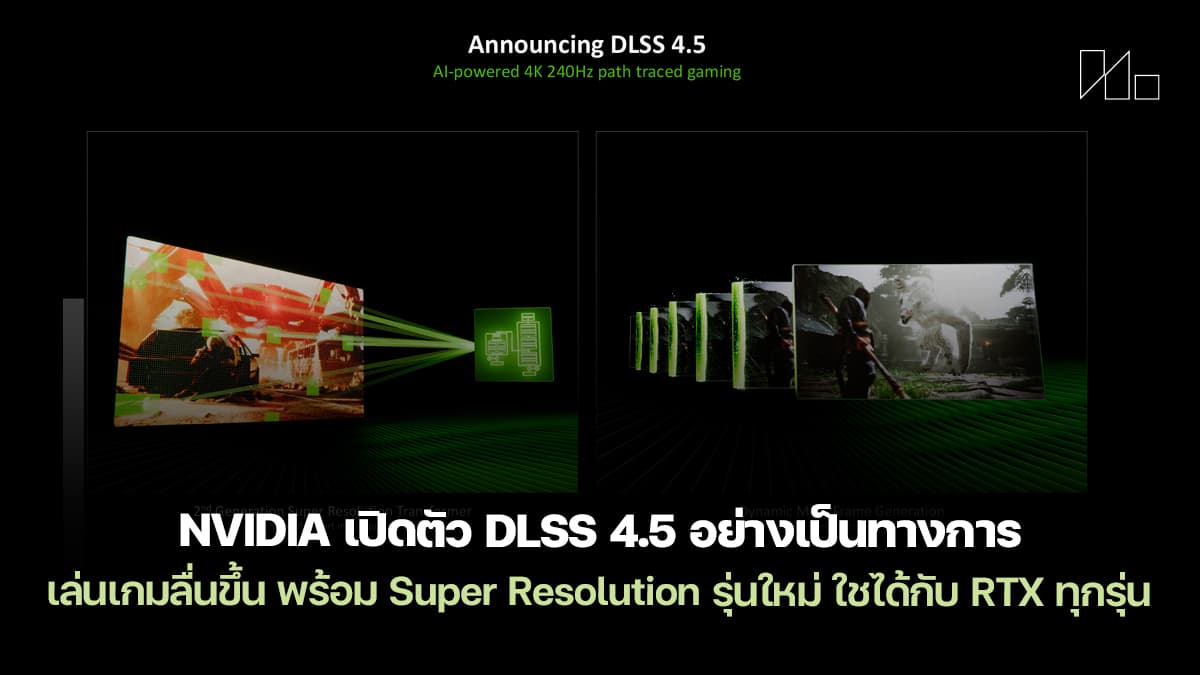
Nvidia has officially rolled out DLSS 4.5, the latest iteration of its Deep Learning Super Sampling technology, introducing new AI-driven frame generation features and significant improvements to its ray reconstruction system. The update is available immediately for owners of GeForce RTX 40 Series and the newer RTX 50 Series graphics cards.
What's New in DLSS 4.5
The DLSS 4.5 update centers on two primary enhancements: expanded frame generation capabilities and a refined AI model for ray reconstruction.
New Frame Generation Modes:
DLSS 4.5 introduces additional AI frame generation presets designed for different gameplay scenarios. While DLSS 3's Frame Generation was a binary on/off feature, version 4.5 offers more granular control. Early reports from developers with access suggest modes optimized for minimal latency in competitive titles and a separate mode prioritizing maximal visual smoothness and artifact reduction for single-player experiences.
Enhanced Ray Reconstruction:
Ray Reconstruction (RR), the AI denoiser introduced with DLSS 3.5, receives a substantial upgrade. The new AI model is trained on a significantly larger dataset, leading to improved handling of fine details like hair, foliage, and particle effects in path-traced scenes. The goal is to reduce temporal instability ("fizzling" or "boiling" pixels) that could occur in motion with the previous version.
Technical Details & Availability
DLSS 4.5 is a driver-level and SDK update. It is supported on all GeForce RTX 40 Series (Ada Lovelace) and RTX 50 Series (Blackwell) GPUs, which contain the dedicated Optical Flow Accelerator hardware necessary for AI frame generation. The technology remains unsupported on older RTX 20 and 30 Series cards.
Game integration is required. The DLSS 4.5 SDK is now available to developers, meaning updates for supported games will roll out over the coming weeks and months. Nvidia's list of "RTX Remix" ready games and titles with full path tracing (like Cyberpunk 2077, Alan Wake 2, and Portal with RTX) are expected to be among the first to receive patches.
How It Compares
DLSS 4.5 represents an iterative but focused improvement over DLSS 3.5. The frame generation enhancements are not a fundamental architectural change but rather a refinement of the AI model and the introduction of user/developer-facing presets. The more significant technical leap appears to be in Ray Reconstruction, which addresses a key pain point in fully path-traced graphics.
Frame Generation Single "Quality" mode Multiple presets (Low Latency, High Quality) Ray Reconstruction Model 3rd-gen AI model 4th-gen model, larger training dataset Hardware Support RTX 40 Series RTX 40 & 50 Series Primary Focus Introducing RR for path tracing Refining RR quality & expanding FG utilityWhat to Watch
The success of DLSS 4.5 will hinge on two factors: the speed of game developer adoption and the tangible perceptual improvement in supported titles. The promise of more stable ray-traced imagery is significant for the visual fidelity of upcoming games built with path tracing in mind. However, as with all temporal upscaling and generation techniques, the ultimate test will be in hands-on reviews measuring image clarity, artifact introduction, and latency impacts across the new presets.
gentic.news Analysis
This release continues Nvidia's aggressive cadence in refining its AI-powered graphics stack, a strategy that has become a core differentiator for its GeForce brand. The focus on improving Ray Reconstruction is particularly telling. It signals that Nvidia is betting heavily on path tracing as the future of real-time graphics, as we noted in our analysis of the "RTX Remix" platform launch last year. The computational demand of path tracing is immense, making efficient, high-quality AI denoising not just a nice-to-have, but an absolute necessity.
The introduction of frame generation presets is a direct response to community feedback. While DLSS 3's Frame Generation was a technical marvel, its one-size-fits-all approach sometimes led to sub-optimal trade-offs between latency and smoothness in different genres. DLSS 4.5's segmented approach is a more mature, user-centric evolution of the technology.
This update also solidifies the hardware divide within the RTX lineup. By restricting DLSS 4.5 to the 40 and 50 Series, Nvidia reinforces the value of its latest architectures and their specific AI tensor and optical flow hardware. This creates a clear performance tiering, as competitors like AMD's FSR 3 and Intel's XeSS remain broadly compatible across GPU brands and generations. Nvidia's strategy is clear: to leverage its vertical integration of hardware, drivers, and AI models to create a best-in-class experience that is locked to its most recent silicon, driving upgrade cycles.
Frequently Asked Questions
What is DLSS 4.5?
DLSS 4.5 is the latest version of Nvidia's Deep Learning Super Sampling, an AI technology that uses a neural network to boost game performance and image quality. This update specifically enhances its Ray Reconstruction denoiser and adds new presets for its AI Frame Generation feature.
Which graphics cards support DLSS 4.5?
DLSS 4.5 is supported on GeForce RTX 40 Series (Ada Lovelace) and RTX 50 Series (Blackwell) graphics cards. It is not available for older RTX 20 or 30 Series GPUs, as they lack the required Optical Flow Accelerator hardware for the frame generation features.
How do I get DLSS 4.5 in my games?
You will need two things: the latest Nvidia Game Ready Driver and for game developers to update their titles with the DLSS 4.5 SDK. You cannot enable it manually in unsupported games. Updates will roll out on a per-game basis.
What's the difference between DLSS Super Resolution and DLSS Frame Generation?
DLSS Super Resolution (the original DLSS) uses AI to upscale a lower-resolution image to your monitor's native resolution, boosting performance. DLSS Frame Generation (introduced in DLSS 3) uses AI to create entirely new frames between rendered ones, further increasing smoothness. DLSS 4.5 adds new presets to Frame Generation.