Nvidia and LG Group announced a joint AI factory project on Tuesday. The facility will power LG's robotics, autonomous driving, and manufacturing AI across its business units.
Key facts
- Nvidia and LG Group announced joint AI factory project.
- LG will use Nvidia Isaac Sim, Isaac Lab, and Cosmos platforms.
- LG Electronics developing home robot CLoiD.
- LG Innotek providing sensing solutions optimized for Nvidia GPUs.
- Partnership spans robotics, autonomous driving, and manufacturing.
Nvidia and LG Group are building an AI factory to accelerate LG Group’s next wave of AI-driven businesses, spanning robotics, autonomous driving, data center technologies and GPU cloud services. According to Nvidia's blog post The AI factory will provide LG Group with accelerated computing infrastructure to train, simulate, validate and deploy AI-based applications across its key businesses.
The collaboration brings together NVIDIA’s full-stack, end-to-end AI factory platform with LG Group’s global leadership in consumer electronics, robotics, mobility components, smart spaces and data center technologies. Together, the companies are connecting AI model development, physical AI data generation, robot simulation and training, edge deployment and factory-scale digital twins into a unified workflow for building physical AI systems.
Physical AI and Robotics Focus
The combination of LG’s production technology data and know-how from global manufacturing sites with NVIDIA’s AI infrastructure and digital twin technologies will help enhance AI-driven manufacturing AI competitiveness. The two companies will collaborate to build an autonomous manufacturing ecosystem in which the entire process — from raw material procurement to production, logistics and customer delivery — is connected in real time through data and AI, and establish it as a new global smart factory standard.
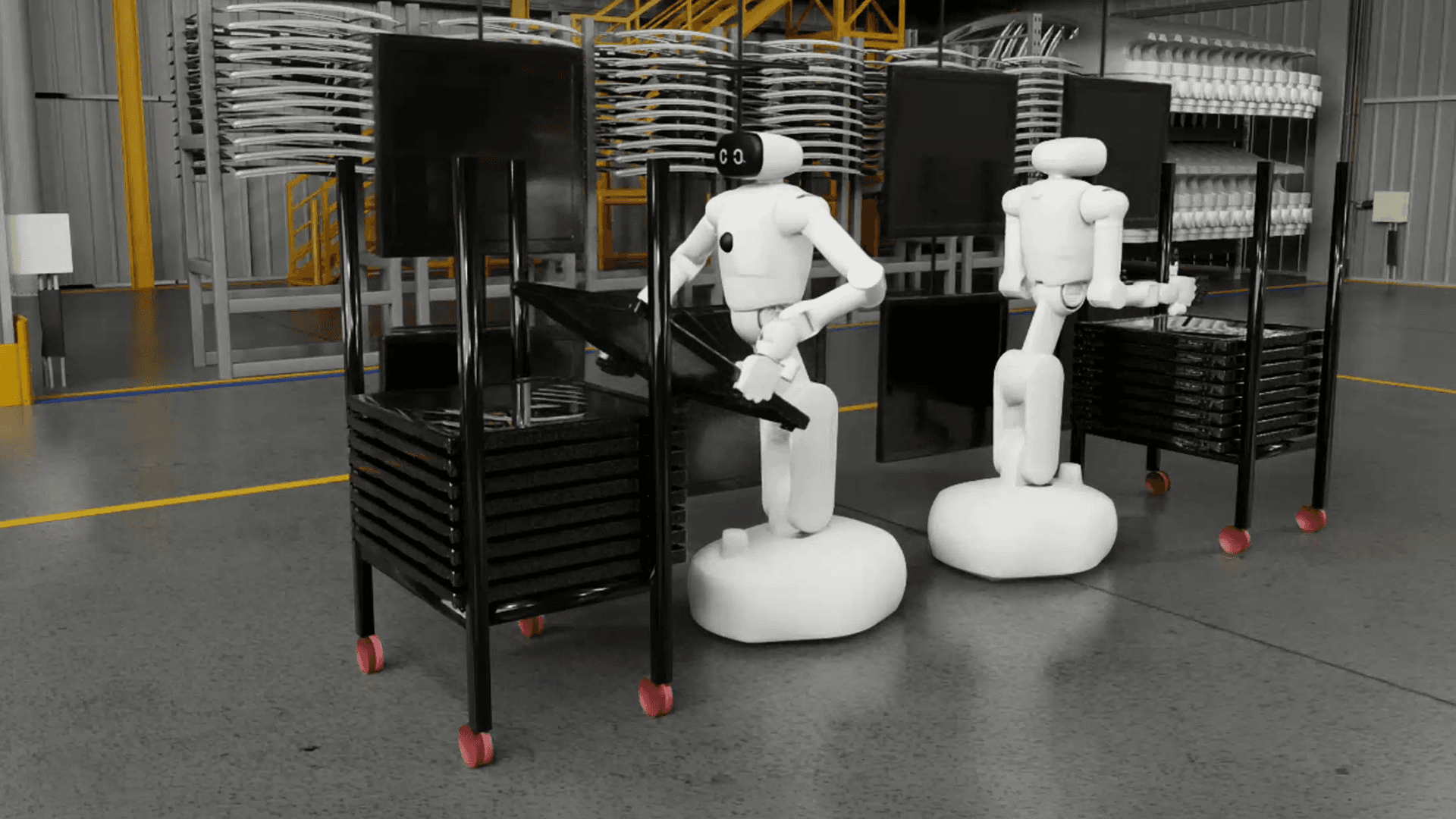
LG Electronics is developing home-based robots like CLoiD to help with a wide range of indoor household tasks, enhancing everyday convenience and improving quality of life. By integrating the NVIDIA Isaac Sim and NVIDIA Isaac Lab open robotics frameworks into their development workflows, LG can simulate, train and validate these home cobots in physically accurate virtual environments before deployment.
The company is exploring using the NVIDIA Isaac GR00T open, reasoning vision action language model for both its home robots and modular robotics platforms. The GR00T model will provide LG robots humanlike reasoning and the ability to execute complex tasks. NVIDIA and LG Electronics also plan to jointly develop reference robots, positioning LG’s robots as part of the NVIDIA Isaac GR00T ecosystem.
To help overcome the training data challenge for robotics, LG Electronics is developing a physical AI data factory poised to help Korean and global companies accelerate physical AI projects. By turning compute into data, LG will be providing high-quality training data for robotics and industrial AI projects, using NVIDIA Cosmos world foundation models for synthetic data generation and augmentation.
LG Innotek, harnessing its world-class optical expertise, plans to provide state-of-the-art robotics components, including sensing solutions, specifically optimized for NVIDIA’s development environments and GPU architecture. LG CNS is building an ecosystem that enables anyone to easily adopt AI robots in manufacturing and logistics sites. By integrating NVIDIA’s robotics technologies including Isaac open robotics frameworks, NVIDI
This deal marks one of the largest conglomerate-level AI infrastructure commitments to date, spanning consumer electronics, automotive, and industrial automation. It also deepens Nvidia's physical AI ecosystem beyond the robotics startups and cloud providers that have dominated its recent partnerships. For LG, the AI factory provides a unified compute backbone for its disparate business units — from LG Electronics' home robots to LG Innotek's optical sensors — that previously operated with separate AI stacks. The partnership also positions LG as a potential reference customer for Nvidia's Isaac GR00T ecosystem, which Nvidia is betting will become the standard platform for robot development.
Watch for the first joint reference robot design from Nvidia and LG Electronics, expected within the next 12 months. The physical AI data factory's output volume — measured in terabytes of synthetic training data generated per month — will be a key metric to track, as it will signal whether LG can scale its data-generation approach beyond internal use to serve Korean and global robotics companies.
What to watch
Watch for the first joint reference robot design from Nvidia and LG Electronics, expected within the next 12 months. The physical AI data factory's output volume — measured in terabytes of synthetic training data generated per month — will be a key metric to track, as it will signal whether LG can scale its data-generation approach beyond internal use to serve Korean and global robotics companies.
Source: blogs.nvidia.com
[Updated 08 Jun via nvidia_dc_blog]
LG Uplus, LG Group's telecom arm, is building a dedicated data center to accommodate Nvidia's AI hardware [per DCD News]. The facility will host the accelerated computing infrastructure for the joint AI factory project, ensuring LG Group has localized, high-bandwidth compute capacity for training and deploying physical AI models across its business units.