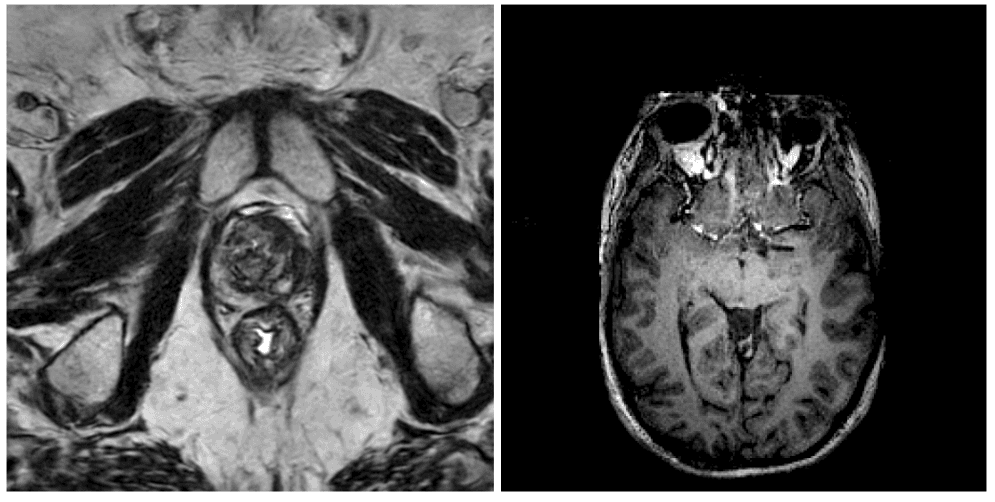
NVIDIA Releases Brain MRI Generation Model on Hugging Face: 3D Latent Diffusion for T1, FLAIR, T2, and SWI Scans

NVIDIA Releases Brain MRI Generation Model on Hugging Face: 3D Latent Diffusion for T1, FLAIR, T2, and SWI Scans

NVIDIA has open-sourced a 3D latent diffusion model for generating high-resolution brain MRI scans across four modalities. The model claims state-of-the-art FID scores and 33× faster inference than prior methods.

1d ago·2 min read·19 views·via @HuggingPapers
Share:

What Happened

NVIDIA has released a brain MRI generation model on the Hugging Face platform. The model is a 3D latent diffusion model capable of synthesizing high-resolution brain scans across four key MRI modalities: T1-weighted, FLAIR (Fluid-Attenuated Inversion Recovery), T2-weighted, and SWI (Susceptibility Weighted Imaging). According to the announcement, the model achieves state-of-the-art Fréchet Inception Distance (FID) scores—a metric for evaluating the quality and diversity of generated images—and operates with 33× faster inference speed compared to previous approaches.

The model's release on Hugging Face suggests it is available for researchers and developers to download, experiment with, and potentially integrate into medical imaging pipelines. The linked resource likely provides the model weights, inference code, and documentation.

Context

Generative AI for medical imaging, particularly 3D data like MRI scans, presents significant technical challenges beyond 2D image generation. Models must produce anatomically plausible 3D volumes across multiple contrasting modalities that are clinically useful. Applications include data augmentation for training diagnostic AI systems, creating synthetic datasets for research while protecting patient privacy, and educational simulation.

Latent diffusion models have become a dominant architecture for high-quality image synthesis. Adapting them to 3D medical data requires significant architectural and training innovations to handle the high dimensionality and memory constraints. NVIDIA's release indicates a focus on both quality (FID) and practical utility (inference speed), which are critical barriers for clinical and research adoption.

Note: This article is based on a brief social media announcement. Detailed technical specifications, benchmark comparisons, training dataset information, and license terms should be verified from the official Hugging Face repository and any accompanying research paper.

AI Analysis

The release is a direct move to establish NVIDIA as a leader in the applied generative AI space for healthcare, specifically for high-fidelity, multi-modal 3D data. By open-sourcing on Hugging Face, they are lowering the barrier to entry for academic and industry researchers, which could accelerate adoption and create a dependency on their hardware-optimized software stack (likely leveraging Tensor Cores and libraries like cuDNN for the cited 33× speedup). The claim of 'state-of-the-art FID' is significant but requires scrutiny. FID, while standard, has known limitations for medical images where structural accuracy is more critical than perceptual realism. Practitioners should immediately look for validation on downstream tasks—for example, does using this synthetic data to train a tumor segmentation model yield performance comparable to training on real data? The support for four distinct MRI sequences (T1, FLAIR, T2, SWI) suggests the model learns a joint representation of brain anatomy, which is a more complex and valuable feat than generating a single modality. The 33× inference speed claim is the most immediately practical detail. Slow sampling has been a major bottleneck for diffusion models in 3D. If this speedup is achieved without a significant quality drop—likely through a combination of architectural efficiency, distillation, and NVIDIA-specific optimizations—it moves synthetic MRI generation from a research curiosity closer to a viable tool for on-demand data augmentation in training pipelines.
Original sourcex.com

Trending Now

More in Products & Launches

View all