NVIDIA has quietly released a significant advancement in generative AI with DiffiT, a Diffusion Vision Transformer now available on Hugging Face. The model achieves a remarkable Fréchet Inception Distance (FID) score of 1.73 on the challenging ImageNet-256 benchmark, establishing new state-of-the-art performance for image generation while using significantly fewer parameters than previous approaches.
The Technical Breakthrough
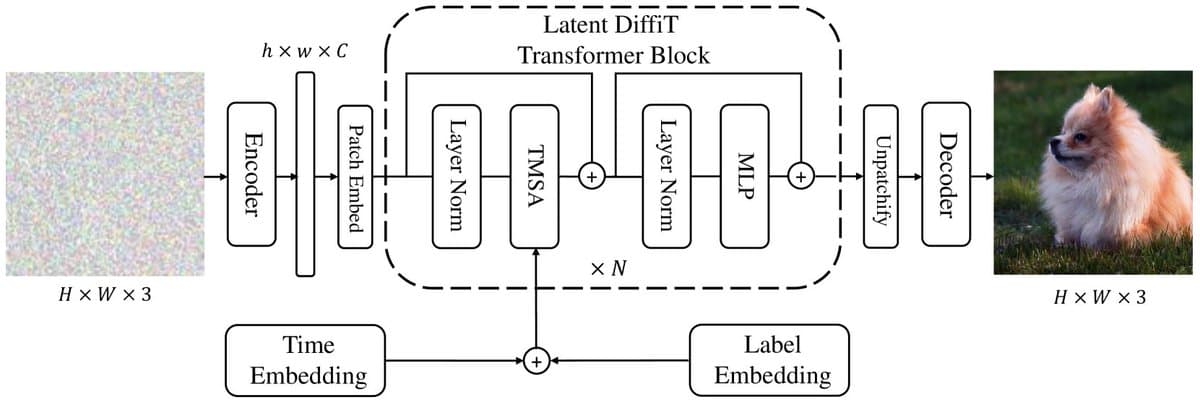
DiffiT represents a novel fusion of two powerful AI architectures: diffusion models and Vision Transformers (ViTs). While diffusion models have dominated image generation in recent years, and Vision Transformers have revolutionized image recognition, their combination in this architecture appears to deliver unprecedented efficiency and quality.
The key achievement lies in the parameter efficiency mentioned in the announcement. Previous state-of-the-art diffusion models typically required massive parameter counts to achieve high-quality results, making them computationally expensive to train and deploy. DiffiT's ability to surpass these models while using fewer parameters suggests fundamental architectural improvements rather than simply scaling up existing approaches.
Understanding the FID Score
The FID score of 1.73 on ImageNet-256 represents a significant milestone in generative AI. FID measures the distance between feature vectors calculated for real and generated images, with lower scores indicating better quality and diversity. For context:
- FID below 2.0 is considered exceptional for complex datasets like ImageNet-256
- Previous state-of-the-art models typically achieved scores between 2.0-3.0
- The improvement from 2.0+ to 1.73 represents meaningful progress in generation quality
ImageNet-256 is particularly challenging because it contains 1,000 object categories at 256×256 resolution, requiring models to generate diverse, recognizable objects across numerous classes.
Architectural Implications
While the source material doesn't provide detailed architectural specifications, the mention of "Diffusion Vision Transformer" suggests several likely innovations:
- Transformer-based diffusion: Unlike traditional U-Net architectures common in diffusion models, DiffiT likely uses transformer blocks throughout the denoising process
- Efficient attention mechanisms: The parameter efficiency suggests novel attention mechanisms or architectural choices that reduce computational overhead
- Improved training dynamics: The combination of ViT and diffusion may enable more stable training or better gradient flow
Practical Applications and Implications
The release of DiffiT on Hugging Face makes this technology immediately accessible to researchers and developers worldwide. This accessibility could accelerate several developments:
- More efficient content creation: Lower parameter counts mean potentially faster inference and lower computational costs for image generation
- Edge deployment possibilities: Reduced model size could enable higher-quality generative AI on edge devices
- Research acceleration: The open availability allows other researchers to build upon NVIDIA's work
- Commercial applications: More efficient high-quality generation could lower barriers for creative industries, marketing, and design applications
The Competitive Landscape
NVIDIA's release positions them at the forefront of efficient generative AI research. While companies like OpenAI, Google, and Stability AI have dominated recent generative AI headlines, NVIDIA's focus on efficiency while maintaining quality represents a different strategic approach. This could be particularly important for:
- Enterprise adoption: Where computational costs and efficiency matter significantly
- Real-time applications: Where inference speed is critical
- Scalable deployment: Where serving millions of users requires optimized models
Future Directions
The DiffiT release likely represents just the beginning of this architectural direction. Future developments might include:
- Higher resolution capabilities: Extension to 512×512 or higher resolutions
- Multimodal integration: Combining with language models for text-to-image generation
- Video generation: Applying similar architectures to temporal data
- Further efficiency improvements: Even more parameter reduction without quality loss
Accessibility and Open Science
By releasing DiffiT on Hugging Face, NVIDIA continues a trend of making significant AI research publicly available. This approach:
- Democratizes access: Allows smaller research groups and companies to work with state-of-the-art technology
- Enables reproducibility: Other researchers can verify results and build upon the work
- Fosters innovation: Open releases often lead to unexpected applications and improvements from the broader community
Conclusion
NVIDIA's DiffiT represents a meaningful step forward in generative AI, demonstrating that quality improvements don't necessarily require ever-larger models. The combination of diffusion models with Vision Transformer architecture, achieving state-of-the-art results with fewer parameters, suggests we're entering a new phase of efficient generative AI development.
As researchers gain access to this model through Hugging Face, we can expect rapid exploration of its capabilities, limitations, and potential applications across numerous domains. The efficiency breakthrough particularly matters for practical deployment scenarios where computational resources are constrained.
Source: HuggingPapers on X