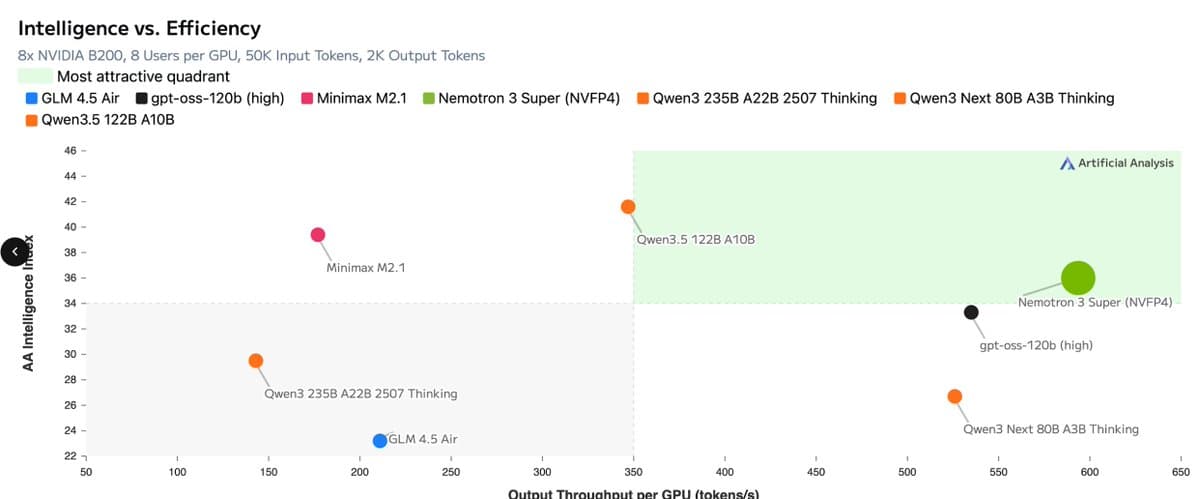
NVIDIA has officially launched Nemotron 3 Super, a groundbreaking large language model that prioritizes computational efficiency without sacrificing performance. According to early analysis shared by AI researcher @kimmonismus, this model represents a significant departure from the industry's obsession with ever-larger parameter counts, instead focusing on delivering maximum intelligence per compute cycle.
Architectural Innovation: Hybrid Mamba-Transformer MoE
At the core of Nemotron 3 Super's efficiency is its innovative hybrid architecture combining Mamba, Transformer, and Mixture of Experts (MoE) components. The model contains 120 billion total parameters but activates only 12 billion during inference—a 10:1 sparsity ratio that dramatically reduces computational requirements while maintaining sophisticated capabilities.
This architectural approach allows Nemotron 3 Super to achieve what NVIDIA appears to be targeting: not the largest model, but the most efficient one capable of competing with significantly larger systems. The hybrid design leverages Mamba's efficient sequence modeling alongside Transformer's proven attention mechanisms, creating a synergistic system that maximizes performance per parameter.
Performance Metrics That Matter
Nemotron 3 Super delivers impressive benchmarks across multiple dimensions:
Extended Context Processing: With a 1 million token context window, the model can process exceptionally long documents, conversations, or codebases—addressing one of the most pressing limitations in current LLM deployments.
Intelligence Benchmark Dominance: The model scores 36 on the Artificial Analysis Intelligence Index, surpassing GPT-OSS-120B despite having far fewer active parameters. This demonstrates that parameter efficiency, not just raw count, determines real-world capability.
Throughput Optimization: Early testing shows approximately 10% higher throughput per GPU compared to competing models, making it particularly attractive for production deployments where inference costs directly impact operational budgets.
Configurable Reasoning: Compute-Aware Intelligence
One of Nemotron 3 Super's most innovative features is its configurable reasoning system, which allows users to select between "full," "low-effort," or "off" reasoning modes based on their specific compute budget per query. This granular control represents a paradigm shift in how organizations can deploy AI—matching computational investment to task importance in real-time.
This feature enables cost-effective scaling where simpler queries consume fewer resources while complex analytical tasks receive the computational attention they require. For enterprise deployments, this could translate to significant savings without compromising on critical functionality.
Training and Openness Commitments
Nemotron 3 Super was trained from scratch using NVIDIA's NVFP4 precision—a first for this model family that likely contributed to both its efficiency and performance characteristics. Perhaps equally significant is NVIDIA's commitment to openness: the company is releasing open weights, open training data, and open recipes, earning an impressive 83 on the Openness Index.
This transparency represents a notable shift for NVIDIA, traditionally more guarded with its proprietary technologies. By opening the architecture, training methodologies, and data, NVIDIA appears to be fostering broader ecosystem development while establishing Nemotron as a reference implementation for efficient AI design.
Deployment and Availability
The model is already live on DeepInfra and Lightning AI platforms, delivering speeds up to 484 tokens per second. This immediate availability suggests NVIDIA has prioritized production readiness alongside architectural innovation—a combination that could accelerate enterprise adoption.
Early testers like @kimmonismus have expressed enthusiasm about the model's capabilities, noting that despite its technical merits, the Nemotron family "has not been used enough so far." This latest release, with its compelling efficiency story, may change that perception rapidly.
The Efficiency-First Future
Nemotron 3 Super represents more than just another large language model—it signals a maturation in AI development priorities. As computational costs and energy consumption become increasingly critical constraints, efficiency-focused architectures like NVIDIA's hybrid Mamba-Transformer MoE design may define the next generation of AI systems.
The model's ability to deliver reasoning performance competitive with systems 3-8 times its active size, while running on just two H100 GPUs, demonstrates that the industry's scaling laws have efficiency dimensions beyond simple parameter counts. This could influence how researchers, developers, and enterprises evaluate AI systems moving forward.
Source: Analysis based on early testing shared by @kimmonismus on X/Twitter, detailing NVIDIA's Nemotron 3 Super release and specifications.