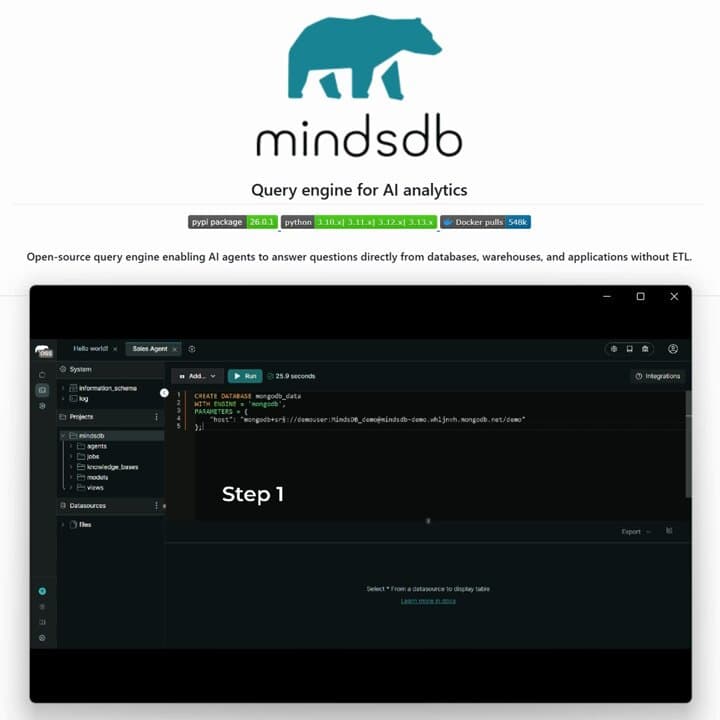
A significant breakthrough in AI-powered data analytics has emerged from independent developer Akshay Pachaar, who has built an open-source analytics agent capable of querying multiple disparate data sources through a unified SQL interface. This development addresses one of the most persistent challenges in business intelligence: integrating data from different systems without time-consuming manual work.
The Multi-Source Analytics Challenge
Modern organizations typically store data across multiple platforms—customer information in CRM systems like HubSpot, transactional data in databases like MongoDB, financial records in separate systems, and marketing metrics in yet other tools. Traditionally, answering business questions that require data from multiple sources involves:
- Writing complex queries for each system
- Manually joining the results
- Reconciling different data formats and schemas
- Dealing with inconsistent data definitions
This process is not only time-consuming but also prone to errors, requiring specialized technical skills that often create bottlenecks in data-driven decision making.
How the Analytics Agent Works
According to Pachaar's announcement, his analytics agent introduces several revolutionary capabilities:
Single SQL Interface: The system provides a unified SQL interface that can query both MongoDB (a NoSQL database) and HubSpot (a cloud-based CRM platform) simultaneously. This is particularly significant because these systems use fundamentally different data models—MongoDB's document-oriented structure versus HubSpot's relational-like CRM data.
Automatic Join Elimination: The agent "needs no manual joins," meaning it can automatically understand relationships between data across different sources and perform the necessary joins behind the scenes. This dramatically reduces the technical expertise required to extract insights from complex data landscapes.
Cross-Source Reasoning: Perhaps most impressively, the system can "reason across both sources in one shot." When asked a question like "Who's our top customer?" it doesn't just pull revenue data from MongoDB and customer information from HubSpot separately—it understands how these datasets relate and provides a synthesized answer.
Practical Applications and Capabilities
The example provided demonstrates the agent's practical value: asking "Who's our top customer?" returns not just revenue figures from the database, but also CRM context and a complete customer profile. This means business users get:
- Revenue data from transactional systems
- Customer interaction history from CRM
- Demographic and firmographic information
- Engagement metrics and support history
All synthesized into a coherent answer without requiring separate queries, manual data manipulation, or specialized technical knowledge.
Open-Source Implications
The fact that this agent is "100% open-source" (available at the provided link) represents a significant democratization of advanced analytics capabilities. Open-source availability means:
- Transparency: Organizations can examine exactly how the system works
- Customizability: Companies can adapt the agent to their specific needs
- Community Development: The broader developer community can contribute improvements
- Cost Accessibility: No expensive licensing fees or vendor lock-in
This approach contrasts with proprietary analytics platforms that often charge substantial fees for similar cross-source querying capabilities.
Technical Significance
From a technical perspective, this development represents progress in several areas:
Schema Mapping and Translation: The agent must understand the schema of both MongoDB collections and HubSpot objects, then map these to a unified query structure.
Query Optimization Across Systems: It needs to optimize queries to minimize data transfer and processing time across different systems with different performance characteristics.
Natural Language to SQL Translation: While not explicitly stated, the ability to answer questions like "Who's our top customer?" suggests some level of natural language processing that translates business questions into the appropriate cross-system queries.
Data Type Reconciliation: The system must handle different data types, formats, and conventions between the source systems.
Future Potential and Limitations
While the current implementation focuses on MongoDB and HubSpot, the architecture suggests potential for expansion to other data sources. The open-source nature means other developers could add connectors for additional systems like PostgreSQL, Salesforce, Google Analytics, or custom APIs.
However, challenges remain:
- Performance at scale: How the system handles very large datasets across multiple sources
- Security considerations: Managing authentication and authorization across different systems
- Data freshness: Ensuring queries reflect real-time or near-real-time data
- Complex relationship mapping: Handling more sophisticated many-to-many relationships across systems
Industry Context
This development arrives as businesses increasingly seek unified analytics solutions. According to industry surveys, data scientists spend up to 80% of their time on data preparation and integration tasks. Tools that can automate these processes have tremendous value in accelerating data-driven decision making.
The approach also aligns with broader trends in AI-assisted analytics, where systems increasingly understand not just how to query data, but what questions users are trying to answer and how to assemble information from multiple sources to provide complete answers.
Conclusion
Akshay Pachaar's open-source analytics agent represents a meaningful step toward eliminating one of the most persistent friction points in business analytics: integrating data from disparate sources. By providing a single SQL interface that can query both MongoDB and HubSpot, automatically handle joins, and reason across sources, it demonstrates how AI can simplify complex data tasks.
The open-source nature of the project makes these capabilities accessible to organizations of all sizes, potentially leveling the playing field in data analytics. As the system evolves and adds support for additional data sources, it could become an important tool in the democratization of data analytics, allowing more people in organizations to ask and answer complex business questions without specialized technical skills.
Source: Akshay Pachaar's announcement on X (formerly Twitter) describing his open-source analytics agent that queries MongoDB and HubSpot through a single SQL interface without manual joins.